Mövenpick Resort Petra
Resort · €€€The most convenient base in Wadi Musa — directly across from the visitor centre, with an Andalusian-style courtyard and a fine rooftop terrace.
30°19′43″N 35°26′31″E
Petra is an ancient city in southern Jordan, carved into rose-coloured sandstone cliffs by the Nabataeans more than two thousand years ago. Once the wealthy capital of the Nabataean Kingdom, it is a UNESCO World Heritage Site and one of the New7Wonders of the World, reached through a 1.2-kilometre natural gorge called the Siq.
Petra is one of the most theatrical places ever built. For centuries it was the capital of the Nabataeans — desert traders who grew rich controlling the caravan routes for incense, spices and silk — and they spent that wealth carving an entire city directly into the canyon walls of southern Jordan.
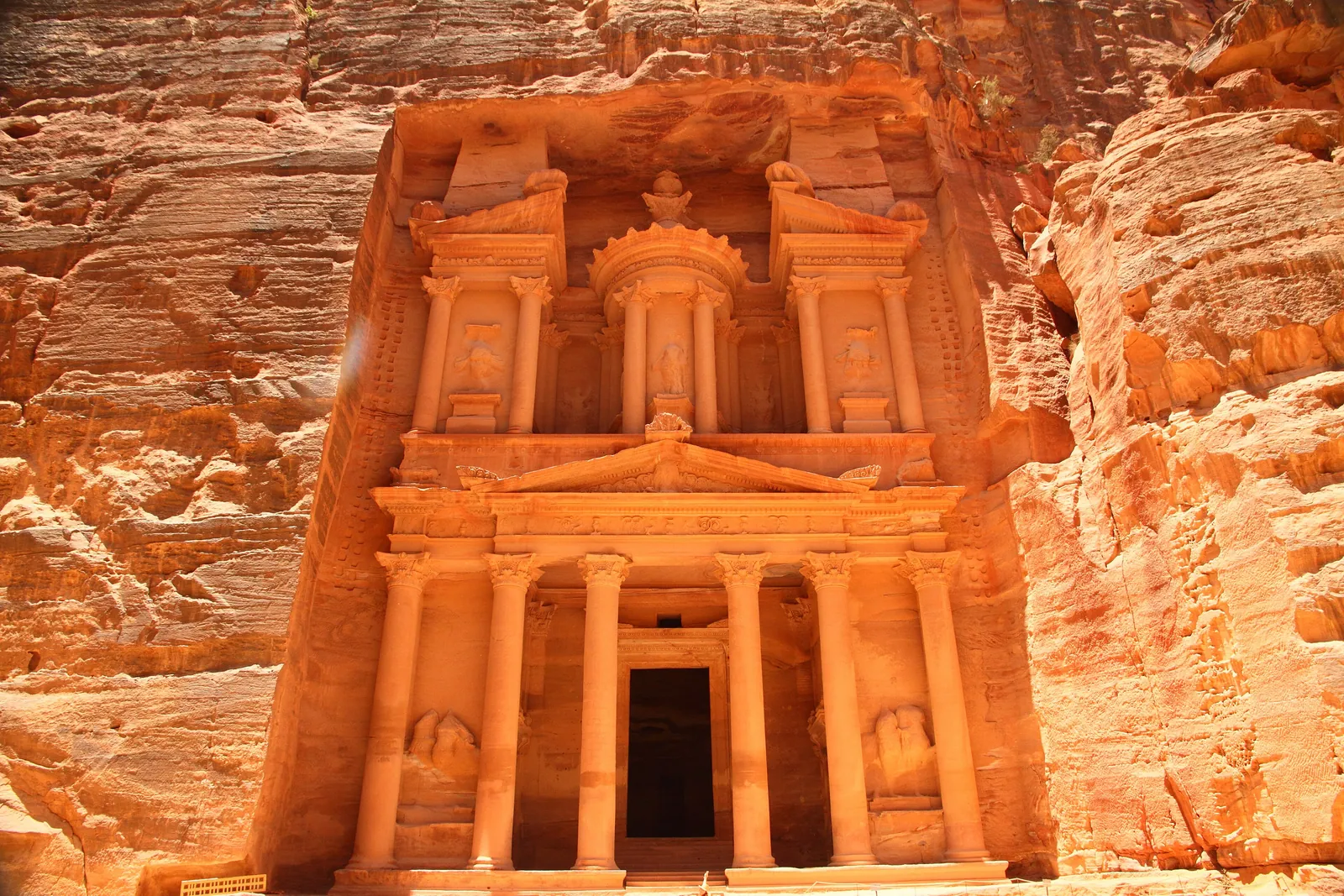
The approach is the masterpiece. You walk for over a kilometre through the Siq, a narrow, twisting gorge where the rock rises a hundred metres on either side, until the cliff parts and the towering facade of Al-Khazneh, the Treasury, appears in a slot of light. Beyond it lies far more than most visitors expect: tombs, a Roman-era theatre, a colonnaded street, and the great monastery of Ad-Deir, an 800-step climb above the valley floor.
Enter the gorge early, before the crowds and the heat. The walk to the moment the Treasury reveals itself is the single greatest arrival in travel.
The 800-step climb to Ad-Deir is steep but unforgettable — and the Monastery facade, larger even than the Treasury, is usually far quieter.
On selected evenings the Siq and the Treasury are lit by some 1,500 candles, with Bedouin music — a separate, atmospheric ticket worth planning around.
A short film to set the scene — sourced from YouTube and credited to its maker.
Hand-picked places to sleep, from the iconic to the characterful — each chosen for position as much as polish.
The most convenient base in Wadi Musa — directly across from the visitor centre, with an Andalusian-style courtyard and a fine rooftop terrace.
Set on a ridge above town with sweeping views down the valley — a comfortable, polished option a short drive from the entrance.
Bubble-domes and Bedouin-style tents under the stars in the Wadi Rum desert — the natural second act to any visit to Petra.
The sights that earn their fame — and a few the crowds miss.
Petra’s emblem — a 40-metre temple facade carved into the cliff at the end of the Siq, most likely a royal Nabataean tomb.
The largest monument in Petra, high above the valley. The climb is demanding but the crowds thin and the scale is extraordinary.
A Nabataean ritual platform reached by a stepped trail, offering one of the best panoramas over the whole rock-cut city.
The vast sandstone-and-granite desert south of Petra — a UNESCO site of towering mesas, famous from Lawrence of Arabia and countless films.
From landmark restaurants to the small rooms only locals mention.
A hands-on evening cooking class in Wadi Musa where you prepare and then eat a full Jordanian meal — mezze, soup and a main.
A warm, family-run Wadi Musa restaurant serving the national dish, mansaf, alongside generous mezze and fresh bread.
The most practical lunch deep inside Petra itself, set among the ruins near the start of the Monastery trail.
| Location | Ma'an Governorate, southern Jordan |
|---|---|
| Built by | The Nabataeans, from around the 4th century BCE |
| Famous for | Al-Khazneh (the Treasury) and Ad-Deir (the Monastery), carved into sandstone |
| Recognition | UNESCO World Heritage Site (1985); New7Wonders of the World (2007) |
| Rediscovered | Brought to Western attention by Johann Ludwig Burckhardt in 1812 |
| Gateway town | Wadi Musa, immediately outside the site |
Petra is a chapter of The Long Way East.
Spring (March to May) and autumn (September to November) are ideal, with mild days and comfortable walking weather. Summer is very hot — explore at dawn and late afternoon if you visit then. Winter days are cool and pleasant but can bring rain, and the desert nights are genuinely cold.
Two days is the sweet spot. One day covers the Siq, the Treasury and the main valley; a second lets you climb to the Monastery and the High Place of Sacrifice at a relaxed pace and, if timing allows, experience Petra by Night. A single rushed day misses much of the site.
A lot. It is roughly four kilometres from the entrance to the far end of the main valley, all of it on foot, plus around 800 steps to the Monastery. The terrain is uneven. Travellers with limited mobility can hire a horse-drawn carriage through the Siq, and Viajes Globales tailors the routing to your comfort.
Yes. Jordan is one of the most stable and welcoming countries in the Middle East, and Petra is a thoroughly developed, well-managed UNESCO site visited by people from all over the world. Normal travel sense applies, and our local guides accompany you throughout.
Absolutely. Wadi Rum, the great sandstone desert about 90 minutes south of Petra, is the natural pairing — most travellers spend a night in a desert camp there. Many also add the Dead Sea, making a classic week-long loop of southern Jordan.
Travel here as a chapter of a grand journey, or as a trip of its own. We will tailor it to your dates and pace.