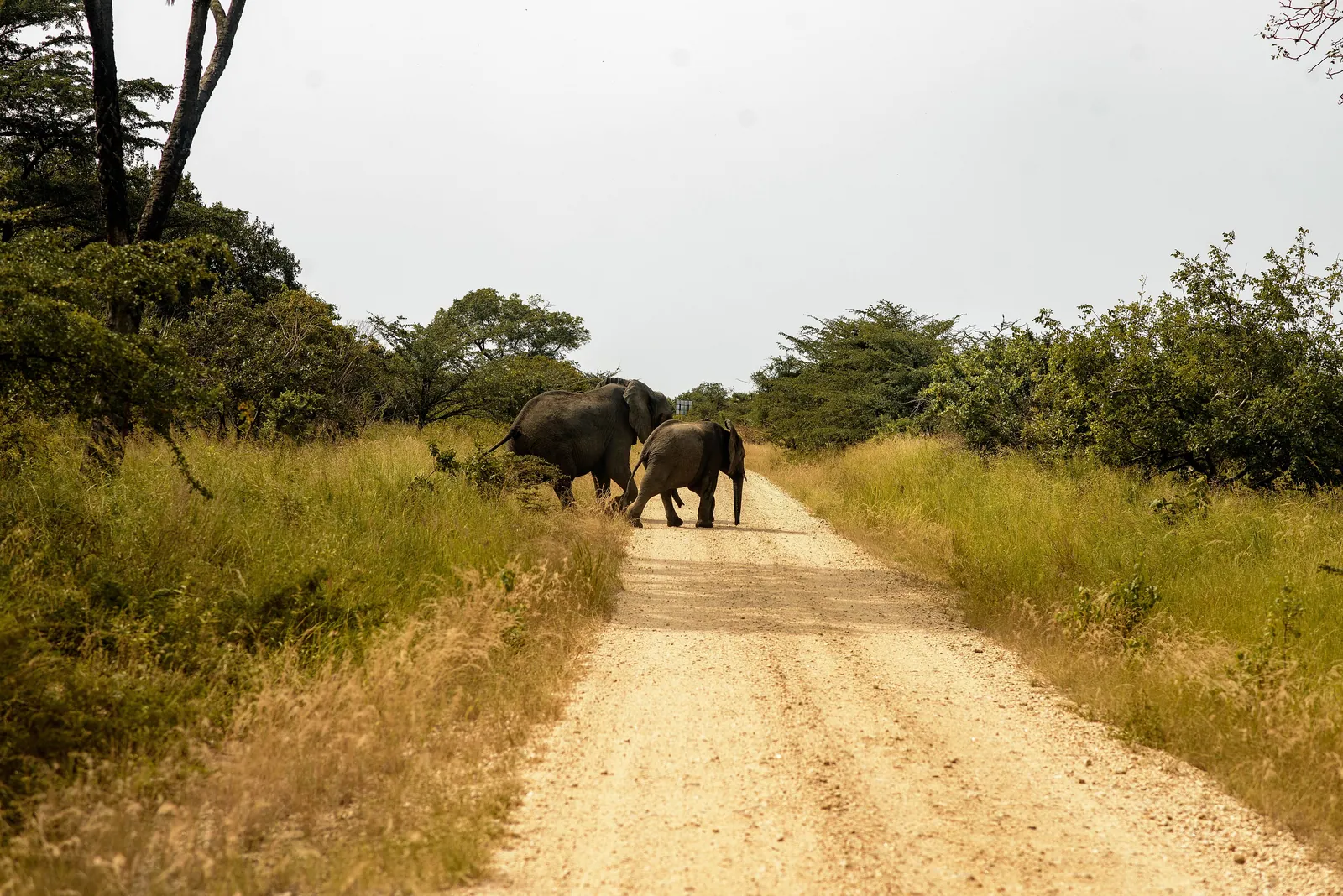
African Elephants: The Mind and Society of the Largest Land Animal
Elephants are not simply large animals — they are deeply social, cognitively complex, and ecologically essential. Here is what science and long observation have revealed about the inner life of the greatest creature walking the African savanna.
An elephant herd moving through the Amboseli dust toward Kilimanjaro is one of the planet's most arresting sights — but the spectacle conceals a still more remarkable reality. The animals you are watching have named each other with rumbles too low for human ears to detect, they remember the faces of hundreds of individuals they have not seen in years, and the oldest female in the group carries a mental map of where water lay in a drought that ended before any of her daughters were born.
The African elephant is the largest land animal alive, and it is also, by any reasonable measure, one of the most intelligent. Decades of field research — in Amboseli, in the Maasai Mara, in Botswana's Okavango — have produced a portrait of a species with a rich inner life, intricate social bonds, and an ecological role so foundational that without it entire landscapes would be unrecognizable. To watch elephants well is to watch something that watches back.
The matriarch and the structure of the herd
Elephant society is built around the female line. The core unit is the family group: a matriarch — typically the oldest female — her daughters, their daughters, and the calves of each generation. The matriarch is not simply the biggest animal; she is the group's memory, its navigator, and its decision-maker. Research in Amboseli by Cynthia Moss and colleagues showed that groups led by older matriarchs made better decisions in droughts and in encounters with predators, because she had lived through crises her daughters had not.
Several family groups that share overlapping ranges and recognise each other form a bond group, and related bond groups form a clan. Adult males live mostly apart, joining female herds only to mate, and older bulls move in a quieter world of their own — familiar with particular waterholes, particular seasonal routes, and occasionally forming loose bachelor associations. The social map of an elephant population, once you begin to read it, is as intricate as any human community.
Communication: the language of rumble and touch
Elephants communicate in a range of registers, from the audible trumpets that travel across a plain to seismic rumbles whose infrasound components travel through the ground itself, potentially over distances of several kilometres. Researchers have catalogued many distinct calls — greeting rumbles, contact calls, musth roars from bulls, the specific calls females use to coordinate movement and signal danger — and the evidence suggests that individuals recognize each other's voices.
Touch is equally important. Elephants greet each other by reaching their trunks into one another's mouths — an act of trust as profound as it looks. A distressed calf is touched and soothed by multiple adults. A returning family member is mobbed with rumbles, spinning, and the insertion of trunks. The trunk itself, with more than 40,000 muscles and extreme sensitivity at its tip, is tool, hand, nose, and social organ in one: elephants use it to stroke a dying companion or dislodge a difficult piece of bark with equal delicacy.
Memory, mourning, and the evidence of a rich inner life
The phrase 'an elephant never forgets' is not quite the cliché it sounds. Experiments and field observation have confirmed that elephants recognize individual humans — and recall whether those humans were previously kind or threatening — after intervals of many years. In drought years, matriarchs lead their families toward water sources they may have visited only once or twice in their lives. This form of 'landscape memory' is thought to reduce mortality during hard seasons by a meaningful margin.
The response of elephants to death is among the most haunting things field researchers have recorded. Herds will stand over a dead companion — sometimes a stranger whose bones they have encountered — touching and smelling the bones, often returning to the same carcass over successive days. Whether this constitutes grief in any way analogous to the human experience is a philosophical question researchers are careful about, but the behaviour is real and consistent, and distinct from how elephants respond to the bones of any other species.
The elephant as ecosystem engineer
The ecological role of elephants extends far beyond what they visibly do. By pushing over trees, elephants convert woodland to open grassland, creating habitat for the grazers that follow. Their dung — voided in enormous quantities as they move — disperses the seeds of hundreds of plant species, many of which pass undamaged through their gut and germinate better for the experience. Their feet press seeds into soft ground; their paths become the highways other animals use.
Where elephants dig for water in dry riverbeds, they create drinking points used by dozens of other species. In forests, they create light gaps that allow understory plants to grow. Their removal from a landscape — as happened when heavy poaching struck populations in the 1970s and 1980s — sends ripple effects through the entire ecosystem: woodland closes, some plant species decline, and the communities of smaller animals that depended on open habitat shift with them. Elephants are a keystone species whose influence is disproportionate to even their enormous size.
Conservation: from the ivory crisis to the present
The twentieth century was brutal for African elephants. Continent-wide numbers that may have exceeded a million at mid-century collapsed to perhaps 600,000 by the late 1980s as ivory poaching — fuelled by international demand and weak enforcement — killed hundreds of thousands of animals. The international ivory ban, enacted through CITES in 1989, brought a dramatic slowdown. Populations in protected areas recovered substantially in subsequent decades.
The picture today is uneven. Savanna elephant populations in southern Africa — particularly in Botswana, Zimbabwe and Zambia — have grown to the point where some managers speak of overpopulation in certain areas. Forest elephants in central and west Africa remain under severe pressure; a separate species from the savanna elephant, they are rarer, slower-breeding, and less protected. Habitat loss as farmland expands into elephant range is now the primary threat across the continent, and the conflict between elephants and farmers — where elephants raid crops and people retaliate — is one of the most complex conservation challenges in Africa.
Watching elephants well
In good wildlife areas, elephants in vehicles are typically relaxed — they have learned to read vehicle behaviour and treat a stationary car as furniture. This tolerance is earned and conditional. A vehicle that approaches head-on, cuts off a route, separates a calf from its mother, or advances when the matriarch faces the car is pressing that tolerance. The protocol is simple: keep to marked tracks, let the herd pass, never get between a cow and her calf, and if a matriarch raises her head and spreads her ears, give ground quietly.
The reward for patience is extraordinary. An elephant at the waterhole in the late afternoon light, covering its back with a trunkful of red dust; a matriarch leading her family across a dry riverbed toward a remembered spring; a calf still learning to use its trunk, tripping on it one moment and successfully lifting a stick the next — these are not generic wildlife sightings. They are glimpses into a life that is, by every measure that counts, fully lived.
Quick answers
How intelligent are African elephants compared to other animals?
Elephants are considered among the most cognitively complex animals on Earth, alongside great apes, cetaceans and some corvids. They pass the mirror self-recognition test, use tools, show evidence of empathy and cooperation, remember hundreds of individuals over many years, and possess a form of landscape memory that guides them to water sources they may have visited only once. The full depth of their cognitive world is still being mapped.
What is the difference between African savanna and African forest elephants?
They are two distinct species. The savanna elephant is larger, with bigger ears shaped somewhat like the African continent, and lives in open grasslands, bush, and woodland across sub-Saharan Africa. The forest elephant is smaller, with rounder ears and straighter tusks, and inhabits the dense rainforests of central and west Africa. Forest elephants are less well studied, rarer, and currently under more conservation pressure than their savanna relatives.
Are elephants endangered?
The African savanna elephant is classified as Endangered on the IUCN Red List, while the African forest elephant is classified as Critically Endangered. Overall African elephant numbers are roughly 415,000 to 420,000, a significant recovery from the crisis of the 1980s in some areas, but forest elephant populations have declined dramatically in recent decades and remain under severe pressure from poaching and habitat loss.
What should I do if an elephant approaches my vehicle?
Stay calm and keep the engine idling so you can move if needed. Do not rev the engine, shout, or drive suddenly. If an elephant is 'mock charging' — a bluff display to move you away — quietly reversing and giving more space usually ends the encounter. A real charge is rarer and is preceded by a flattened trunk, pinned ears and intent. Your guide will manage the response; follow their lead without hesitation.
How long do elephants live, and how much do they eat?
African elephants can live for up to 70 years in the wild, though most do not reach that age. Their lifespan is ultimately limited by their teeth: they cycle through six sets of molars over their lives, and when the last set wears out, they can no longer chew food effectively. An adult elephant eats between 150 and 300 kilograms of vegetation per day and drinks around 150 litres of water, which is why ranging over large areas is essential.

Let the reading become a route.
When an article sparks something, our planners are the next step. Tell us what you are dreaming of.