Bali's Ritual Year: Galungan, Nyepi and the Calendar of Offerings
Bali runs on two interlocking calendars, and the result is a festival almost every day somewhere on the island. But three celebrations stand apart — Galungan, Kuningan and the Day of Silence — and they reveal everything that makes Balinese culture extraordinary.
Bali is famous for its rice terraces and its temples, but the deeper truth is that the island runs on ceremony. The Balinese people, predominantly Hindu in a predominantly Muslim country, organise their entire social and agricultural life around an interlocking system of two calendars — the 210-day Pawukon cycle and the Saka lunar calendar — whose combination produces a schedule of offerings, ceremonies and celebrations so dense that, on any given day on the island, something sacred is happening somewhere nearby. A temple anniversary, a tooth-filing rite, a cremation procession, an offering left at a roadside shrine.
For the traveller, three celebrations rise above the calendar's constant texture: Galungan and Kuningan, the ten-day festival of ancestral spirits and the triumph of dharma over adharma; and Nyepi, the Day of Silence, when the entire island shuts down in a darkness so complete that you can see the Milky Way from the beach. These are not performances for visitors. They are the expressions of a living cosmology, and they require only presence and patience to be among the most powerful cultural experiences available to a traveller anywhere.
Galungan: when the ancestors return
Galungan falls every 210 days, on the Wednesday of the eleventh week of the Pawukon calendar, and it marks the moment when ancestral spirits are believed to descend to earth and visit their families. The physical sign that Galungan is coming is the appearance of penjor: tall, curved bamboo poles decorated with young coconut leaves, woven palm ornaments, fruit and flowers, planted in front of every household gate along every road on the island. A road lined with penjor — and on Galungan every road is — is one of the most beautiful sights in Bali.
In the days before Galungan, families prepare offerings (banten) of extraordinary intricacy: towers of fruit, flowers, rice cakes, and cooked food assembled on woven palm-leaf bases and carried to the family temple, the village temple, and the main temple of the district (the pura puseh and pura desa) in processions led by women balancing the towers on their heads. The spiritual meaning is the reaffirmation of dharma — order and right conduct — over its opposite, a theme expressed through offerings, prayers, and the preparation of lawar, a ceremonial dish of minced meat, vegetables and grated coconut, mixed with fresh blood and spices.
Kuningan: the departure of the ancestors
Kuningan falls ten days after Galungan, on the Saturday of the twelfth week of the same cycle, and it marks the moment the ancestral spirits return to their realm. It is, in many ways, the more personal of the two celebrations: families gather at the family shrine for prayer and reflection, and the offerings include specifically yellow rice — nasi kuning, coloured with turmeric — which gives the day its name (kuning means yellow in Balinese and Indonesian).
The day has a quieter quality than Galungan. There are no grand processions, but the family temples are full from early morning, and the mood is one of gratitude and farewell rather than arrival and celebration. By noon, the penjor begin to be taken down, the ancestors have been seen off, and the island returns to its ordinary dense ceremonial rhythm — until the next Galungan, 210 days away.
Nyepi: the Day of Silence
There is nothing quite like Nyepi anywhere else on earth. On the first day of the Saka new year — falling in March, the exact date varying with the lunar calendar — the entire island of Bali goes dark and silent for twenty-four hours. The airport closes. Traffic stops. The streets empty. Tourists must stay in their hotels. Even lights are minimised; the darkness on Nyepi night, on an island of more than four million people, is extraordinary.
The purpose is religious and cosmological. Bali is being made to look uninhabited, so that evil spirits flying over the island will believe there is nothing worth visiting and pass it by. The Nyepi fast begins at 6 am and lasts until 6 am the following morning; no fires, no travel, no work, no entertainment. For a traveller staying in Bali on Nyepi, the experience of sitting in near-darkness, in silence, on an island that has voluntarily switched itself off, is unlike anything the tourism economy has managed to produce.
The eve of Nyepi: the Ogoh-Ogoh parade
The night before Nyepi belongs to the Ogoh-Ogoh: enormous paper-mâché and bamboo demons, elaborately constructed over weeks by village youth groups (seka teruna), paraded through the streets by torchlight and then burned. The ogoh-ogoh represent malevolent spirits, and their dramatic procession is meant to purify the island before the silence that follows. The processions are loud, theatrical, fiercely competitive — villages take pride in the scale and craft of their constructions — and they are entirely public.
The contrast with the silence the next day is extreme and deliberate. On Pengerupukan (the eve of Nyepi) the island is at its loudest, most vivid and most exuberant; on Nyepi it is quieter than any inhabited place most travellers have ever experienced. The juxtaposition is the point: the noise drives the demons away, and the silence confirms they have gone.
The daily texture of offering and ceremony
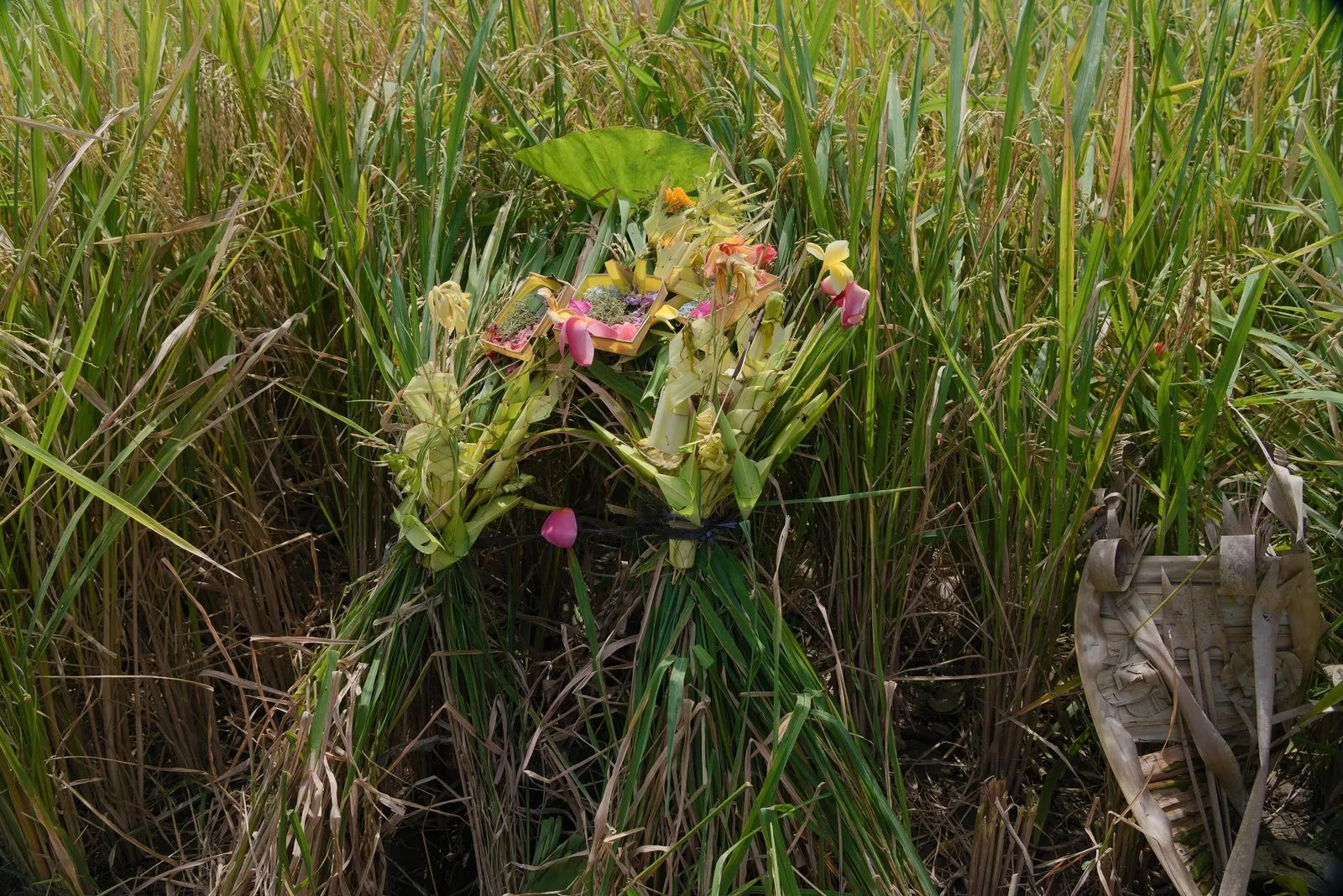
Galungan and Nyepi are the peaks of the ceremonial year, but Bali's ritual life does not pause between them. Every day, across the island, women prepare and place canang sari: small square offerings of woven palm leaf containing flowers, incense, and a few grains of rice, placed at household shrines, at the base of trees, at intersections, at the entrances to temples and shops. The making of canang sari is not a special act — it takes five to ten minutes a day and is as unremarkable as making coffee.
Temple anniversaries (odalan) happen constantly, every 210 days per temple, and Bali has thousands of temples. On odalan day the local community arrives in ceremonial dress — women in kebaya blouses with silk sashes, men in udeng headdresses — carrying offerings, praying, and celebrating late into the night with music (gamelan), dance and feasting. A traveller who happens upon an odalan is welcome to watch from a respectful distance, and in many cases will be invited closer. This is the daily Bali that most short visits never reach.
How to be a good guest during Balinese ceremonies
A few practical points matter. During temple ceremonies and processions, wear a sarong and sash — these are widely available to rent or borrow at temple entrances. Women who are menstruating are traditionally asked not to enter temples, and this request should be respected. Photography is generally acceptable in public processions but ask before photographing intimate moments of prayer or family ceremony.
During Nyepi, the rules are non-negotiable: stay in your hotel or villa, keep lights low, and treat the day as the Balinese do — as a genuine day of self-reflection and quiet. It is not an inconvenience. Travellers who have spent a Nyepi in Bali consistently describe it as one of the most unexpected and affecting days of any journey. A calendar that includes even one of these ceremonies — Galungan morning, a village odalan, Nyepi night — will give you something that no amount of temple visits or rice terrace walks quite matches.
Quick answers
When does Galungan fall, and can I plan my visit around it?
Galungan falls every 210 days according to the Balinese Pawukon calendar, always on a Wednesday. Because 210 days does not divide neatly into the Gregorian year, the Gregorian date shifts each time. A quick search for 'Galungan dates' with the year of your travel will give you the exact date; Balinese calendar resources and Bali tourism sites publish the dates several years in advance. Plan to arrive two to three days before Galungan to see the penjor going up and the preparations, and stay through Kuningan ten days later if possible.
What is Nyepi and can tourists stay in Bali during it?
Nyepi is the Balinese Hindu New Year and the Day of Silence, observed on the first day of the Saka lunar new year, usually in March. The entire island observes twenty-four hours of silence, darkness and stillness: the airport closes, roads are empty, and all activity ceases. Tourists in Bali during Nyepi are required to remain in their accommodation and minimise light and noise. It is entirely legal and possible to be in Bali on Nyepi — and many travellers who have experienced it consider it one of the most memorable days of their lives.
What should I wear at a Balinese temple ceremony?
A sarong (a wraparound length of cloth covering the lower body) and a sash tied around the waist are required for entry to most temple ceremonies and are considered respectful at all Balinese religious events. They can be rented or borrowed at the entrance to most major temples, and in markets throughout the island. Shoulders should be covered. Bright colours and elaborate dress are not required — simple and modest is correct.
What is lawar and when is it eaten?
Lawar is a ceremonial Balinese dish prepared for Galungan and other major temple ceremonies. It is a mixture of minced meat (often pork or chicken), vegetables (typically long beans or jackfruit), freshly grated coconut, spices and, in the traditional preparation, fresh blood, which helps bind the dish. It is a complex, strongly flavoured preparation that takes considerable skill to make correctly. Because the blood component means it spoils quickly, lawar is eaten the day it is made and is specifically associated with communal ceremony — it is not a restaurant dish but a ritual food.

Let the reading become a route.
When an article sparks something, our planners are the next step. Tell us what you are dreaming of.