Barranquilla's Carnaval: Colombia's Great Atlantic Festival
The Carnaval de Barranquilla is the world's second-largest carnival and UNESCO Intangible Heritage — four days of cumbia, mapalé, Congos and the Battle of Flowers that celebrate Colombia's Caribbean soul with unrestrained joy.
In the last days of February, the Caribbean port city of Barranquilla transforms. The city — Colombia's fourth largest, built at the mouth of the Magdalena River where it meets the Atlantic — has been preparing for months: the costumes are finished, the cumbamba queens crowned, the dance troupes rehearsed. Then the Carnaval begins, and for four days it does not stop. The Carnaval de Barranquilla is the second-largest carnival in the world after Rio de Janeiro, and UNESCO has inscribed it as a Masterpiece of the Oral and Intangible Heritage of Humanity.
What makes Barranquilla's carnival different — and deeper than most — is that it is not a pageant grafted onto a city's calendar. It is the expression of a culture that is genuinely mixed: Indigenous, African and Spanish roots, braided over four centuries of Caribbean port life into dances, rhythms, costumes and foods that exist nowhere else in quite this form. The cumbia, which began here and spread across Latin America, is only the most famous of the carnival's many musical threads. Attending the Carnaval de Barranquilla is a full-body lesson in how a culture finds its identity in celebration.
The four days and their structure
The Carnaval de Barranquilla runs from Saturday to Tuesday of the week before Ash Wednesday, and each day has its own character. The Battle of Flowers (Batalla de Flores) on Saturday afternoon opens the carnival: a grand parade of floats, folkloric groups, cumbia bands and the Carnaval Queens along the Vía 40, the main parade route along the river. It is the most photogenic day, the floats lavishly decorated, the queens in spectacular costume.
The Gran Parada de Tradición y Folclor on Sunday is the most culturally rich event, a marathon procession of the carnival's many dance groups (comparsas) performing the traditional dances of Colombia's Caribbean coast — cumbia, porro, gaita, merecumbé — alongside the African-rooted dances of the Congo tradition. Monday brings a second Gran Parada. Tuesday is the last day and the most emotionally charged: the burning of Joselito Carnaval, a symbolic figure who represents the carnival itself, whose death in effigy at dusk closes the four days and officially ends the festival. Women weep, genuinely and theatrically at once, for the death of the carnival.
The dances and their roots
The cumbia is Barranquilla's most famous contribution to the musical world: a rhythm and dance that began on Colombia's Caribbean coast, blending Indigenous wind instruments (gaita flutes, maracas) with African percussion (tambores, alegre drums) and European melody. In its carnival form it is danced in pairs, the woman in a layered white and gold skirt (pollera), candle in hand, the man circling her, hat in hand, in a courtship mime. Cumbia travelled south and inland and became the rhythmic DNA of half of Latin American popular music.
Alongside cumbia, the Congo tradition is the carnival's most distinctive African inheritance. The Congos are dance groups whose masks, costumes and ritual choreography derive directly from Central African practices brought to the coast by enslaved people. The Congos represent the re-enactment of an uprising — the king and queen of the Congos lead their court in a mock battle — and the tradition carries a political and spiritual weight that is never entirely absent from the dancing. Mapalé is more overtly African in its movement: a fast, sensual drum dance in which the body articulates African rhythms with a directness that contrasts sharply with the slower cumbia.
The food of the Carnaval: Caribbean Colombia at the table
The Carnaval is also a food event, and the cuisine of the Atlantic coast is among Colombia's most distinctive. Arepa de huevo — a fried maize patty split and filled with egg and, often, seasoned minced meat — is the most beloved carnival street food, sold from carts along the parade route, eaten standing, blistering hot. Carimañola, a torpedo-shaped yuca fritter filled with seasoned meat and fried, is its companion. Fried fish (mojarra, red snapper) with coconut rice and patacones (twice-fried green plantain) is the carnival meal proper, eaten at the tables that line the streets around the Vía 40.
Coconut rice (arroz con coco) is the defining side dish of the coast — rice toasted in reduced coconut milk until some of the grains are golden, then cooked through until tender. It has a subtle sweetness and a nutty fragrance that no other rice preparation quite matches. Sancocho de guandú (a hearty soup of pigeon peas, chicken and yuca), arepas de chócolo (sweet corn cakes with cheese), and fresh tropical fruit cut and seasoned with lime and chilli complete the street table. Throughout the four days, the party does not pause for eating — both happen simultaneously, loudly, in the open air.
The Queens, the Marimonda and the characters of carnival
The Carnaval de Barranquilla is organised around its queens. The Reina del Carnaval is elected months in advance and serves as the symbolic centre of the festival, representing the city's identity and presiding over the main events. Alongside her, neighbourhood and group queens are crowned across the coastal region. The queens' costumes are engineering achievements as much as fashion: hand-sewn, sometimes weeks in construction, and designed to be carried, not merely worn.
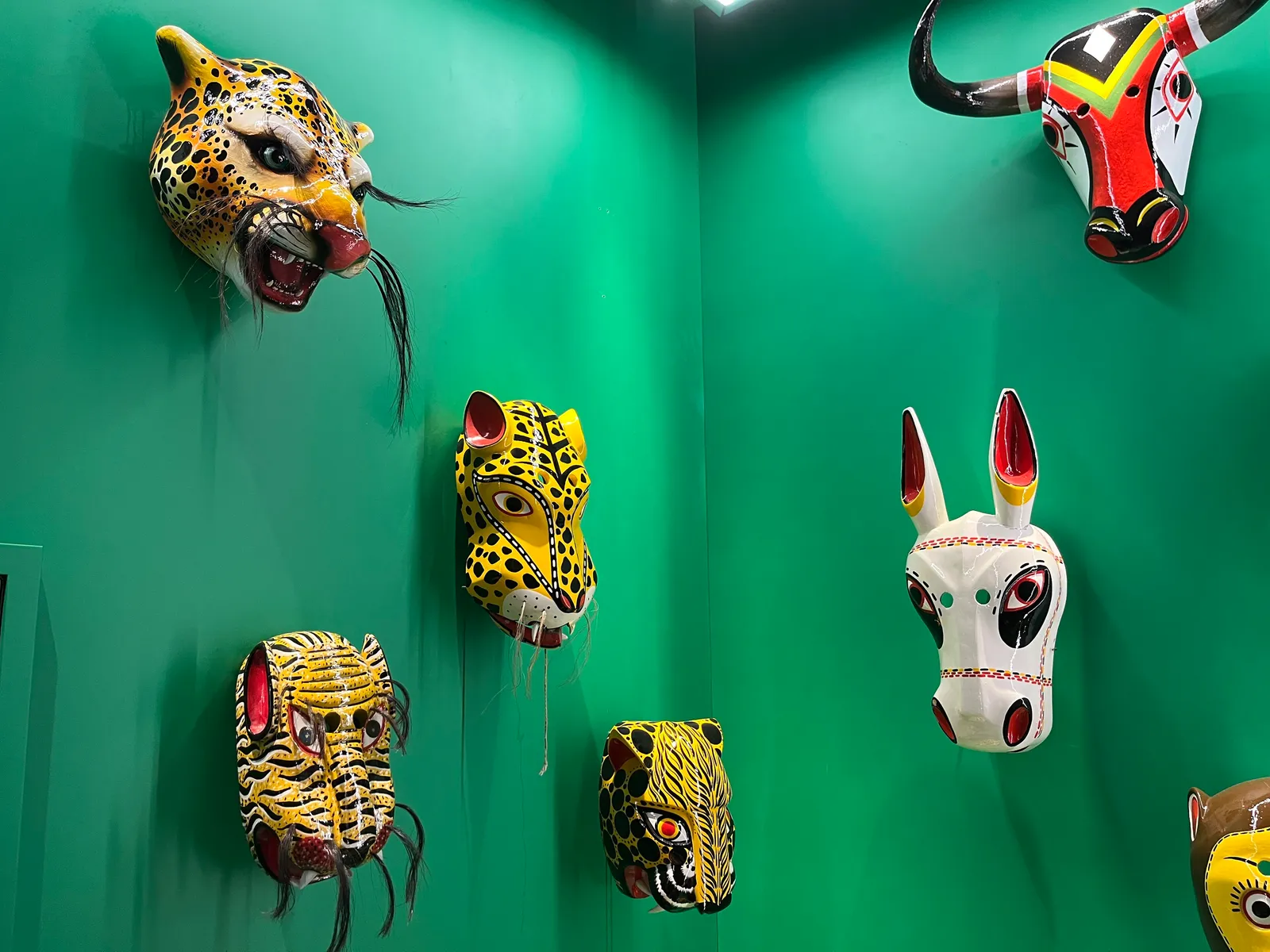
The Marimonda is the carnival's defining comic mask: a figure in a baggy suit, with an elephant's trunk for a nose and donkey's ears, whose origins are satirical — the costume was invented to mock the wealthy classes of Barranquilla, and even today it retains a subversive edge amid the general festivity. The Monocuco, masked and anonymous in a pointed conical hat, allows participants to wander the crowds without being identified. Garabato, the skeleton figure who battles Death and wins, is perhaps the most philosophically loaded character: a reminder, in the midst of celebration, of mortality and the defiance of it.
The city and how to be in it
Barranquilla is a working port city, built for commerce rather than tourism, and it does not package itself for visitors in the way that, say, Cartagena does. The Carnaval changes this temporarily and absolutely: the city opens itself fully, the streets become the venue, and the local families who sit in bleachers along the Vía 40 are the audience, not tourists. This is what makes it worth the effort of getting there.
The Carnaval draws large crowds and the city's hotel capacity is not enormous relative to the festival's scale; accommodation books out many months ahead. The best seats for the parade are the bleachers along the Vía 40, which can be booked through official carnival channels. But much of the most rewarding carnival experience happens off the main parade route — in the neighbourhood celebrations (verbenas) where the dancing is uninhibited, the food is home-cooked, and the welcome to a respectful stranger is genuinely warm.
Travelling to the Carnaval well
Plan far in advance: hotels, flights and any packaged carnaval experience should be secured six months ahead or more. Barranquilla is most easily reached by air from Bogotá (one hour) or Medellín. The weather in February is hot and humid — the Atlantic coast at the end of the dry season is reliably warm, and the four days of the Carnaval are spent largely outdoors. Light, loose clothing, sun protection and good footwear for standing and dancing are the correct preparations.
A few practical points. The bleacher seats along the parade route provide shade and guaranteed sight lines; standing on the street gives proximity to the dancers but demands stamina and awareness of your belongings. The verbenas, the neighbourhood celebrations held the evening of each day, are the social heart of the Carnaval: loud, communal, lasting deep into the night, and the place where the dancing is least staged. Find one to attend, and arrive early enough to get a table.
Quick answers
When exactly does the Carnaval de Barranquilla take place?
The Carnaval de Barranquilla runs for four days, from the Saturday to the Tuesday of the week immediately before Ash Wednesday. Because Ash Wednesday falls forty-six days before Easter, and Easter's date shifts each year, the Carnaval date also varies. It typically falls in late February or early March. For the exact dates in any given year, the official Carnaval de Barranquilla website or a simple search for 'Ash Wednesday [year]' will give you the reference point.
Is it safe to attend the Carnaval de Barranquilla as a visitor?
The Carnaval is a mass public event and the usual precautions apply: keep valuables to a minimum, use a money belt or secure bag, stay with companions in crowds, and be alert to your surroundings in the most densely packed parts of the parade route. Barranquilla is a large city and has the attendant urban safety considerations. The Carnaval itself, however, is a genuinely celebratory event, and the overwhelming majority of the interaction a visitor has will be welcoming and festive.
What is the connection between cumbia and the wider music of Latin America?
Cumbia originated on Colombia's Caribbean coast, blending Indigenous wind instruments with African percussion and European melody. From Barranquilla it spread inland and south, reaching every country in Latin America and mutating into dozens of regional forms: Colombian cumbia, Mexican cumbia, Argentine cumbia villera, Peruvian chicha. It is now one of the most widely distributed popular rhythms in the Americas, a foundational genre underlying much of what is heard across the continent at street parties, weddings and public celebrations.
What is Joselito Carnaval and why is he burned?
Joselito Carnaval is the symbolic personification of the Carnaval de Barranquilla — a figure who 'arrives' with the festival and 'dies' on its last day, the Tuesday before Ash Wednesday. His death, marked by the burning of a doll in his likeness and accompanied by mock weeping from carnival-goers (particularly women, who perform a theatrical lament), represents the end of the festivities and the return to ordinary life before the austerity of Lent. It is a closing ritual with a strongly emotional charge, and the combination of genuine and performed feeling is typically Barranquillero.

Let the reading become a route.
When an article sparks something, our planners are the next step. Tell us what you are dreaming of.