Bhutan: the Last Himalayan Kingdom
Bhutan opened to tourism only in 1974 and has since managed visitors with a deliberate policy designed to protect its Buddhist culture and pristine environment. What that means for the traveller is a Himalayan country of monasteries, fortresses and mountain vistas that remains, in the deepest sense, itself.
There are several ways to arrive in Bhutan, but the most instructive is the flight into Paro. The approach requires the pilot to execute a series of tight turns between mountain ridges before descending into a narrow valley at 2,200 metres, and it concentrates the mind admirably. Through the oval window you can see, very close, pine forests and fluttering prayer flags and the white walls of Paro Dzong, the great fortress-monastery that guards the valley entrance, and you understand immediately that this is a country that has not been flattened by the world.
Bhutan is a constitutional monarchy of roughly 800,000 people, bordered by India to the south and China's Tibet Autonomous Region to the north. It was never colonised. It resisted the expansion of the British Indian empire while trading with it; it ignored the Silk Road and its attendant disruptions; it absorbed Buddhism from Tibet in the 8th century and has cultivated it ever since with a rigour that has produced, over thirteen centuries, a visual and architectural culture of extraordinary beauty. The country measures itself by Gross National Happiness rather than Gross Domestic Product — a policy framework developed by the fourth king, Jigme Singye Wangchuck, that has attracted considerable international attention and considerable scepticism, and that is best assessed, as most things in Bhutan are best assessed, in person.
The dzong: fortress, monastery and seat of government
The dzong is the defining architectural form of Bhutan: a massive whitewashed fortress built at the confluence of rivers or on promontories commanding valley views, serving simultaneously as the administrative and religious centre of the district it governs. The great dzongs of Bhutan — Paro Dzong (Rinpung Dzong), Punakha Dzong, Trongsa Dzong and Wangdue Phodrang Dzong among them — are among the most impressive works of vernacular architecture in Asia. Their scale is castle-like; their interiors are Buddhist temples of extraordinary elaboration, with gilded shrines, painted murals, silk thangkas and the daily presence of the monks who live and practice within their walls.
Punakha Dzong, at the confluence of the Pho Chhu and Mo Chhu rivers in the warm lower valley of Punakha, is generally regarded as the most beautiful in the country: built in 1637–38 under the Zhabdrung Ngawang Namgyal, the monk who unified the Bhutanese principalities into a single state, it is the winter residence of the Je Khenpo (chief abbot) and the site of Bhutan's most spectacular festival, the Punakha Drubchen, re-enacting a 17th-century military victory over Tibetan invaders. The building sits in a garden of jacaranda and flame trees; the rivers on either side run aquamarine from glacial melt; the effect is of a fairy tale given architectural form.
Paro and the Tiger's Nest
The Paro Valley is the entry point and, for most visitors, the heart of the Bhutanese experience. It is a broad, fertile valley at 2,200 metres — wide by Bhutanese standards, its floor cultivated in rice and wheat, its flanks forested with blue pine and rhododendron, its ridgelines dotted with chortens (stupas) and the small farmhouses with their elaborate painted facades. The National Museum of Bhutan, housed in a circular watchtower (Ta Dzong) above Paro Dzong, contains the best survey of Bhutanese textile, religious art and historical artefact outside the monasteries themselves.
The Taktsang Palphug Monastery — the Tiger's Nest — clings to a sheer cliff face at an elevation of 3,120 metres, some 900 metres above the valley floor, accessed by a three-to-four-hour climb through pine and rhododendron forest. It is one of the most dramatically sited religious structures in the world: a series of white-painted buildings linked by stairways cut into the cliff, hanging impossibly above the valley, anchored (in legend) by the tiger on which the Indian saint Guru Rinpoche flew to this spot in the 8th century to meditate. The climb is steep enough to be an investment and the monastery itself is a functioning religious site, not a ruin — monks live here, butter lamps burn in every chamber, and the smell of incense drifts from doorways that open onto thousand-metre drops.
Thimphu and the Bhutanese present
Thimphu, Bhutan's capital, is a city of roughly 115,000 people — the only capital in the world without traffic lights (they were tried briefly and deemed less effective than traffic policemen). It is a genuinely unusual city: modern buildings constructed in traditional Bhutanese style (required by law), a main street of cafes and shops alongside prayer-wheel lanes and incense merchants, and the permanent tension of a small nation negotiating its identity between its own deeply rooted culture and the demands of a connected world. Mobile internet arrived in Bhutan in 2003; television arrived in 1999. The speed of change since then has been rapid, and the young Bhutanese navigating it are a fascinating subject for the attentive traveller.
The Memorial Chorten in Thimphu, built in 1974 as a memorial to the third king, Jigme Dorji Wangchuck, is the most visited religious site in the capital: elderly Bhutanese circumambulate it from early morning, spinning prayer wheels and murmuring mantras, and the sight of them — the women in their woven kira (traditional dress), the men in their gho (knee-length robes), the old mixing with the young in a ritual that has not changed in form for centuries — is one of the images that stays with a visitor long after the mountains have faded from memory.
Festivals and the religious calendar
Bhutan's tsechu festivals — celebrated at the great dzongs and monasteries throughout the year, each district holding its own on a different date in the Bhutanese lunar calendar — are among the most spectacular cultural events in the Himalayan world. The tsechu lasts three to five days and centres on Cham dances: masked and costumed performances by monks depicting the subjugation of malevolent forces, the life of Guru Rinpoche and the rewards awaiting the virtuous. The costumes and masks are elaborate works of art in themselves, and the combination of costumed dancers, monastery courtyards, mountain backdrops and crowds of Bhutanese in their finest traditional dress produces a spectacle unlike anything else in Asia.
The Paro Tsechu (March or April) and the Punakha Drubchen and Tsechu (February or March) are the most attended by international visitors. The Thimphu Tsechu (September or October) is the most accessible but the largest and most crowded. For those who prefer a more intimate experience, the tsechus of Bumthang — the cultural heartland of Bhutan, a valley of ancient temples in the central highlands — carry particular historical depth. Our journeys are timed around the tsechu calendar, which shapes the rhythm of the Bhutanese year the way the liturgical calendar once shaped life in medieval Europe.
The high country: trekking in Bhutan
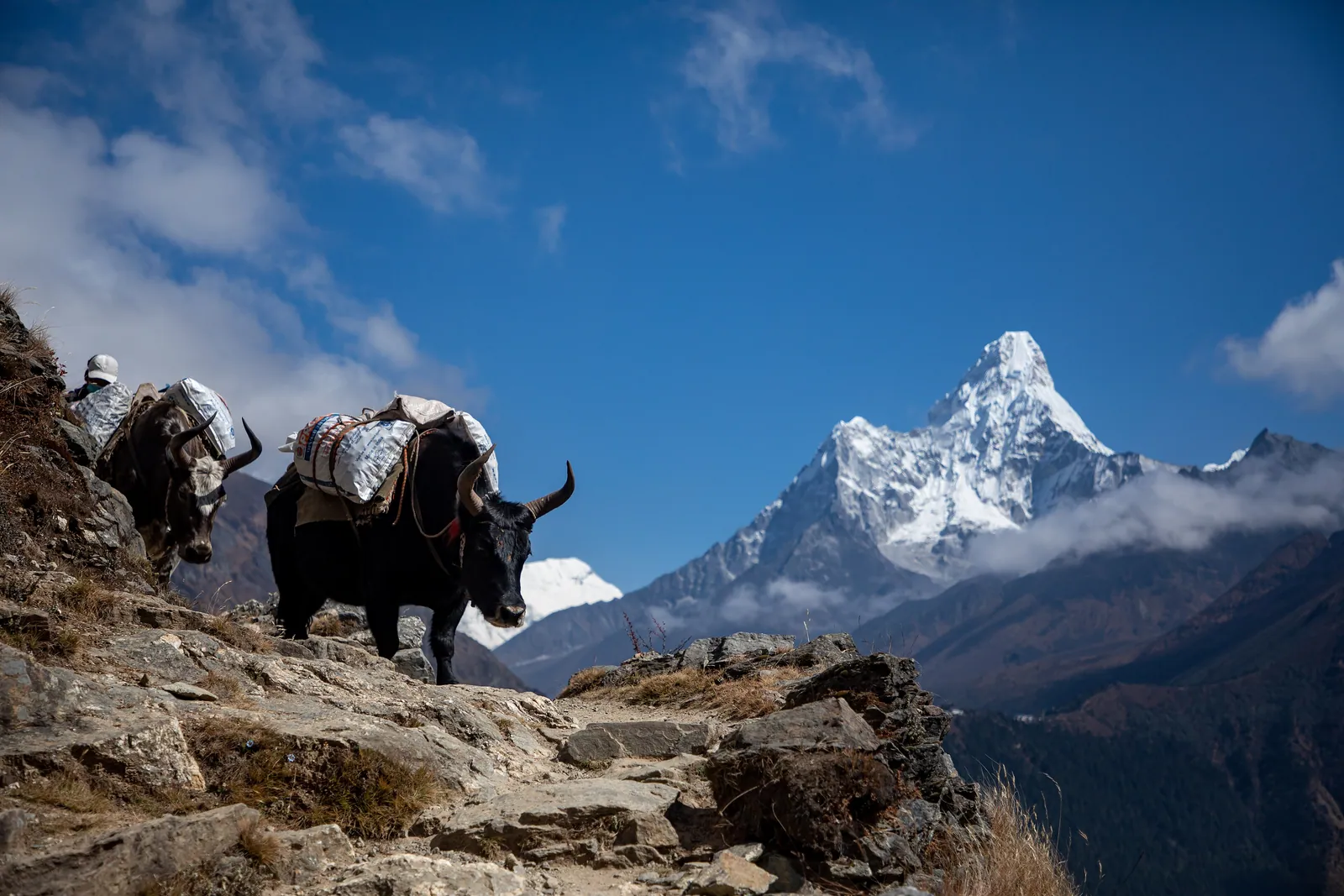
Bhutan's northern border with Tibet rises to peaks above 7,000 metres, and the trekking country between the dzong valleys and the high ranges is among the finest in Asia: well-maintained trails, minimal crowds, forests of blue pine, silver fir and rhododendron giving way to yak pastures and granite peaks, with the possibility of seeing blue sheep, red pandas and occasionally the black-necked crane (which winters in the Phobjikha Valley at 3,000 metres). The Snowman Trek, a high-altitude route through the remote Lunana district to the north, is considered one of the most challenging multi-week treks in the world; most of its route lies above 4,000 metres and it is only possible in a narrow seasonal window.
The Druk Path Trek, a five-to-six-day walk between Paro and Thimphu crossing several passes above 4,000 metres, is the most popular multi-day trek and provides a concentrated version of what Bhutanese mountain travel has to offer: high-altitude lakes, views of the Himalayan chain from Gangkhar Puensum (the world's highest unclimbed peak, at 7,570 metres, left unclimbed out of respect for local beliefs) across to Chomolhari (7,326 m), and camp nights of great stillness under skies unpolluted by any light from below.
The sustainable development fee and how to visit
Bhutan charges a Sustainable Development Fee (SDF) of USD 100 per person per night (reduced from USD 200 in 2023), in addition to the standard costs of accommodation, guides and transport. This is not an all-inclusive daily rate but a per-night charge on top of other costs, and it funds Bhutan's free healthcare and education system, environmental conservation and cultural preservation. It means that Bhutan is not a budget destination, and it is designed not to be: the fee is explicitly intended to ensure that visitors contribute meaningfully to the country's welfare.
Visas are processed through your tour operator and cannot be obtained independently. All visitors to Bhutan must travel with a licensed Bhutanese tour operator, and independent travel is not permitted. This is a genuine constraint for some travellers, but in practice it means that everything is arranged and the logistical energy that would otherwise go into bookings and transport goes instead into experiencing the country. The best time to visit coincides with the major tsechus: March–May (spring, Paro Tsechu) and September–November (autumn, Thimphu Tsechu and the best trekking conditions) are the optimal windows.
Quick answers
Why does Bhutan charge a Sustainable Development Fee, and what does it cover?
Bhutan's Sustainable Development Fee (SDF) of USD 100 per person per night (as of 2023) is a deliberate policy to limit mass tourism and ensure that visitors contribute directly to the country's wellbeing rather than merely extracting value from it. The fee funds Bhutan's free healthcare, free education and environmental conservation programmes. It is not included in your accommodation costs — it is charged in addition — so Bhutan requires a meaningful budget. The country has chosen quality over quantity of visitors, and the result is a tourism experience that feels genuinely uncrowded and respectful.
Can I travel independently in Bhutan?
No. All visitors to Bhutan (except Indian, Bangladeshi and Maldivian nationals, who have a different arrangement) must travel with a licensed Bhutanese tour operator and have a pre-arranged itinerary. This rule applies to all nationalities and cannot be circumvented. In practice it means your guide is always present, everything is pre-booked, and your day-to-day experience is smooth. The best operators offer considerable flexibility within this framework — guides who adapt itineraries to your interests, pace and weather.
What is the best time of year to visit Bhutan?
March to May offers warm temperatures, rhododendron forests in bloom at altitude, and the Paro Tsechu in April — one of the most spectacular festivals in Bhutan. September to November offers the clearest mountain views, the Thimphu Tsechu in September or October, and the best conditions for trekking. The monsoon (June to August) brings heavy rain, leeches on forest trails and reduced visibility, but the valleys are intensely green and the dzongs are hauntingly beautiful in mist. December to February is cold but clear, and the Punakha Tsechu and Drubchen are held in February or March.
How difficult is the hike to Tiger's Nest?
The Taktsang (Tiger's Nest) hike is a round trip of roughly 10 kilometres with an elevation gain of about 900 metres from the car park. Most moderately fit adults complete it in three to four hours each way, with a rest at the cafeteria viewpoint halfway up. The path is well-maintained and there are horses available for hire for the first section. The final section, descending into and climbing out of the ravine immediately below the monastery, involves steep stone stairways. It is one of the most rewarding hikes in the world — the combination of mountain scenery, forest and the monastery's extraordinary setting makes the effort more than worthwhile.
Does Bhutan have a tipping culture?
Tipping is not a formal part of Bhutanese culture, but it has become expected in the tourism industry due to international visitors' habits. A reasonable tip for a guide after a week's travel is in the range of USD 10–15 per day; for drivers, somewhat less. Tips should be given in person at the end of the trip, not through the operator. The Sustainable Development Fee already supports Bhutanese welfare broadly, but the guides and drivers who work in tourism are individual people for whom a thoughtful tip represents meaningful additional income.
Let the reading become a route.
When an article sparks something, our planners are the next step. Tell us what you are dreaming of.