Birds of Paradise of New Guinea: the Most Extravagant Birds on Earth
New Guinea's birds of paradise have evolved the most elaborate plumage and the most complex courtship displays in the avian world — the result of millions of years without mammalian predators and an abundance of fruit.
Before the light is properly up, the sound starts: a mechanical, almost industrial ratcheting that the field guides describe as 'nasal and far-carrying' but which, at twenty metres from the source, is more accurately described as unlike anything you have heard before. The male Magnificent Bird-of-Paradise is beginning his display, and for the next thirty minutes he will go through a choreography that evolution has been refining for millions of years — inflating the electric-blue breast shield, raising the twin elongated tail wires, circling the cleared display court with a precision that suggests rehearsal, though nothing in his life has been rehearsed. The female arrives without ceremony. She sits above him, observes with an expression that can only be called evaluative, and eventually — the field guides are coy about the timing — departs. The male continues displaying, because that is what he does.
There are around 45 species of birds of paradise in the family Paradisaeidae, almost all of them confined to New Guinea and its satellite islands, with a handful of species extending into the Cape York Peninsula of northeastern Australia and the Moluccas. New Guinea — the world's second-largest island, shared between Indonesia (as the provinces of Papua and West Papua) and the independent state of Papua New Guinea — is one of the least-visited large landmasses on Earth, its interior forests still largely intact, its wildlife still largely unknown to the tourist circuit. The birds of paradise are the island's most visible and most extraordinary ambassadors, and watching a displaying male in the wild is among the most concentrated experiences of natural wonder that any traveller can have.
Why New Guinea: the ecology of extravagance
The extraordinary plumage of male birds of paradise exists because of a convergence of factors that are unusual in tropical ornithology. New Guinea's forests are food-rich — the island's soils are fertile, its rainfall reliable, and its forests produce fruit and invertebrates in quantities that allow birds to meet their nutritional needs relatively quickly. This leaves males with time that is not spent foraging. In the absence of significant mammalian ground predators (New Guinea has no native cats or canids), elaborate plumage did not carry the survival penalty that it would in more predator-rich environments. Sexual selection, operating over millions of years, produced the result: the most extravagant birds in the world, their plumage so extreme that early European naturalists who received specimens from trade skins — from which the legs had been removed — concluded that the birds must spend their entire lives in flight.
The ecology of display varies dramatically between species. Some birds of paradise display individually on cleared forest-floor courts, removing every leaf and twig from a carefully selected patch of ground. Others display in trees, with groups of males competing in the same tree for female attention — a system called a lek. The King of Saxony Bird-of-Paradise displays alone in the forest understorey, raising the extraordinary head plumes that exceed twice its body length. The Superb Bird-of-Paradise transforms itself into what looks, from the front, like a smiley-face pattern in black and cyan — one of the most visually surreal things in the natural world.
Seeing them: the Arfak Mountains and Vogelkop
The Vogelkop Peninsula (also called the Bird's Head Peninsula) at the western tip of New Guinea — in the Indonesian province of West Papua — takes its name from the Dutch for 'bird's head,' a reference to the peninsula's shape on the map and to the extraordinary avifauna that made it famous to early naturalists. The Arfak Mountains inland from Manokwari are among the most accessible bird-of-paradise watching destinations in all of New Guinea, with a network of local guides — the Hatam people who have lived in this forest for generations and built their economies partly around guiding visiting birders — and a set of well-established display sites where species including the Vogelkop Bowerbird (not a bird of paradise but equally extraordinary), Western Parotia, and Magnificent Bird-of-Paradise are reliably seen.
The standard approach is to hire local guides through established community guiding operations and walk to the display sites in the pre-dawn dark, arriving to set up before the birds begin. The trails are moderate in difficulty and genuinely rewarding even for travellers who are not specialist birders: the forest is magnificent, the mossy mid-elevation terrain at around 1,800 to 2,200 metres is vivid with orchids and ferns, and the immersion in a relatively intact tropical mountain forest in the company of knowledgeable local guides is an experience with a depth that a single target species cannot fully convey.
Papua New Guinea: Tari Valley and the highlands
In the eastern half of the island — in the independent state of Papua New Guinea — the Tari Valley in the Southern Highlands Province is the classic bird-of-paradise destination for English-speaking visitors. The local Huli people, famous for their elaborate feathered wigs and body paint, have developed a sophisticated guiding culture around the birds of paradise that inhabit the surrounding forests. Several lodges in the Tari area operate purpose-built bird hides overlooking display trees and forest courts where species including the Raggiana Bird-of-Paradise (Papua New Guinea's national emblem), Blue Bird-of-Paradise, Princess Stephanie's Astrapia, and Loria's Bird-of-Paradise are regularly seen.
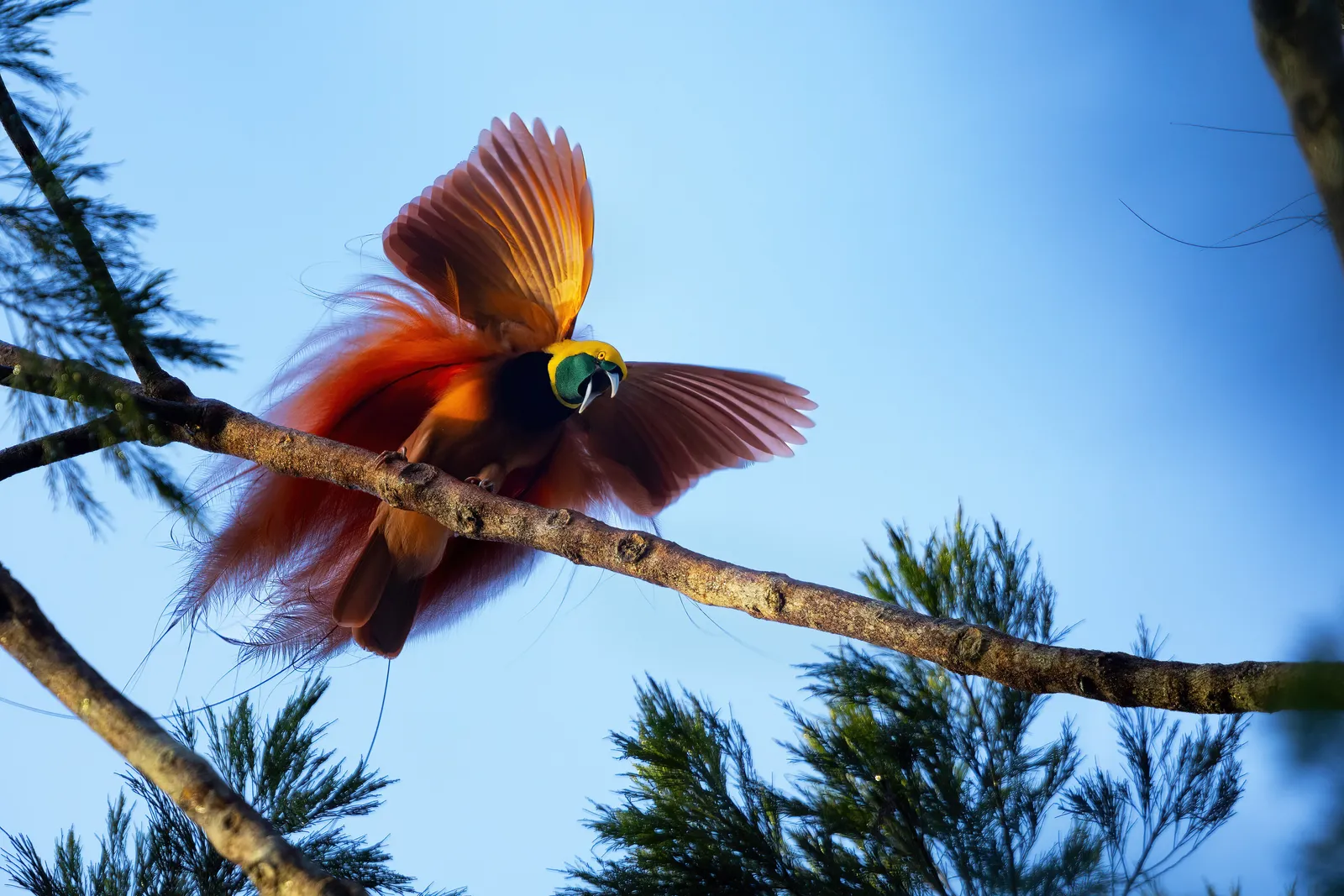
The Raggiana Bird-of-Paradise is the most widely seen species in Papua New Guinea and appears on the national flag — a cascading explosion of orange-red plumes that the males display in communal leks in certain trees, attracting females over a display season that typically peaks between May and October. Watching a lek of Raggiana males in full display — a dozen birds in a single tree, their plumes raised, their postures contorted in competition — is one of those wildlife experiences that overwhelms description. The Hulis' own use of bird-of-paradise plumes in ceremonial headwear is one of the most immediately compelling human-wildlife relationships in the world.
The bowerbirds: the other New Guinea phenomenon
Any visit to New Guinea that focuses only on birds of paradise misses the bowerbirds, which are not the same family but share the island and have independently evolved an equally extraordinary set of behaviours. Male bowerbirds do not develop elaborate plumage — instead, they build elaborate structures, the bowers, as display arenas to attract females. The Vogelkop Bowerbird builds a hut-like structure of sticks, sometimes a metre and a half high, surrounded by a decorative garden of coloured objects: moss, berries, beetle wing covers, flowers, and occasionally human-made items of appropriate colour.
The Western Bowerbird and the MacGregor's Bowerbird build differently structured bowers; each species has a diagnostic architectural style that remains consistent across the population — a transmitted cultural behaviour rather than a genetically encoded one. Finding and watching a bowerbird at its bower is an experience with a slightly different quality from watching a bird-of-paradise: the bower itself is present when the bird is absent, and examining it — the careful placement of each object, the choice of colours, the maintenance activity — tells a story about intelligence and aesthetic preference that is among the most thought-provoking things in natural history.
Conservation: the forest that keeps them
New Guinea's forests are among the largest and least disturbed tropical forests remaining on Earth, and the island has been spared the most severe patterns of agricultural conversion that have affected Borneo, Sumatra, and the Amazon — partly because of its rugged terrain, partly because of low population density in many interior areas, and partly because of land tenure systems that vest control of forests in local clans rather than the state. The result is that the birds of paradise are, by tropical standards, reasonably well conserved — but the pressures are increasing.
Logging concessions in the lowland forests of both Indonesian Papua and Papua New Guinea are expanding, and the palm oil frontier that has devastated Borneo's lowland forest is beginning to move into New Guinea. In Papua New Guinea specifically, customary land rights provide a degree of protection, but also mean that conservation outcomes depend on community-level decisions that are vulnerable to economic incentives. Bird-of-paradise-based tourism, when structured to provide income directly to local guide communities — as it is at the best operations in the Tari Valley and the Arfak Mountains — is one of the stronger arguments for keeping the forest intact.
Planning a New Guinea birding journey
New Guinea is not a casual destination. Infrastructure in both Indonesian Papua and Papua New Guinea is limited; transport between locations can require a combination of domestic flights, road travel, and boat; and the logistical complexity of assembling a permit, guide, and accommodation sequence in the right order requires planning and experience. The rewards, for travellers who make the commitment, are commensurate: this is one of the few places left on Earth where the wildlife is genuinely wild, the forest genuinely intact, and the local guides genuinely irreplaceable.
The standard entry points are Manokwari or Sorong for the Indonesian side (for the Arfak Mountains and Vogelkop), and Port Moresby or Mount Hagen for Papua New Guinea (for the Tari Valley and the highlands). The best season for bird-of-paradise displays is broadly from May to October, when display activity is most intense. Birding tour operators with specific New Guinea expertise — those who have personally visited the sites, know the individual local guides, and understand the permit requirements — are essential for a first visit; this is not a destination to improvise. Our guides who have accompanied ornithology expeditions to New Guinea describe it, consistently, as the most challenging and the most rewarding wildlife destination they have worked.
Quick answers
How many species of birds of paradise are there, and can I see them all?
There are around 45 species in the family Paradisaeidae. A comprehensive New Guinea circuit — covering both the Vogelkop and the Papua New Guinea highlands, with time in the lowlands and mid-elevation forests — might yield 15 to 20 species over two to three weeks. Specialist birding tours with very experienced local guides and an itinerary built around maximising species count can do considerably better. No single destination offers all species, and some are genuinely rarely seen regardless of effort.
Do I need to be a serious birder to visit New Guinea for birds of paradise?
No — but you should be genuinely motivated. The logistics of reaching the display sites, the early morning starts, and the travel infrastructure challenges of New Guinea are best absorbed by someone who cares deeply about what they will see at the end of them. Travellers who arrive as moderate enthusiasts frequently leave as serious converts; the birds of paradise have a way of making ornithologists of people who never expected to become one.
Is it safe to travel in Papua New Guinea?
Papua New Guinea requires careful planning and good local partnerships. Port Moresby, the capital, has a serious crime problem and should not be explored independently; travel in the highlands, where most bird-of-paradise tourism takes place, is considerably safer when organised through established operators with trusted local guide networks. The Tari area and the Arfak Mountains in West Papua are routinely visited by birding groups and are not considered high-risk destinations when approached with experienced local support.
What is the relationship between the Huli people and birds of paradise?
The Huli of the Tari Valley are one of the most culturally distinctive peoples of Papua New Guinea, famous for their elaborate decorative traditions that incorporate bird-of-paradise plumes in ceremonial headwear (wigs) worn by men. The plumes used are typically from farmed or traded birds; wild bird-of-paradise hunting for plumes was historically practised but is now controlled. The Hulis' cultural connection to the birds gives bird-of-paradise guiding a depth of meaning that extends well beyond ornithology, and many Huli guides combine exceptional field knowledge with a living relationship to the birds that is genuinely moving.
What other wildlife is found in New Guinea besides birds of paradise?
New Guinea has extraordinary biodiversity beyond the birds of paradise. Tree kangaroos inhabit the mountain forests; cassowaries — the large, flightless birds — live in the lowland forests; the island holds numerous species of possum, cuscus, and bandicoot. The marine environment around New Guinea is among the richest in the world, part of the Coral Triangle, and the island's rivers support freshwater species found nowhere else. For a serious naturalist, New Guinea is the single most species-rich and least explored large island on Earth.

Let the reading become a route.
When an article sparks something, our planners are the next step. Tell us what you are dreaming of.