Chobe and the Okavango Delta: Botswana's Two Great Wildernesses
Botswana protects more wilderness per capita than almost any country on Earth — and its two great ecosystems, the flooded channels of the Okavango and the elephant-thick floodplains of Chobe, offer profoundly different ways to encounter African wildlife.
Botswana made a deliberate choice. In the 1990s, as its neighbours debated how to balance wildlife with mass tourism, Botswana chose the opposite: low volume, high value. It restricted visitor numbers to its national parks and reserves, kept out the proliferating lodges and vehicles of higher-volume destinations, and used conservation levies to fund community-based wildlife management. The result is some of the least crowded and most ecologically intact safari country in Africa.
The two ecosystems at the heart of Botswana's wilderness — the Okavango Delta and Chobe National Park — could hardly be more different in character. The Okavango is water in a desert: a river from the Angolan highlands that fans out into the Kalahari sands and disappears, never reaching the sea, creating an inland delta of channels, reed beds, lagoons and islands that floods seasonally and supports a staggering density and variety of life. Chobe, to the northeast, is a drier, more open landscape built around the Chobe River, and it holds the largest concentration of elephants on Earth — an estimated 130,000 animals in the wider ecosystem.
The Okavango: a river that loses itself
The Okavango River rises in the highlands of Angola and flows south-east into Botswana, where it meets the flat sands of the Kalahari Basin and disperses. With no downward gradient to channel it forward, the river spreads: across an area of some 20,000 square kilometres at peak flood, creating the world's largest inland delta. The water eventually evaporates or is absorbed by the desert, never reaching the ocean.
The flood is seasonal and, counterintuitively, arrives in the dry season. Rain falls in Angola from November to March; the flood pulse takes roughly three months to travel down the Okavango system, reaching the southern delta around June to August — the dry season in Botswana itself, when the surrounding Kalahari is parched. This inverted hydrology concentrates wildlife around the delta's water precisely when the rest of the landscape offers very little: the flood is a magnet, and the game densities at peak water can be extraordinary.
Life in the channels
The Okavango is best experienced from the water, and the traditional vessel is the mokoro — a dugout canoe poled through the reed-fringed channels by a guide standing at the stern. The mokoro was originally carved from ebony or sausage trees, though most camps now use fibreglass replicas to protect the remaining trees. Silently, at water level, it offers a completely different perspective from a game vehicle: the papyrus walls close around you, a malachite kingfisher sits at eye level on a reed stem, and a hippo's eyes appear, watchful, at the surface of a lagoon ahead.
The delta also supports extraordinary bird life year-round: African fish eagles, the saddle-billed stork, the pel's fishing owl, and seasonal concentrations of wading birds that draw specialist ornithologists from across the world. Seasonal floodplains bring in the great game herds — elephants, buffalo, lions, leopards, wild dogs and the rare sitatunga antelope, which is semi-aquatic and particularly associated with the delta's reed beds. No two days in the Okavango offer quite the same landscape: channels open and close as the flood advances and recedes.
Chobe: elephants and the river
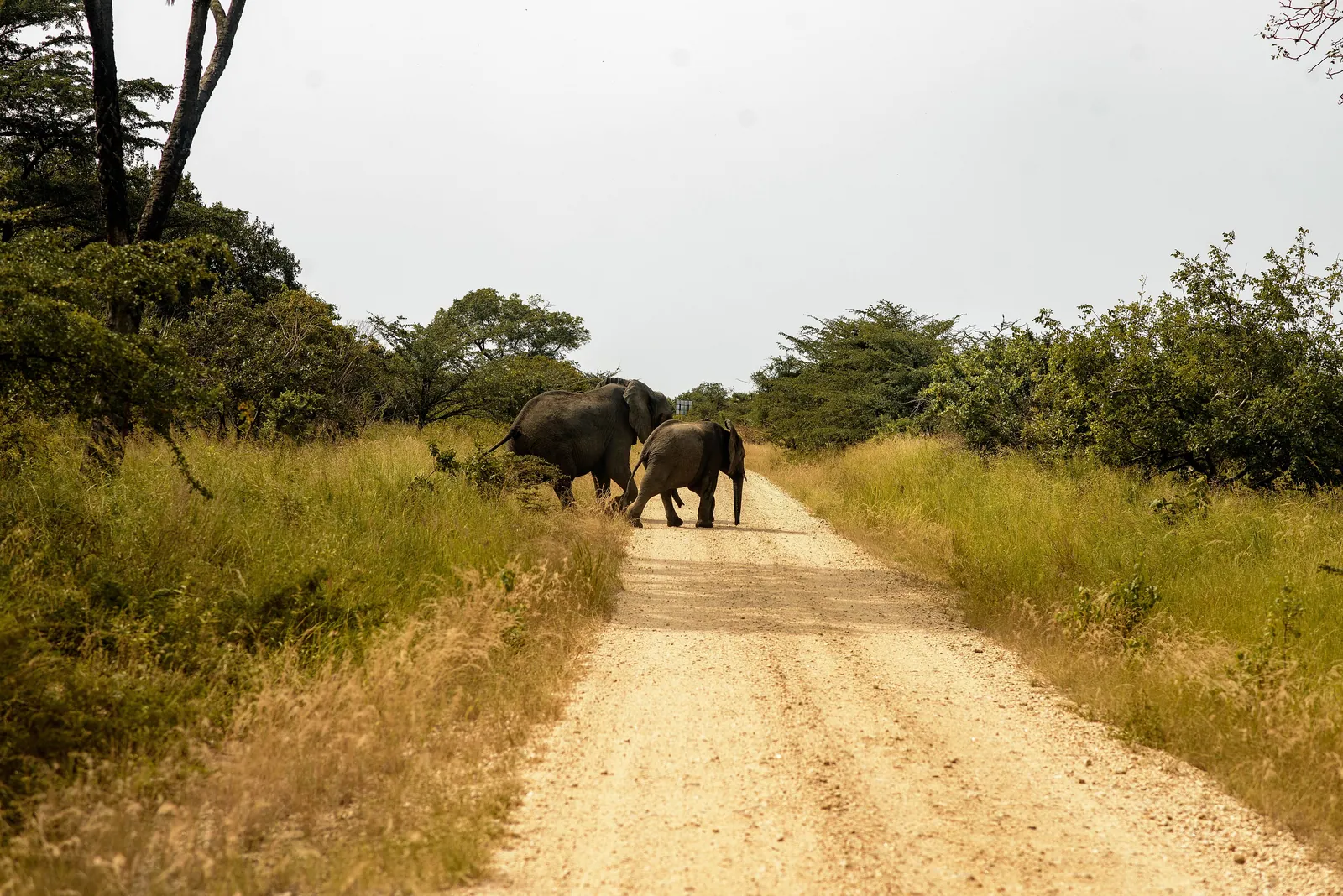
Chobe National Park in northeastern Botswana is among the best-known elephant destinations on Earth, and with reason. The Chobe River forms the northern boundary of the park, and in the dry season the elephants — and there are thousands of them — converge on its banks to drink and bathe. A game drive or a river cruise along the Chobe in July or August can put you among herds of several hundred animals at close range: young bulls sparring, matriarchs shepherding calves into the shallows, the whole dusty mass of the herd cooling itself in slow, contented wallowing.
The park also holds substantial numbers of buffalo, lions, leopards, wild dogs, sable and roan antelope and, in the Chobe riverfront section, very large herds of elephants that at certain times of year make individual sightings almost irrelevant in favour of simply watching the mass movement of animals. The park is large enough and varied enough that quieter areas — the Savuti Channel and the remote Linyanti — offer a different character: drier, more open, with a different community of wildlife.
Camp life and the low-volume model
The lodges and camps of Botswana's private concessions are small by design: most hold no more than eight to sixteen guests. The ratio of land to visitor is high, which means you rarely encounter another vehicle in the field. Morning and evening drives are the pattern, with walking safaris offered in most areas — Botswana was among the first countries in Africa to formalise the walking safari as a guided wildlife experience, and guides here are typically among the most knowledgeable on the continent.
The trade-off for this quality is cost: Botswana is among the most expensive safari destinations in Africa, and the per-person daily rates at the premium camps can be substantial. For a first-time visitor focused on sheer numbers of animals, the higher-volume East African destinations may offer more visible wildlife per dollar. But for a traveller who has already done the Serengeti, or who wants a quieter, deeper encounter with a wilder ecosystem, Botswana offers something qualitatively different.
Combining the two ecosystems
The Okavango and Chobe are typically visited together on a single Botswana journey — usually flying between them by light aircraft, the standard way of moving between camps in a roadless wilderness. Three nights in each area is the practical minimum; four or five nights per ecosystem allows both game driving and water-based activities in the Okavango, and a combination of river cruise and inland drive at Chobe.
Victoria Falls, just across the Zimbabwean border from Chobe, forms a natural bookend: many travellers enter or exit Botswana through the falls town of Kasane, combining the park with a night or two beside the Zambezi. From here a journey can extend south to the Cape, or loop north to the Serengeti. Botswana is most compelling as part of a longer southern or eastern African arc — a place whose depth rewards the traveller who gives it more than a token night.
Quick answers
When is the best time to visit the Okavango Delta?
The delta floods between roughly June and August, when the annual pulse from Angolan rains reaches Botswana's interior. This peak-flood season, which coincides with Botswana's dry season, brings the highest water levels, the best mokoro and boat activities, and strong wildlife concentrations around the water. The dry season from May to October is generally the best overall window for both the Okavango and Chobe.
How do you get to the Okavango Delta?
Most visitors fly into Maun, the gateway town for the delta, from Johannesburg or other regional hubs. From Maun, small charter flights on light aircraft transfer guests directly into the delta's private concession airstrips — most of which are grass strips in the wilderness. The flying is part of the experience: the delta seen from the air, with its channels gleaming through the reed beds, is one of the great aerial views of Africa.
Why does Botswana have so many elephants?
Botswana banned trophy hunting in 2014 and maintains strict protections across its national parks and wildlife management areas. The northern corridor of the country, including Chobe, Linyanti and the Okavango, forms one of the largest continuous wildlife areas in Africa, providing enough range for the population to grow. The Chobe ecosystem alone is estimated to hold around 130,000 elephants — a density that creates both extraordinary viewing and significant pressure on local vegetation.
Is Botswana worth the high cost?
The answer depends on what you value in a safari. Botswana's high per-day costs buy a combination of very low visitor density, exceptional guide quality, large private concessions and ecologically intact wilderness that is genuinely difficult to find elsewhere in Africa. For a traveller who wants the widest possible choice of wildlife in the most accessible camps, East Africa may deliver more for the money. For a traveller who values solitude, depth and the chance of a genuinely remote experience, Botswana's premium is typically justified.
Let the reading become a route.
When an article sparks something, our planners are the next step. Tell us what you are dreaming of.