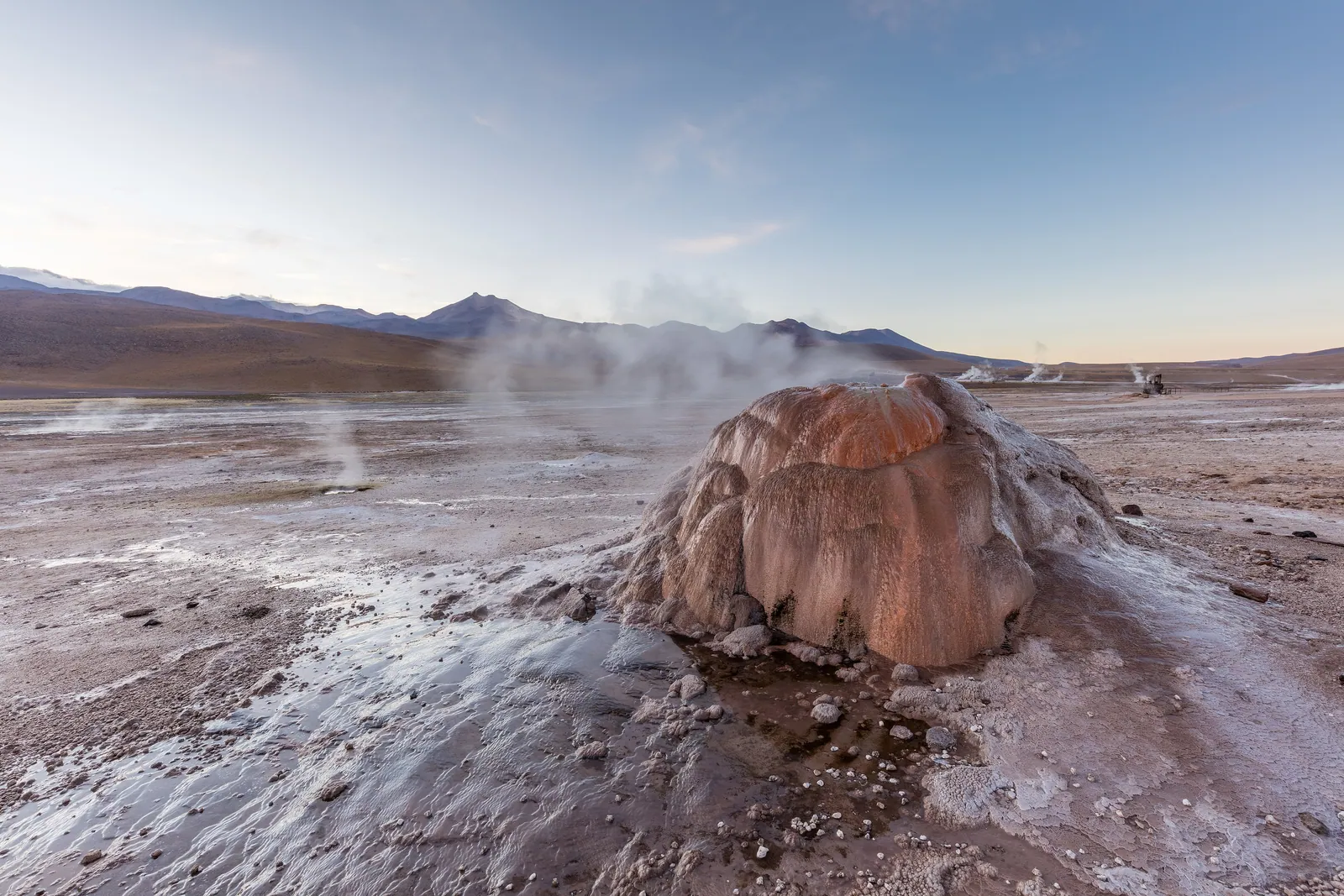
Dawn at El Tatio: The World's Highest Major Geyser Field
Why the Atacama's great geyser field is visited in the freezing dark, what actually happens when the sun comes up, and how to do the early start well — the cold, the altitude and the steam.
El Tatio is visited at dawn for a precise physical reason. The geyser field sits at over 4,300 metres in the Andes east of San Pedro de Atacama, and it is the contrast between the freezing pre-dawn air and the boiling water underground that turns each vent into a towering column of white steam. Arrive after the sun has warmed the basin and the spectacle quietly deflates.
So the El Tatio excursion begins in the dark and the cold — a departure from San Pedro hours before sunrise, a climb of nearly two kilometres in altitude, and arrival at the field just as the light comes. It is the most demanding morning of an Atacama week and, for many travellers, the most memorable. Here is how it works, and how to do it well.
What El Tatio actually is
El Tatio is a geothermal field of more than eighty active geysers, set in a high basin ringed by Andean volcanoes. It is the largest geyser field in the Southern Hemisphere and, at over 4,300 metres, the highest major one on Earth. The heat comes from the same restless geology that built the Andes: rain and snowmelt seep deep into the ground, are superheated by magma below, and force their way back up through fumaroles, hot springs and erupting vents.
Unlike the tall, dramatic jets of Yellowstone or Iceland, most of El Tatio's geysers are modest in height — often less than a metre of spouting water. The spectacle is not the height of the water but the steam: in the cold dawn air, each vent releases a plume that can rise many metres, and the whole basin fills with drifting, sunlit columns of white.
Why the timing is everything
The steam show depends entirely on temperature contrast. Before sunrise the air at 4,300 metres can sit well below freezing, while the geyser water emerges close to boiling. That gap is what makes the vapour condense into the dense, visible columns El Tatio is famous for. As the sun climbs and the air warms through the morning, the contrast fades and the plumes thin to near-invisibility.
This is why the excursion is uncompromising about its hours. A guided trip from San Pedro typically leaves around 5 a.m. for the drive of roughly two hours, timed to reach the field as the first light touches the steam. It is genuinely cold, genuinely early, and genuinely worth it — the half-hour around sunrise is the entire reason to come.
The altitude question
El Tatio is the highest place most travellers reach on an Atacama itinerary, and the altitude deserves respect. Going from a night's sleep at 2,400 metres in San Pedro to standing at 4,300 metres before dawn is a significant jump, and it is normal to feel breathless, light-headed or slow as you walk the field. The cold compounds it: your body is working hard simply to keep warm on a third less oxygen.
The sensible response is built into the itinerary rather than left to the traveller. We schedule El Tatio for later in an Atacama stay, never on the first or second day, so the body has already begun adjusting. Move slowly at the field, do not rush between vents, keep drinking water, and tell your guide if a headache or nausea sets in. For most people the altitude is simply a backdrop; pacing keeps it that way.
Dressing for a 4,300-metre dawn
The single most common mistake at El Tatio is underdressing. Travellers picture a desert and pack for heat; the pre-dawn geyser field is one of the coldest places on the whole Atacama itinerary, often well below zero. Dress in proper layers — a warm base, an insulating mid-layer, a windproof outer shell, plus hat, gloves and a buff for the face. You will shed layers as the sun rises and the basin warms.
Sturdy closed shoes matter too: the ground around the vents is uneven, crusted and, in places, slick with mineral deposit and ice. Stay on the marked paths and keep a clear distance from the pools — the water is at boiling point, the crust around some vents is thin, and serious burns have happened to visitors who strayed. Many trips end with a soak in El Tatio's natural hot-spring pool, so a swimsuit and towel are worth bringing.
El Tatio on a grand journey
On Andes to Antarctica and The Pacific Arc, the El Tatio dawn is one of the set pieces of the Atacama Desert leg — a guided pre-dawn departure from a San Pedro lodge, with a small group, a 4x4 and a guide who knows the field's vents and its hazards. The cold start is real, but so is the payoff: breakfast laid out in the steam as the sun comes up over the Andes.
The descent back toward San Pedro is part of the morning's pleasure. The road drops slowly through high wetland and grassland where vicuñas graze and the occasional viscacha suns itself on the rocks, often with a stop at a tiny altiplano hamlet. By late morning you are back in the village, the hardest excursion of the week already behind you and the warm hours of the afternoon ahead.
Quick answers
Why do you have to visit El Tatio so early in the morning?
The geysers are famous for their tall steam columns, and that steam only forms when the freezing pre-dawn air meets the near-boiling water. As the sun rises and warms the basin, the contrast fades and the plumes shrink to near-nothing. To see El Tatio at its best you must be there around sunrise, which means leaving San Pedro de Atacama at roughly 5 a.m.
How high is El Tatio, and will the altitude be a problem?
El Tatio sits at over 4,300 metres, making it the highest place on a typical Atacama itinerary. Coming from San Pedro at 2,400 metres, it is normal to feel breathless and slow. We schedule the trip for later in an Atacama stay, after a few days of acclimatising, and ask travellers to move gently at the field. For most people the altitude is a manageable backdrop rather than a barrier.
What should I wear and bring for the El Tatio excursion?
Dress for serious cold: a warm base layer, an insulating mid-layer, a windproof shell, plus hat, gloves and a face buff, because the pre-dawn field is often well below freezing. Wear sturdy closed shoes for the uneven, icy ground, and stay on marked paths well clear of the boiling pools. Many trips include a soak in the natural hot spring, so pack a swimsuit and towel too.
Let the reading become a route.
When an article sparks something, our planners are the next step. Tell us what you are dreaming of.