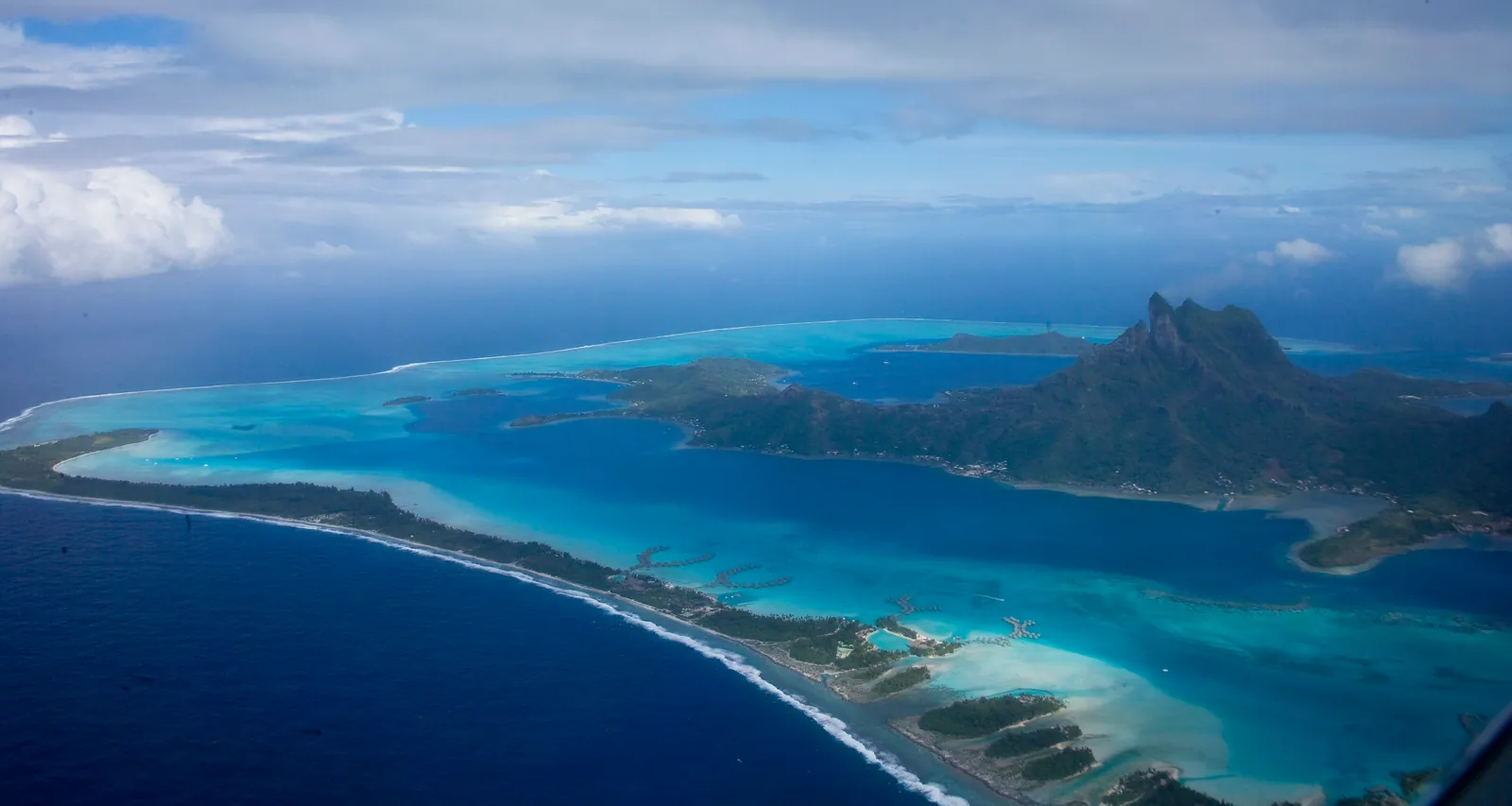
Fiji: The Archipelago of a Thousand Colours at the Heart of the Pacific
Fiji is not one island but more than three hundred, scattered across the South Pacific among tropical reefs, cloud forests, kava ceremonies and a Fijian hospitality that travellers recall with more clarity than any beach.
The International Date Line passes less than a hundred kilometres east of the Fijian islands, making this archipelago one of the first inhabited territories on Earth to welcome each new day. It is a circumstance Fijians know and that somehow seems to capture their relationship with time: a culture that celebrates the arrival of the present with the same ceremony it brings to everything else. Fiji has three hundred and thirty-three islands, of which just over a hundred are inhabited, and stretches across the South Pacific between 15 and 22 degrees south latitude, where sea temperature never falls below 25 degrees in any month of the year.
The visitor who arrives expecting only white-sand beaches and coral reefs — which exist here, and are extraordinary — discovers a place more complex and fascinating than anticipated. Fiji has two main ethnic groups — indigenous Fijians of Polynesian and Melanesian origin, and Indo-Fijians descended from workers brought by the British in the nineteenth century — who coexist in a multi-ethnic society with its own historical tensions and its own irreplaceable culture of synthesis. It has cloud forests in the interior of Viti Levu that bear no resemblance to the coastal resorts. And it has kava — the yaqona ceremony — which is the best possible way to be received in a village.
The geography: Viti Levu, Vanua Levu and the island groups
Fiji is divided into several geographical groups. Viti Levu is the main island — home to the capital, Suva, and the international airport at Nadi — and has a mountainous interior of considerable beauty: the Viti Levu mountain range reaches 1,323 metres at Mount Tomanivi, and on its slopes grow cloud forests that protect important watersheds and harbour endemic birds. Vanua Levu, the second-largest island, is quieter and less touristically developed, with less-visited dive reefs. The Mamanuca group, west of Viti Levu, is the cluster of small islands closest to Nadi and the easiest to reach; the Yasawa group, further north, is a chain of volcanic islands of spare beauty with lagoons of an inexplicable colour.
Off the northern coast of Vanua Levu lies the Great Sea Reef, one of the longest barrier reef systems in the world, and Fijian waters have a particularly notable diversity of soft corals: Fiji is known worldwide among divers as the soft coral capital of the world, with colonies of sea fans, tree corals and soft corals in densities and colours that surprise even those who have dived in the Coral Triangle.
Kava and the yaqona ceremony
Yaqona — also widely called kava across the Pacific — is a drink prepared from the ground roots of the plant Piper methysticum, and in Fiji its ritual consumption is the centre of social and political life. The sevusevu ceremony — the formal presentation of a gift of yaqona roots to a village chief as a gesture of respect and a request for permission to enter the community — is still practised in traditional Fijian villages and is the correct way to visit one.
Yaqona has a mild, mildly anaesthetic effect on the lips and tongue, and drinking several cups produces a physical relaxation and social ease that has led Fijians to describe it as the glue that binds the community. Kava has the peculiarity of being simultaneously sober — it does not intoxicate in the alcoholic sense — and profoundly social. The long yaqona sessions in villages, with music, conversation and the continuous round of the tanoa (the wooden bowl from which it is served), are one of the most genuine experiences Fiji offers.
The reefs: diving the soft corals
Fiji's waters are warm enough for year-round diving without a wetsuit, and underwater visibility in normal conditions exceeds twenty metres. The best dive sites are concentrated around the Somosomo Strait between the islands of Taveuni and Vanua Levu — the Rainbow Reef is one of the most photographed dives in the South Pacific — and around the Mamanuca and Yasawa Islands, where reef sharks, manta rays, green sea turtles and Napoleon wrasse are regular sightings.
The island of Taveuni, Fiji's third-largest, is particularly prized by technical divers: the current running through the Somosomo Strait feeds one of the richest coral ecosystems in the Pacific. On land, Taveuni harbours the Bouma National Heritage Park, with waterfalls and a fragment of tropical wet forest that is largely intact, where the tagimaucia (Medinilla waterhousei) grows — a red-and-white flower that exists only in Fiji and appears on Fijian banknotes.
Fijian culture: meke, talanoa and the village
Traditional Fijian society is organised around the mataqali, the family clan that holds communal land. Fijian villages — bure of cane walls and pandanus thatch, grouped around a central green — maintain social structures and chiefly hierarchies (the turaga) that coexist with modern life. The meke is Fijian dance and song: women perform the meke wesi with fluid arm and hand movements that tell stories; men present the meke i wau, a war dance with spears and clubs.
Traditional Fijian cooking centres on the lovo, an earth oven: hot stones covered in banana leaves over which taro, sweet potato, pork, chicken and seafood cook for hours, producing meats of a tenderness and smoky depth that has no equivalent in any conventional oven. A lovo meal in a village, invited by the villagers themselves, is an experience that transcends any restaurant. The talanoa — open conversation, without hierarchy, where everyone speaks and everyone listens — is also an explicitly stated cultural value that Fijians cite with pride as one of the foundations of their society.
Suva: the capital of the South Pacific
Suva, on the south-east coast of Viti Levu, is the largest city in island Oceania outside Honolulu, and one of the most culturally interesting. Its harbour, for decades the busiest in the South Pacific, sees less merchant traffic today but retains the British colonial architecture and the cosmopolitan mix that history left. Suva Municipal Market is one of the most animated markets in the Pacific: ranks of Fijian, Indo-Fijian and Polynesian vendors offer kava in roots and powder, multi-coloured taro, tropical fruits, siapo (bark cloth) textiles and crafts from every neighbouring archipelago.
The Fiji Museum in Suva holds the most important collection of South Pacific artefacts in the region: Fijian war canoes (camakau) of up to fifteen metres, wooden and bone weapons from the war years, objects from the first encounters with Europeans, and documentation of the ritual cannibalism that accompanied tribal warfare until the mid-nineteenth century — a historical period that Fijians themselves address without evasion, as part of a past they have moved beyond.
When to go and how to move around the archipelago
Fiji's high season is the dry season, from May to October, when humidity is lower, rainfall is scarce and temperatures range between 23 and 29 degrees. The cyclone season runs from November to April, with the highest probability of heavy rain and cyclones between December and March, though years without significant cyclones are the norm. The Yasawa and Mamanuca groups receive less rain than the mountainous interior of Viti Levu, thanks to an orographic rain shadow.
Inter-island transport is by light aircraft (Fiji Link has a dense short-haul network), by fast ferry for the islands closest to Viti Levu, or by small expedition vessel for the most complete outer-island itineraries. The expedition ships that cruise the Yasawa and Lau groups offer the most immersive experience: access to resort-free islands, village landings and the chance to dive reefs that very few travellers have ever visited.
Quick answers
What is the difference between indigenous Fijians and Indo-Fijians?
Fijians iTaukei (indigenous Fijians) are descended from the archipelago's original inhabitants, with Melanesian and Polynesian roots. Indo-Fijians are descended from workers brought by the British between 1879 and 1916 to work on sugar plantations. They now represent just under forty percent of the population. They have distinct languages, religions (mainly Hinduism and Islam among Indo-Fijians, Christianity among iTaukei Fijians), culinary traditions and cultures, and coexist in a multi-ethnic society that has had political tensions but also a deep everyday coexistence.
Is it safe to drink kava?
Kava consumed in moderate quantities is safe for most healthy adults. It does not create addiction in the conventional sense and its effects are mild — relaxation, slight oral numbness. Heavy, prolonged consumption can cause a skin condition called kava dermopathy, but this is associated with very intensive consumption over long periods. The quantities involved in tourist ceremonies present no risk. Those with liver problems should consult a doctor before trying it.
Can I visit a Fijian village respectfully?
Yes, and it is highly recommended if done well. The correct approach is to arrive with a sevusevu — the gift of yaqona roots — and request permission from the chief. Remove shoes when entering communal spaces, cover shoulders and knees (hats or caps indoors are considered disrespectful), and wait to be invited to sit. Good local guides know these protocols and explain them in advance. Visiting a village without these protocols, as though it were a tourist attraction, is disrespectful to the local culture.
Which island group is best for diving?
For soft corals and marine diversity, the Somosomo Strait between Taveuni and Vanua Levu (Rainbow Reef, Great White Wall) is the reference destination for experienced divers. For ease of access and variety of sharks and rays, the Mamanuca and Yasawa Islands are excellent and accessible from Nadi. The Lau group at the eastern edge of the archipelago is more remote but offers virtually pristine reefs.
What is a bure and what is it like to stay in one?
The bure is the traditional Fijian dwelling: cane or bamboo walls, a four-pitch pandanus or thatched roof, natural fibre mat flooring. Many Fijian resorts have built modern bure that retain the traditional aesthetic but with full comforts. Staying in one at a beach resort is a comfortable experience with the right cultural backdrop; staying in a village bure, invited by a local family, is qualitatively different and more authentic.
Let the reading become a route.
When an article sparks something, our planners are the next step. Tell us what you are dreaming of.