Greenland: The Ice Continent and the Living Inuit Culture
Greenland is the world's largest island and holds the planet's second ice sheet, but it is also home to an Inuit culture that has spent four thousand years adapting human ingenuity to one of Earth's most extreme environments.
Greenland has a way of making superlatives feel inadequate. Covering more than two million square kilometres — of which roughly eighty percent lies beneath an ice sheet that in places exceeds three kilometres in thickness — it is the world's largest island and one of the planet's most significant repositories of fresh water. Were that ice to melt in its entirety — a scenario that climatologists study but that would take centuries to unfold — global sea levels would rise by around seven metres. That single figure is sufficient to understand Greenland's role in the physics of the Earth's climate.
And yet Greenland is not only ice. Along its coast, free of glaciers for much of its length in summer, live around fifty-six thousand people — the majority Inuit, known as Greenlanders or Kalaallit — in settlements of brightly painted houses that stand out against the black of the rock and the white of the frozen fiord. Their culture, their language (Greenlandic, or Kalaallisut) and their traditions of hunting, kayaking and bone carving are a direct continuation of a four-thousand-year civilisation. To travel to Greenland is to embark simultaneously on a polar expedition and an encounter with one of the oldest and most resilient living cultures in the Arctic.
The ice sheet: understanding the inlandsis
Greenland's ice sheet — known as the inlandsis, from the Danish and Greenlandic — covers approximately 1.7 million square kilometres and contains a volume of ice of around 2.85 million cubic kilometres. It is the second largest on Earth, surpassed only by Antarctica's. The ice sheet has a topography of its own: its centre is a vast elevated dome reaching more than three kilometres above sea level, from which the ice flows radially outward to the edges through fast-moving ice streams called outlet glaciers, many of which terminate in coastal fiords producing icebergs.
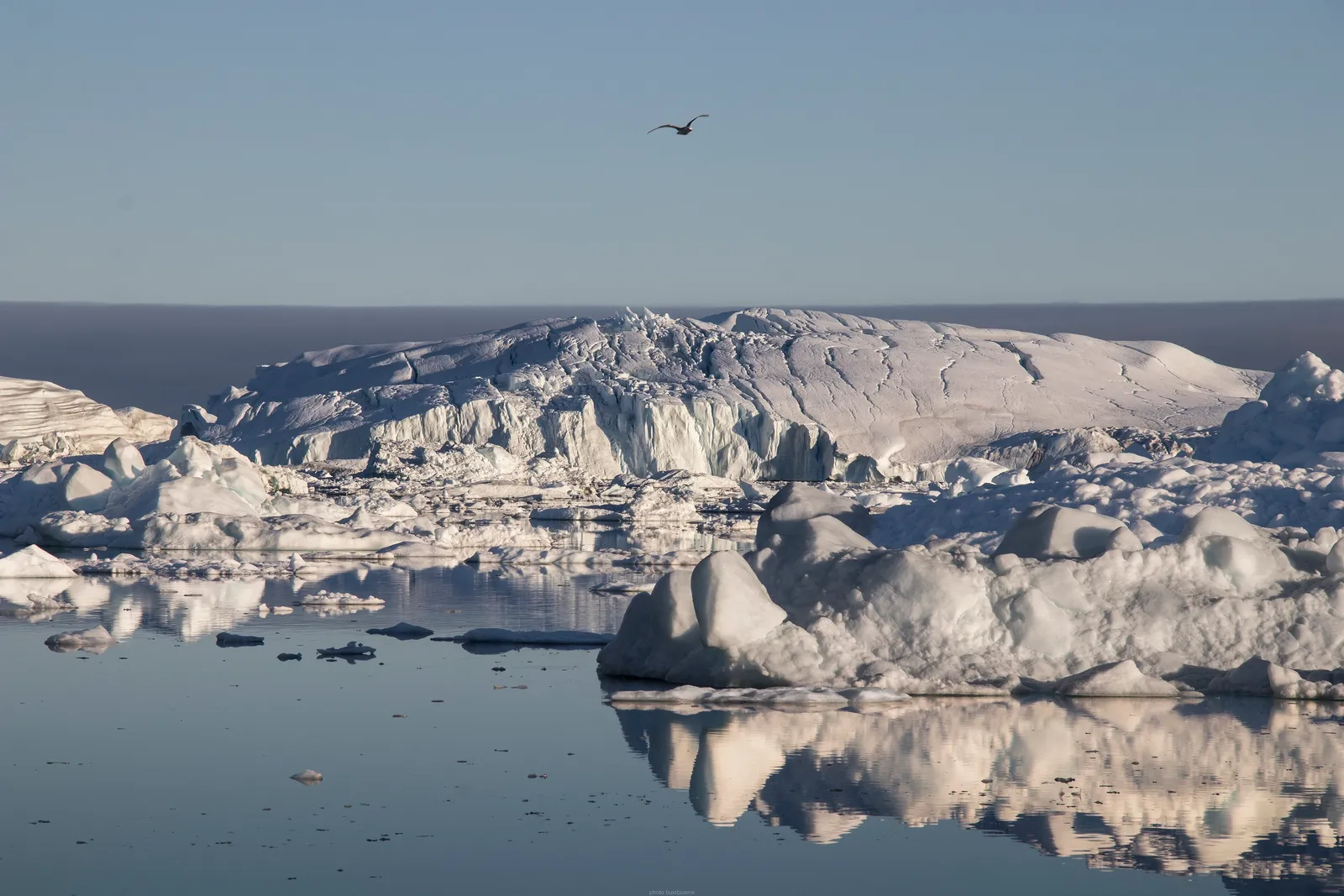
The glacier Sermeq Kujalleq, known in Danish as Jakobshavn Isbrae, in Disko Bay on the west coast, is one of the fastest-moving and most prolific iceberg-producing glaciers in the world: in some years it discharges more than forty cubic kilometres of ice into the ocean. The iceberg that sank the Titanic in 1912 most likely originated from the glaciers of Greenland's west coast. The Ilulissat Icefjord, inscribed as a UNESCO World Heritage Site in 2004, is the most accessible gateway to this spectacle of ice in motion.
The fiords and the sea ice
Greenland's coastline is cut by thousands of fiords, some of them hundreds of kilometres long. In the south and west, summer fiords are navigable and offer scenes of an almost unreal beauty: rock walls dropping vertically to the water, icebergs in every conceivable shape — some as large as multi-storey buildings, blue and translucent on their exposed faces — and, at the back of the fiord, an absolute silence broken only by the cracking of ice or the wind on the cliffs.
In the north and east the situation is more extreme. Scoresby Sound, on the east coast, is the world's longest fiord at more than three hundred kilometres, and sea ice persists there much later in the season. Expedition ships that venture into these waters navigate among drifting sea-ice pans in a landscape that rarely has any human presence in it. The Arctic wildlife here — narwhals, bowhead whales, polar bears, Arctic foxes, musk oxen, reindeer — is wilder and less accustomed to human presence than in Svalbard.
Inuit culture: four thousand years of adaptation
The ancestors of today's Greenlanders arrived on the continent in successive migratory waves from northern Canada. The Saqqaq culture appeared around four thousand five hundred years ago; the Dorset culture followed; finally, the Thule culture, the direct ancestor of modern Greenlandic Inuit, spread across all of Greenland around eight hundred years ago. This cultural continuity is not merely history: the techniques of kayak construction, caribou and seal hunting, hide clothing and language are living inheritances actively transmitted today.
The Kalaallisut language — West Greenlandic, the official language alongside Danish — is a polysynthetic language of extraordinary grammatical complexity in which long, intricate words express what other languages would need entire sentences to say. Young Greenlanders grow up navigating simultaneously between Scandinavian modernity — Greenland is an autonomous territory of the Kingdom of Denmark — and the traditions of their grandparents. In communities like Ilulissat, Sisimiut or Tasiilaq, hunters still go out onto the ice on dog sleds and in kayaks, not as tourist performance but as a way of life.
The Norse and the riddle of their disappearance
Greenland was colonised by Norwegian Vikings around 985, led by Erik the Red, who had been exiled from Iceland and found land on the other side of the Denmark Strait. He established two settlements — the Eastern Settlement, near present-day Qaqortoq, and the Western Settlement, near present-day Nuuk — which prospered for several centuries and came to hold thousands of people. The ruins of these farms and of the Romanesque churches they built are still visible in the south.
By the middle of the fifteenth century, the Norse settlements of Greenland had disappeared. Why is one of the great debates of medieval history: the climatic deterioration of the Little Ice Age, the collapse of trade with Europe, conflicts with the Inuit, and a cultural rigidity that prevented adaptation to the Arctic way of life — all of these factors probably contributed. What makes the case particularly striking is the contrast with the Inuit, who not only survived the same climatic cooling but expanded their territory during that very period.
Nuuk and the southern settlements: the human face
Nuuk, Greenland's capital with around eighteen thousand inhabitants, is a city of surprising contrasts: apartment blocks in vivid colours alongside the harbour, a national museum containing the Qilakitsoq mummies — fifteenth-century Inuit bodies preserved by the cold and dry air, of extraordinary archaeological significance — and restaurants serving dishes built on seal, whale and reindeer alongside traditional Danish cooking. The Greenland National Museum in Nuuk is an essential stop for contextualising everything the traveller will see afterwards.
Further south, the Qaqortoq and Narsarsuaq region holds the most accessible Norse remains, a more abundant summer vegetation — including small forests of dwarf birch and Arctic willow — and the exceptional colours of the Arctic summer. The Disko region on the central west coast is the hub of access to the Ilulissat Icefjord and the Sermeq Kujalleq glacier. The most complete expedition itineraries combine several of these scenes, sailing south to north or the reverse in small ships that can enter fiords and bays inaccessible to larger cruise vessels.
How to travel to Greenland
Greenland has no roads between its towns: transport is by air (Air Greenland operates a dense network of short internal flights), by ship or, in winter, by dog sled and snowmobile. International flights enter primarily from Copenhagen to Nuuk (around four hours) or to Kangerlussuaq (the former American Sondrestrom base, now the main internal air hub). Seasonal flights from Reykjavik serve several destinations.
The small-ship expedition season runs from June to August, with July as the most stable and accessible month. Groups are small — expedition ships suited to Greenland's fiords rarely carry more than a hundred passengers, and the best considerably fewer. Luggage and expectations should be calibrated for meteorological variability: storms can arrive quickly, and the experience of being stranded in a village of fifty people for a day of dense fog is not a setback but, frequently, the most memorable moment of the trip.
Quick answers
Do I need a visa to visit Greenland?
Greenland is an autonomous territory of the Kingdom of Denmark and belongs to the Danish realm but not to the European Union or the Schengen Area. Citizens of many countries (including the EU, the USA, Canada, Australia and others) can enter without a visa for tourist stays of up to three months. The standard entry is via Denmark or Iceland, whose own entry requirements apply to transit.
What is the difference between travelling to the north and south of Greenland?
The south is more accessible, has more summer vegetation, the Norse ruins and the Narsarsuaq fiord. The central-west, around Ilulissat and Disko Bay, offers the most impressive spectacle of icebergs and access to the Sermeq Kujalleq glacier. The north and east are far more remote and require specialist expedition ships; the east, around Tasiilaq and Scoresby Sound, is probably the wildest and least-visited Arctic landscape in the world.
Can you see the northern lights in Greenland?
Yes. Greenland lies beneath the auroral oval for much of the year. The best time to see them is from September to March, when there is enough nocturnal darkness. In summer the midnight sun makes auroras invisible. Auroral activity depends on the solar cycle and sky clarity; the northern and eastern regions offer the best conditions due to lower light pollution.
What wildlife can be seen in Greenland?
Greenland's Arctic wildlife includes polar bears (mainly in the north and east), reindeer, musk oxen (in the northeast), Arctic fox, ringed seals, bearded seals, narwhals, bowhead whales, belugas and, in the more open waters of the south, humpback whales and orcas. The seabird colonies on the coastal cliffs are also spectacular.
Let the reading become a route.
When an article sparks something, our planners are the next step. Tell us what you are dreaming of.