Holi: India's Festival of Colour that Dyes a Nation
For two days each spring, India stops and erupts in clouds of coloured powder. Holi is the most jubilant Hindu festival of the year, and experiencing it in the country is an intensity few journeys can prepare you for.
There are few experiences in the world that arrive at the senses with quite the raw force of Holi. Not in any bad sense, but in the most literal one: the sharp smell of coloured powder mixed with water; the blunt impact of a water balloon; the joyful chaos of a street turned into a canvas; the yellow on your teeth and the green in your ears hours later. Holi is the great Hindu spring festival, celebrated on the full moon of the lunar month of Phalguna, which falls between February and March. It is also, in essence, the festival of equality: for a few hours, social hierarchies, ages, genders and economic classes dissolve under the same cloud of powder.
The festival has roots in Hindu mythology — it celebrates the victory of good over evil, in particular the story of Prahlada and the demoness Holika, from whom its name derives — but its lived dimension is above all sensory and social. In cities such as Vrindavan and Mathura in Uttar Pradesh, where tradition says Krishna played as a child, the celebrations extend for days or weeks. In Varanasi, Holi takes a different character, played in the days before the main festival with ash from the cremation ghats. In Rajasthan it assumes different forms from village to village. India is large enough that Holi is not one festival but many, celebrated under the same name.
Holika Dahan: the fire that comes before the colour
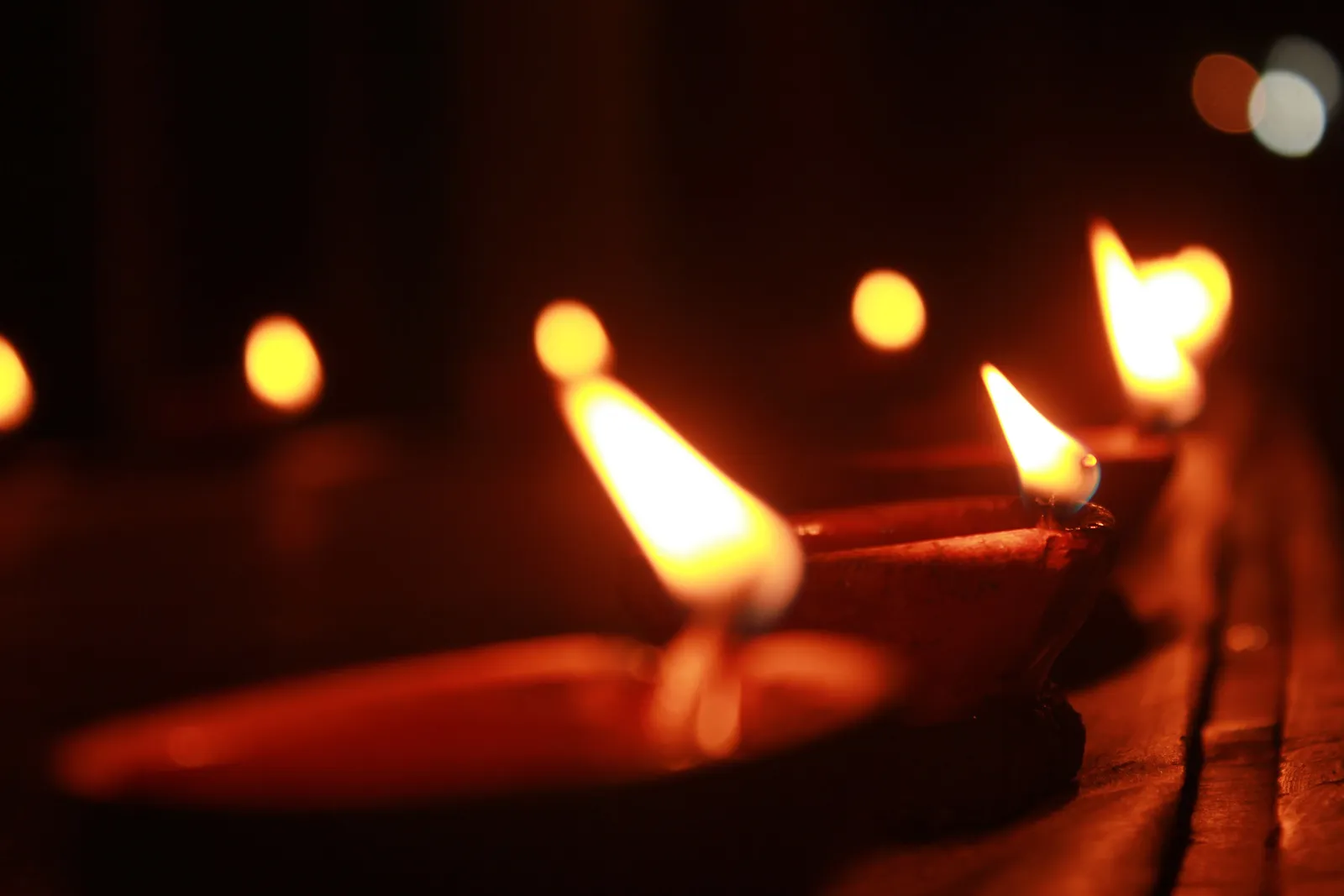
Holi is in fact a two-day festival. The eve — Holika Dahan — is marked by the lighting of large bonfires in squares and at crossroads to commemorate the destruction of the demoness Holika. The legend holds that Holika attempted to kill the devout Prahlada by sitting with him in a fire, but her immunity to flames failed her because she had misused it, and it was she who burned while Prahlada emerged unharmed. The bonfires are prepared for days beforehand with wood, straw and sometimes effigies; people walk around them clockwise, singing and offering coconuts and fresh grain — the symbol of the newly harvested crop.
This vigil has a more contemplative and ritual character than the following day. Families gather, specific sweets are prepared — in particular gujiya, a deep-fried pastry filled with khoya, dried fruit and sugar that is the quintessential Holi sweet — and everything old and unwanted from the ending year is symbolically burned. The fire is the threshold: when it dies down and the smoke disperses, the colour Holi begins.
The day of colour: how it works and what to expect
On the morning of the main day of Holi — known in some states as Dhuleti or Dhulandi — people take to the streets with bags of gulal (coloured powder in shades of red, pink, orange, yellow, green, blue and purple), water pistols and balloons filled with coloured water. The unwritten rule is that anything goes between willing participants: powder is thrown, water is poured, strangers are embraced. Colour is the day's universal language, and the person who arrives clean at midday has committed a kind of social faux pas.
The most intense celebrations happen between dawn and midday; from around two in the afternoon most cities begin to quieten. People bathe, change, visit family and friends, and share the festival's food. For a foreign visitor, participation is the only real way to understand Holi: watching from a distance produces photographs but not the understanding of what it means for an entire country to decide, for one day, that ordinary life can wait.
Where to experience it: Vrindavan, Varanasi and beyond
Vrindavan and Mathura in Uttar Pradesh are the most celebrated centres of Holi. In this region, the mythical land of Krishna, the nearby villages of Barsana and Nandgaon hold Lathmar Holi days before the official date: the women of Barsana chase the men of Nandgaon with wooden staves (lath) while the men defend themselves with shields, re-enacting a game said to have been played by the young god. It is chaotic, physical, genuinely festive and deeply rooted in local devotion.
Varanasi has its own character: Holi in the sacred city on the Ganges includes a massive gathering on the ghats and a procession of powder-covered sadhus that lends a spiritual dimension hard to find elsewhere. Jaipur celebrates the festival with a particular energy in the old city, where the pink powder sold in the dyers' quarter is the purest in the city. For those seeking a more intimate experience, rural villages in Rajasthan or southern Gujarat offer a courtyard-and-family Holi that contrasts luminously with the chaos of the large cities.
The food of Holi: sweets, thandai and the tradition of bhang
Like all great Indian festivals, Holi has its own food. Gujiya — the fried pastry filled with khoya that households prepare for days — is the central sweet. Puran poli is another classic in Maharashtra: a flatbread stuffed with sweet chana dal and spices. Malpua (pancakes fried in sugar syrup) and dahi bhalle (lentil dumplings in spiced yogurt) are staples at family tables across the north.
Thandai is the drink of the day: a cold spiced milk prepared with almonds, melon seeds, rose petals, cardamom, pepper, cinnamon, saffron and, in many cases, an infusion of cannabis seeds known as bhang. Bhang is legally consumed in many Indian states during Holi and has centuries of history within the festival context; it is sold openly at government shops in states including Rajasthan and Uttar Pradesh. Visitors should know that its effects are real and can be surprisingly potent.
The deeper meaning: seasons, fertility and reconciliation
Beyond its Hindu mythology, Holi is at its root an end-of-winter agricultural festival celebrating the spring harvest — the rabi, in northern India — that has existed in some form since before the Vedic period and shares its logic with other social-inversion festivals around the world: European Carnival, the Thai Songkran, the fertility rites of ancient Rome. The colour that is thrown is a way of marking the end of the dark, cold season; the bonfire the night before burns evil and cold together.
There is also in Holi a dimension of social reconciliation. It is a tradition to visit enemies and rivals during the festival, exchanging sweets and powder as gestures of peace. Grudges are expected to be left behind with the smoke of Holika. It does not always work in the complex reality of daily life, but the aspiration is written into the festival: spring is a new beginning, and the colour that equalises everyone is its reminder.
How to prepare for participation
Three practical points are universal for Holi. First: wear clothes you are prepared to ruin permanently — commercial colour powder is very difficult to remove completely. Second: protect your camera and phone in a waterproof bag and leave them away during the most intense moments. Third: bring sunglasses or swimming goggles to shield your eyes from powder, which can cause irritation, though natural plant-based powder is gentler than the synthetic plastic powder that unfortunately also circulates.
Participation is the key. Holi observed from a window is an anecdote; Holi lived in the street, covered in yellow and orange, arms extended to receive or throw powder at the laughing stranger in front of you, is one of the rare travel experiences that genuinely transforms your perception of the world. There are few moments in which the barrier between traveller and place dissolves so completely — and so joyfully.
Quick answers
When does Holi take place?
Holi is celebrated on the full moon of the Hindu month of Phalguna, which falls in the Gregorian calendar between late February and late March. The exact date varies each year. Vrindavan and Mathura begin celebrations one to two weeks early with Lathmar Holi. In 2026 the main Holi falls on 3 March.
Is Holi safe for foreign travellers?
Holi is generally a very welcoming festival for visitors, but it is advisable to attend with a guide or local hosts, particularly in large cities. Recent years have seen reports of inappropriate behaviour at some urban celebrations, so attending in a group and staying in well-populated areas is recommended. Village celebrations and those organised at temples tend to be more family-oriented and safer.
Does the colour powder stain permanently?
Commercial colour powder can stain skin for several days; hair may stay tinted for a week or more. Clothing is usually permanently stained. Natural plant-based powder — easier to find in Vrindavan and at specialist shops — is gentler on the skin and washes out somewhat better from fabric. Applying coconut oil to skin and hair before going out acts as a protective barrier.
Where is the most spectacular Holi celebrated?
Vrindavan and Mathura are the reference points for their history and duration: the Lathmar Holi of Barsana is unique. Varanasi adds the spiritual dimension of the Ganges ghats. Jaipur has a highly visual celebration in its old city. Delhi celebrates Holi with great energy across many neighbourhoods. For a more intimate and less crowded experience, villages in Rajasthan and Gujarat are preferable to large cities.
What is bhang and is it legal?
Bhang is a preparation of cannabis leaves and seeds mixed into drinks and sweets during Holi. It has a traditional role in the festival and is permitted by authorities in several Indian states — including Rajasthan and Uttar Pradesh — in the context of the festival. Its psychoactive effects are real and can be intense; anyone without experience of cannabis should take minimal quantities or avoid it. It is not legally sold or consumed outside the festival period in most states.
Let the reading become a route.
When an article sparks something, our planners are the next step. Tell us what you are dreaming of.