How Overland Travel Changes What You See
Travelling by land does not just change how long a journey takes. It changes what the journey is made of — the things you notice, the way places connect, the kind of memory you carry home.
It is easy to think the difference between flying and travelling overland is simply duration — that the slow way is the fast way with more hours added. It is not. Overland travel changes the actual content of a journey: the proportion of it you spend looking at the world, the transitions you witness, the people you fall into conversation with, the texture of what you bring home. The clock is the least of it.
This article is less a how-to than a reflection on that change. It sets out what, specifically, shifts when you cross a region by train, ship and road instead of overflying it — and why that shift is the reason Viajes Globales builds journeys the slow way. The argument is not that flying is wrong. It is that the ground gives you a different, and we think richer, kind of seeing.
You see the joins
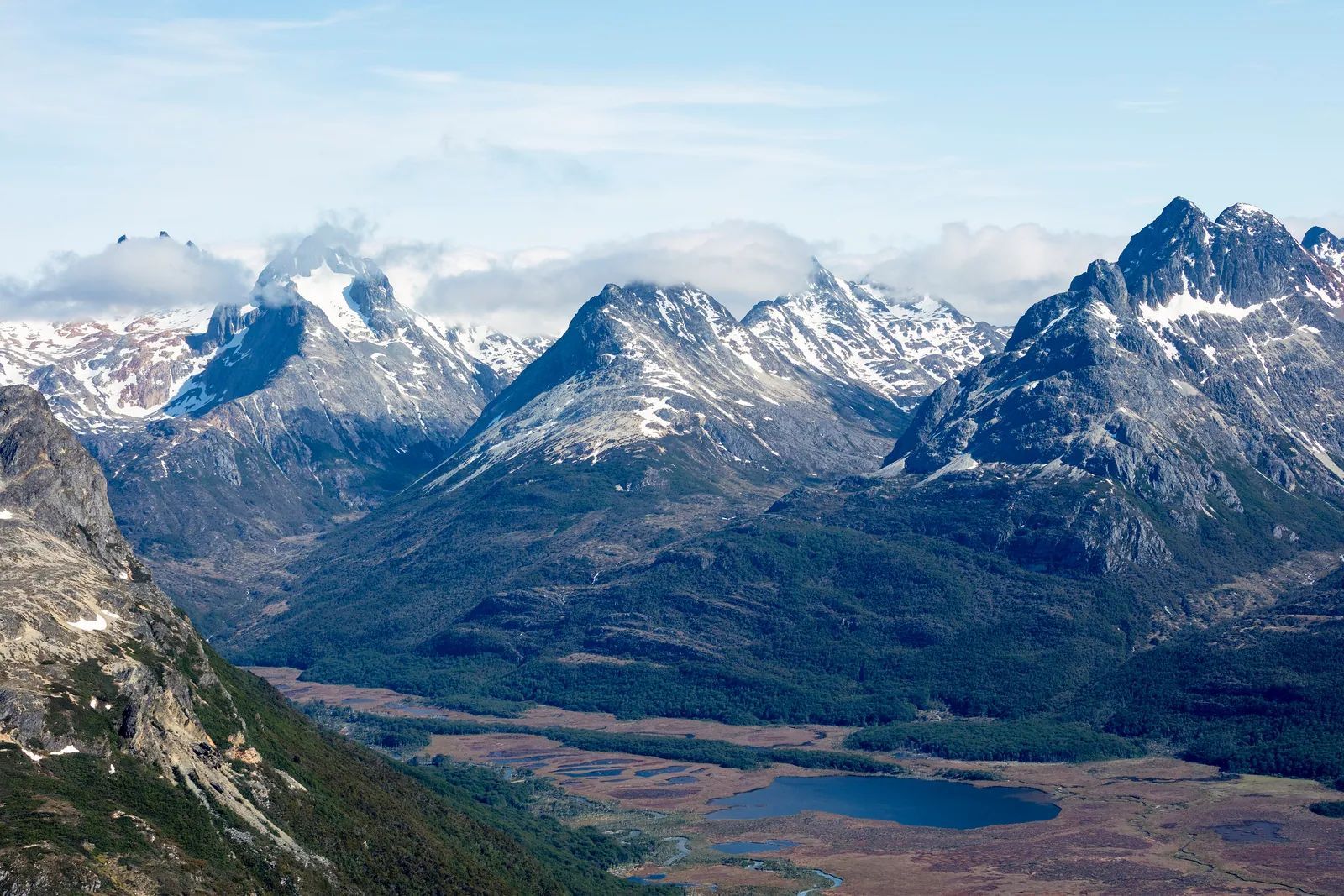
Flying gives you a journey made of destinations with nothing between them — a string of beads with no thread. Overland travel restores the thread. You see how the desert becomes farmland, how one language gives way to the next, how a mountain range builds and falls. The country stops being a set of separate places and becomes a continuous, comprehensible whole.
This is the deepest change, and it is cumulative. By the end of an overland journey you can hold the whole route in your mind as a single line, because you were present for every transition along it. That is why a traveller finishing Andes to Antarctica or The Long Way East can describe not just the highlights but the country between them — the journey has a shape, not just a set of stops.
You see ordinary life, not just landmarks
Air travel delivers you to the curated places: the old town, the famous site, the viewpoint. These are worth seeing, but they are a country's exceptions, not its substance. Overland travel routes you through the ordinary — the working edges of cities, the farmland, the market towns, the unremarkable middle of a region where most people actually live.
From a train window or a ferry deck you watch the everyday: fields being worked, goods being moved, children walking to school, the same actions a guidebook never lists. This is not lesser travel than the landmark kind; it is the context that makes the landmarks legible. A monument means more when you have crossed the country that built it and seen the lives lived around it.
You see the scale of distance
A flight tells you two cities are two hours apart. It does not tell you how far apart they really are. Overland travel restores the true sense of distance — the felt knowledge of how vast a desert is because you crossed it for a day, how high a mountain range stands because the train laboured up it for hours. Scale stops being a number and becomes an experience.
This changes how you understand history and geography ever after. The Silk Road's length, the reach of an empire, the isolation of a remote valley — these become real once you have spent your own days covering the ground. A traveller who has crossed a continent overland carries a calibrated sense of the world that no map or flight can supply.
You see at a speed you can absorb
There is a human limit to how fast the world can be taken in. At walking pace, or the pace of a boat or a train, the eye and mind can actually process what passes — the detail of a hillside, the change in the architecture, the faces at a station. At the speed of an aircraft, the world is simply a texture far below, too fast and too distant to read.
Slower travel returns the world to a legible speed, and with it returns attention. The hours on a train or a deck are not empty time to be filled with a screen; they are the time in which seeing actually happens. Much of what travellers remember most vividly from a grand journey turns out to be these in-between hours — not because nothing else was memorable, but because this was when they were truly looking.
You come home with a different kind of memory
All of this adds up to a change in what you bring home. A journey of flights between destinations tends to be remembered as a list — places visited, things seen, separate and unconnected. An overland journey is remembered as a narrative, with a beginning, a direction and an end, because that is how it was actually lived: one continuous movement across the surface of the world.
That is the case for the slow line, and it is why our journeys are built around it. We use a flight where distance or sense demands one, but the ground is the default, because the ground is what gives a journey its thread. Travel overland and you do not simply visit more carefully — you come home with a journey you can tell as a single, coherent story, which is the most lasting souvenir there is.
Quick answers
Isn't overland travel just flying with extra hours added?
No — it changes the content of the journey, not only its length. Travelling by land lets you see the transitions between places, the ordinary life of a region, and the true scale of distance, all at a speed your senses can actually absorb. The result is a journey remembered as a continuous story rather than a disconnected list of destinations.
What does overland travel let you see that flying doesn't?
The joins between places — how landscapes, languages and cultures shift from one to the next; everyday life rather than only landmarks; and the genuine scale of distance, felt rather than abstract. It also returns the world to a speed slow enough to truly look at. Flying delivers destinations; overland travel delivers the country between them, which is what makes the destinations make sense.
Do your journeys travel entirely overland?
The ground is the default, but not an absolute rule. We travel overland by train, ship and road wherever the route is rewarding, and use a flight where distance or practicality genuinely calls for one — to cross an ocean, or to skip a region with no sensible land route. The aim is a journey with a continuous, coherent thread, which overland travel is simply the best way to achieve.
Let the reading become a route.
When an article sparks something, our planners are the next step. Tell us what you are dreaming of.