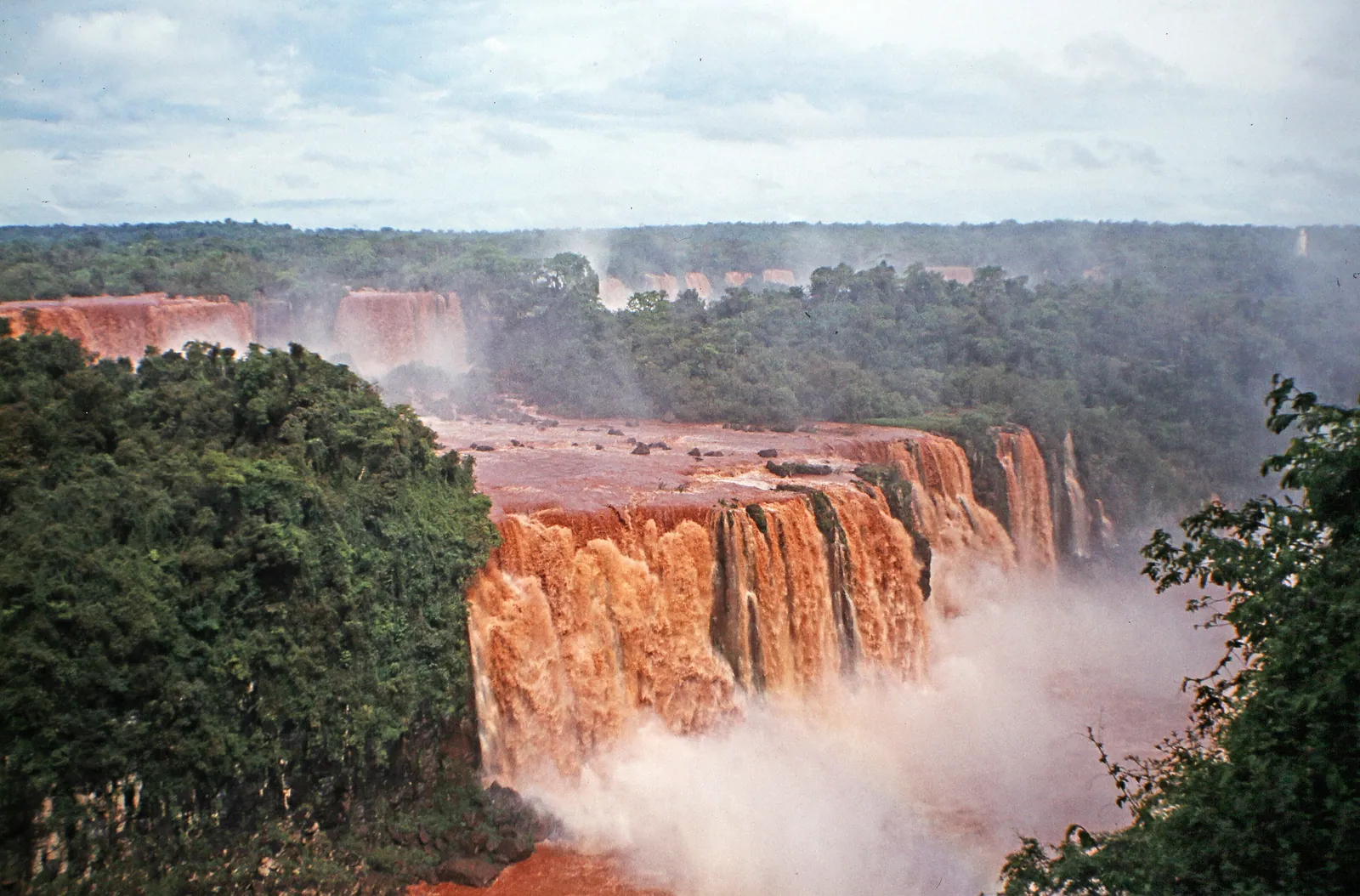
Iguazu Falls: Two Countries, One Cascade
The largest waterfall system on Earth straddles the border of Argentina and Brazil, and seeing it from both sides is not a luxury — it is a different experience each time.
Iguazu is not one waterfall. It is a horseshoe of up to 275 individual falls spread across nearly three kilometres of the Iguazu River, which marks the border between Argentina and Brazil at the point where it plunges over a basalt escarpment into a canyon below. In sheer volume and breadth, Iguazu surpasses both Niagara and Victoria Falls, and the American first lady Eleanor Roosevelt, visiting in 1958, is said to have looked at them and remarked that Niagara was suddenly nothing.
The falls sit at the meeting point of three countries — Argentina, Brazil and Paraguay converge just upstream — in a region of subtropical rainforest that belongs to the same Atlantic Forest biome as coastal Brazil. Two national parks flank them, one on each side of the border, and both are UNESCO World Heritage sites. On the Andes to Antarctica journey, Iguazu is reached on the way south and stands apart from everything else on the route: it is a purely humid, forested, loudly tropical experience in a journey otherwise dominated by altitude and ice.
The Garganta del Diablo
The centrepiece of the system is the Garganta del Diablo — the Devil's Throat — a U-shaped canyon roughly 150 metres wide and 700 metres long into which the Iguazu River funnels the bulk of its water. At the Garganta, the river does not cascade so much as annihilate itself: the fall drops around 82 metres and the mist column above it is visible from kilometres away, rising in a permanent cloud over the forest.
The Argentine side offers the closest approach. A system of elevated walkways reaches to within a few metres of the lip, and at peak flow the spray soaks you completely before you even reach the railing. This is the place to come early: the light hits the mist from the east in the morning, firing rainbows across the curtain of water, and the crowds are thinner in the first hour after the park opens.
The Argentine side: walking inside the falls
Parque Nacional Iguazú on the Argentine side is designed for immersion. An extensive network of walkways at multiple levels — upper, lower and catwalks over the river — puts you beside, beneath and occasionally inside the spray of individual falls. The lower circuit places you at water level, looking up at the cascades from the canyon floor; the upper circuit brings you to the edge of the falls themselves, looking down into the gorge.
Boat excursions launch from the lower circuit and motor directly into the base of the falls, a deliberately drenching experience best suited to those for whom getting soaked is the point. Beyond the spectacle, the Argentine park rewards slow walking: coatis — the long-nosed South American relatives of the raccoon — move through the undergrowth and beg shamelessly near the restaurants, toucans work the forest canopy, and the paths between circuits traverse secondary Atlantic Forest that is alive with birdlife.
The Brazilian side: the panorama
Parque Nacional do Iguaçu on the Brazilian side offers the opposite experience: one long, wide-angle view of the Argentine falls from across the canyon. A single main path runs along the canyon rim for about 1.2 kilometres, from the hotel above the park to a platform at the edge of the Garganta, and from it you can see almost the full arc of the system laid out before you.
What the Brazilian side sacrifices in intimacy it gains in scale. From here you grasp the full three kilometres of falling water at once — a perspective that the Argentine walkways, for all their closeness, cannot give you. The light is best in the afternoon on the Brazilian side, with the sun behind you illuminating the falls. If you can visit both, the sequence of Argentine morning and Brazilian afternoon is the classic combination, and the contrast between the two perspectives makes each sharper.
The forest and its wildlife
The falls are embedded in one of the most biodiverse forest systems in South America. The Atlantic Forest of the Iguazu region is home to jaguars, tapirs, giant anteaters and capybara, though these larger animals are rarely seen. What the traveller sees more readily are the birds: over 400 species have been recorded in and around the parks, including the great dusky swift that nests behind the curtains of water itself, emerging in wheeling flocks at dusk.
The surrounding landscape is subtropical and dramatically green, a complete contrast to the Andean and Patagonian landscapes that occupy most of a southern South America journey. The air is thick and warm, the vegetation is layered and loud, and the light is different — diffuse and luminous rather than the sharp, high-altitude clarity of the mountains. Iguazu is a reminder of how much variety the continent holds.
Getting there, and spending the time well
Iguazu is reached by air from Buenos Aires or São Paulo to the airports on each side of the border — Puerto Iguazú in Argentina and Foz do Iguaçu in Brazil. The two towns are close to each other and connected by an international bridge. A stay of two or three nights covers both parks comfortably, with time left for a sunset on the river and a visit to the Itaipu dam, the vast hydroelectric structure just downstream whose reservoir begins where the falls end.
The falls are open year-round, though the volume of water is greatest in late austral summer and autumn — February to April — when the rainy season swells the Iguazu River to its maximum. In drought years the flow can thin noticeably, and the Garganta in particular loses some of its force. The forest, however, is always green, and the wildlife watching is good in all seasons.
Where Iguazu fits in the wider journey
Iguazu occupies a peculiar and satisfying position in a journey down South America. It is humid, tropical and low-altitude — roughly 150 metres above sea level — and it arrives, in a typical itinerary, as a transition: the last great spectacle of the subtropical north before the long haul south into Patagonia. From the spray of the Garganta to the ice of Perito Moreno is a journey through almost every climate the continent offers.
It is also, in the plainest sense, one of the most overwhelming natural experiences on the continent. The falls are not subtle. They announce themselves with sound long before they are seen, and they leave the kind of impression that resists being filed away as merely one more item on an itinerary. Travellers who have been to other great waterfalls almost always rank Iguazu first, and the travellers who visit it for the first time tend to understand why immediately.
Quick answers
Do I need to visit Iguazu from both sides?
Visiting both sides is strongly recommended, and they offer genuinely different experiences rather than the same view twice. The Argentine side puts you beside and beneath the falls on an extensive walkway network; the Brazilian side gives you a wide panorama of the full arc of the system from across the canyon. The classic combination is Argentine morning for the Garganta del Diablo at close range, and Brazilian afternoon for the full panoramic perspective.
When is the best time to visit Iguazu Falls?
The falls are open and impressive year-round. Water volume is generally highest from February to April, when the rainy season has filled the Iguazu River, and the Garganta del Diablo is at its most dramatic. The dry season from June to September brings lower water but clearer skies and easier walking. Avoid Argentine school holidays if you want smaller crowds.
Is Iguazu safe to visit?
Both parks are well managed with good infrastructure, and the falls themselves are safely viewed from walkways and platforms. The border region has the usual precautions of any busy tourist area — secure your belongings, use official transport, and follow park rules. The parks close in severe weather, and rangers will restrict access to the Garganta del Diablo if the river is dangerously high.
What wildlife is likely to be seen at Iguazu?
Coatis are almost guaranteed — they move freely through the Argentine park and are bold near food areas. Toucans, great dusky swifts, swallows and many other birds are visible throughout the day. Capybara can sometimes be seen near the river. Jaguars and tapirs live in the parks but are rarely encountered by visitors. Birders should allow extra time: over 400 species have been recorded in the region.

Let the reading become a route.
When an article sparks something, our planners are the next step. Tell us what you are dreaming of.