Jemaa el-Fnaa and the Souks of Marrakech
The great square of Marrakech and the covered markets that spill north from it are the beating heart of the medina. Here is how the souks are organised, what Jemaa el-Fnaa becomes after dark, and how to enjoy both well.
Jemaa el-Fnaa is the vast open square at the centre of the Marrakech medina, and the souks are the warren of covered market streets that run north from it. Together they form the commercial and social core of the old city — the place where the medina's daily life is most concentrated and most visible.
What makes the square remarkable is not its appearance but its life. By day it is a busy crossroads; by night it transforms into an open-air theatre of food stalls, musicians and storytellers. That living performance tradition is so distinctive that UNESCO recognised it as a Masterpiece of the Oral and Intangible Heritage of Humanity. Knowing how the square and souks work lets a traveller meet them with confidence rather than confusion.
The square by day and by night
By daylight Jemaa el-Fnaa is comparatively open: orange-juice carts, water sellers in bright costume, and a scattering of performers occupy a wide, sunlit space. The minaret of the Koutoubia stands just to the south-west, and the square works mainly as a great hinge between the souks, the gardens and the wider medina.
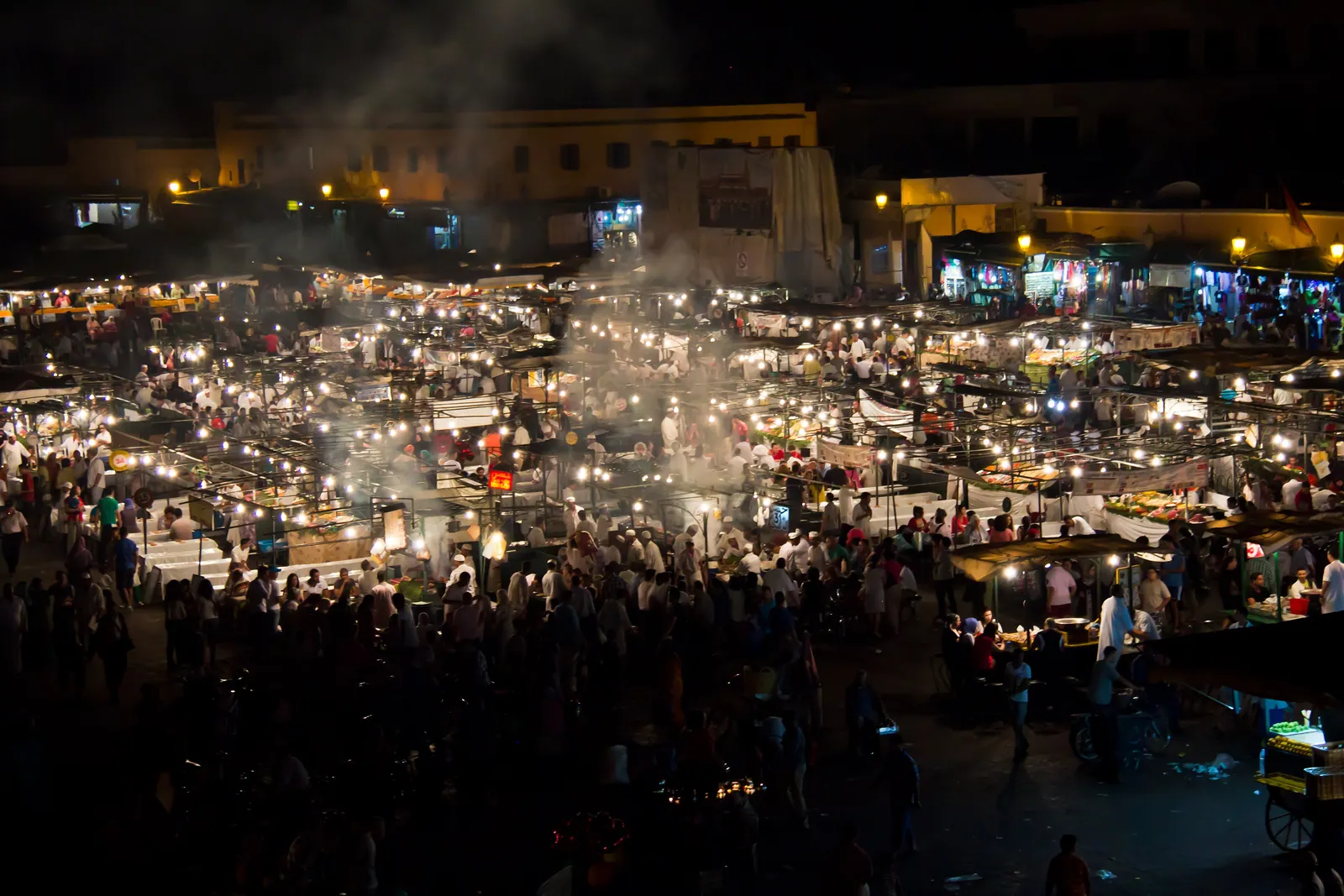
After sunset it changes entirely. Rows of food stalls are wheeled into place, their lamps and smoke filling the air; circles of onlookers gather around musicians, drummers, dancers and storytellers. The Arabic name is often translated as the assembly place — a square that has been a stage for public performance for many centuries. To watch it fill is one of the defining experiences of Morocco.
How the souks are organised
The souks of Marrakech run roughly northward from the square in a dense lattice of covered lanes, many shaded by slatted roofs that throw bars of light across the ground. Traditionally each trade had its own quarter, and the names survive: there are areas long associated with dyers, with leatherworkers, with metalworkers, woodworkers, slipper-makers and spice merchants.
This grouping by craft is the key to reading the souks. Rather than a single undifferentiated market, you are passing through a sequence of specialist districts. The Souk Semmarine, a broad main artery, is the usual point of entry; from it, smaller lanes branch toward the more specialised zones. Following a particular craft from lane to lane gives a wander structure and purpose.
The art of buying
In the souks, bargaining is a normal and expected part of trade for most goods — it is a social exchange, conducted with good humour, not a confrontation. A workable approach is to look first without committing, learn what similar items cost in several shops, and only then negotiate seriously where you genuinely intend to buy. Settling on a price you are happy with matters more than winning every dirham.
It helps to know what you are looking at. Marrakech is a centre for leather, carpets and rugs, lanterns and metalwork, ceramics, woodwork and the soft leather slippers called babouches. Quality varies widely, and a good local guide can point you toward reputable workshops and explain how a piece is made — context that turns a souvenir into something understood and valued.
Eating in the square
The night-time food stalls of Jemaa el-Fnaa are an experience in themselves. Numbered stands serve grilled meats and vegetables, harira soup, snail broth, fried fish and an array of salads, with bench seating shared among strangers. The scene is theatrical and the vendors lively in their calls for custom.
A few sensible habits make it enjoyable. Choose a stall that is busy with Moroccan diners and cooking food fresh to order, and confirm prices before you sit. Many travellers prefer to watch the square's spectacle from one of the rooftop cafés on its edge over a mint tea, then descend for a dish or two — a combination that gives both the view and the immersion.
The square on The Long Way East
On The Long Way East — the journey from Madrid that crosses from Spain into Morocco — Jemaa el-Fnaa is the social centre of the days spent in Marrakech. Staying in a riad within the medina, travellers can reach the square on foot, and we time at least one evening to coincide with its nightly transformation.
The souks reward more than a single visit. We treat them not as a shopping errand but as a way to meet the medina's working life — to see craftsmen at their benches and understand how the old city sustains itself. Returning at different hours, a traveller comes to feel the rhythm of the square, from its quiet morning to its crowded, luminous night.
Quick answers
Is bargaining expected in the Marrakech souks?
For most goods, yes. Negotiating a price is a normal and accepted part of trade in the souks, conducted as a friendly exchange rather than a dispute. The exception is fixed-price items such as food. A good approach is to browse several shops first to gauge prices, stay relaxed and good-humoured, and only bargain hard where you genuinely intend to buy.
Is the food in Jemaa el-Fnaa safe to eat?
It can be very good, with sensible care. Choose stalls that are busy with local diners and clearly cooking food fresh and hot to order, rather than those with food sitting out. Confirm the price before sitting down. Many visitors enjoy the square's atmosphere from a rooftop café and then eat a dish or two at a stall, which works well.
What can you buy in the souks of Marrakech?
Marrakech is a major centre for traditional crafts. The souks are known for leather goods, carpets and rugs, brass and copper lanterns and metalwork, ceramics, woodwork, spices, and the soft leather slippers called babouches. Quality and price vary widely between shops, so it helps to compare several and, where possible, to buy from workshops where you can see the craft being made.
Let the reading become a route.
When an article sparks something, our planners are the next step. Tell us what you are dreaming of.