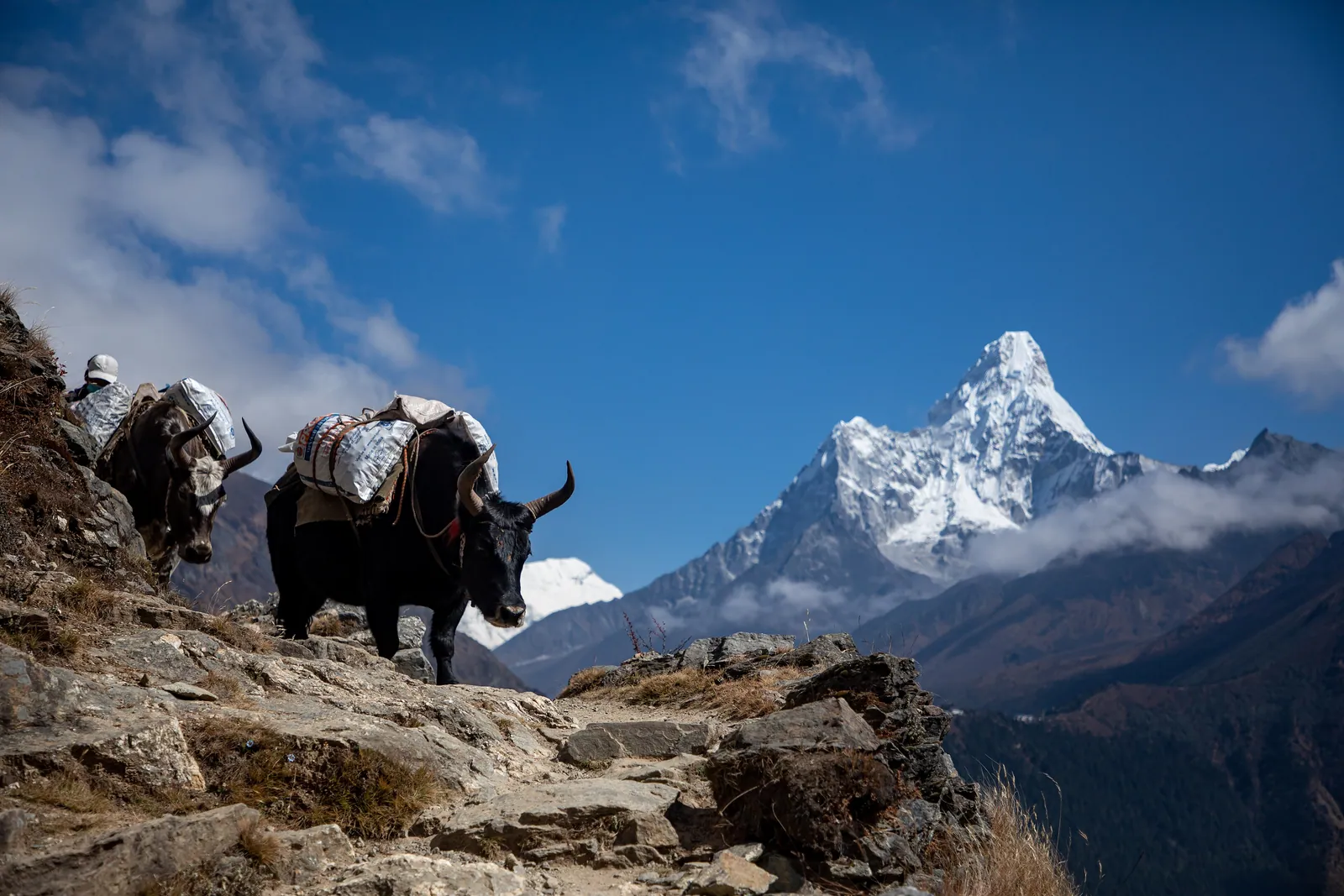
Ladakh: the High Desert of the Indian Himalaya
Perched between the Himalayas and the Karakoram at altitudes above 3,500 metres, Ladakh is a Tibetan Buddhist kingdom folded into the Indian state of Jammu and Kashmir — a land of monasteries, prayer flags, cold desert and some of the most extraordinary mountain scenery on Earth.
The road from Manali to Leh crosses two passes above 5,000 metres and takes two days to drive in summer, assuming the landslides cooperate and the border road commission's teams have cleared the winter debris. When you arrive in Leh — the medieval capital of the Ladakhi kingdom, now a town of perhaps 30,000 at 3,500 metres — you feel it immediately: the air is thin, the light is electric, and the landscape looks like nothing you have seen before. Red and ochre cliffs rise from the Indus valley floor; white-painted monasteries cling to summits above; rows of prayer flags rattle in a wind that seems to have come from Tibet, because it has.
Ladakh occupies a zone of extraordinary geographical and cultural confluence. It sits in the rain shadow of the Himalaya, which means it receives little precipitation and looks more like Tibet or the high deserts of Central Asia than anything in the Indian subcontinent — a cold, crystalline aridity utterly unlike the monsoon lowlands to the south. Yet it has been part of India since 1947, and its culture, shaped over centuries by Tibetan Buddhism and the trade routes connecting India to Central Asia, is one of the most intact and articulate in the Himalayan world.
The monasteries: sky-fortresses of the Tibetan world
The great gompas (monasteries) of Ladakh are among the finest examples of Tibetan Buddhist architecture outside Tibet itself, and they occupy positions that defy easy explanation — summits and spurs that could only have been chosen for their inaccessibility and their ability to survey the valley below. Thikse Gompa, perched on a conical hill above the Indus about 20 kilometres east of Leh, is the most photographed: twelve storeys of whitewashed and ochre buildings rising from the rock, topped by a gold-roofed assembly hall. The dawn light turns its walls warm amber; at the morning puja, monks wrap themselves in maroon robes and begin the liturgy before the valley floor has seen sunlight.
Hemis Gompa, the largest and wealthiest monastery in Ladakh, is the site of the Hemis Festival, usually held in June or early July on the anniversary of the birth of Guru Rinpoche (Padmasambhava): two days of sacred Cham dance, in which monks in brocade costumes and painted masks re-enact episodes from Tibetan Buddhist mythology, accompanied by long horns, cymbals and drums. Lamayuru, the oldest monastery in Ladakh — possibly dating to the 11th century — sits in a landscape of eroded clay formations unlike anything else in the region, a moonscape of pale badlands from which the gompa rises like a vision. These three alone constitute a journey.
The Indus valley and the old kingdom
The Indus River, one of the great rivers of Asia, rises in Tibet and flows through Ladakh before crossing into Pakistan. The Ladakhi valley of the Indus is the cultural heartland of the old kingdom: a strip of irrigated green against the brown desert, dotted with villages of flat-roofed stone houses, apricot orchards and fields of peas and barley at altitudes where, until the introduction of irrigation, nothing would grow. The Namgyal dynasty ruled this valley from the 15th century until 1842, when Dogra forces from Jammu conquered the kingdom; the old palace at Leh, modelled on the Potala in Lhasa and rising nine storeys above the town, dates from the 17th century.
Alchi Monastery, 70 kilometres west of Leh, is the most important art-historical site in Ladakh and one of the most significant in the Tibetan Buddhist world. Founded in the late 10th or early 11th century and never destroyed or rebuilt in the manner of later monasteries, it contains murals and wooden sculptures of extraordinary antiquity and sophistication — a stylistic bridge between Indian, Central Asian and Tibetan artistic traditions that scholars still travel here to study. The paintings in the Sumtsek (three-storeyed) chapel, depicting bodhisattvas of tremendous size with garments rendered in meticulous detail, are among the oldest surviving examples of Kashmir-school Himalayan painting.
Ladakhi Buddhism in daily life
Buddhism in Ladakh is not confined to monasteries. It is woven into the fabric of daily existence in ways that a visitor notices gradually: the mani walls of carved stone tablets inscribed with the mantra om mani padme hum that line every village path; the chortens (stupas) marking the entrances to settlements; the strings of prayer flags that flutter between buildings, trees and hilltops, sending their prayers into the wind with each movement. A Ladakhi home will have a prayer room, maintained by the household's eldest daughter, and a butter lamp that burns on special days.
The Ladakhi Buddhist calendar generates a cycle of festivals throughout the year, many of them celebrated with Cham dances performed by the monks of the local gompa. In the winter months, when the high passes are closed and outside visitors absent, these festivals revert to their original social function: gathering the scattered villages of a valley for prayer, celebration and the renewal of community bonds. The Losar festival (Tibetan New Year, usually in January or February) is the most important of these winter celebrations — celebrated quietly by families in Leh, but with particular energy in the outer villages of Zanskar and the Nubra Valley.
The landscape: trekking Ladakh's high ground
Ladakh's landscape is the primary draw for many travellers: a cold desert of extraordinary scale and colour, ringed by mountain ranges that include some of the highest peaks on Earth. The Stok Kangri, at 6,153 metres, is the highest summit accessible to fit and acclimatised non-technical climbers and is attempted each summer by hundreds of people. The Markha Valley trek, a classic six-to-nine-day crossing of the Stok and Zanskar ranges south of Leh, takes walkers through remote villages where families still follow the patterns of seasonal transhumance, past ruined forts and over passes above 5,200 metres, with views of Kang Yatse and the Karakoram peaks beyond.
The Zanskar Valley, accessible by a road that is closed for most of the year, is the most remote inhabited region of Ladakh: a Buddhist kingdom within a kingdom, culturally distinct and geographically isolated by ranges on every side. In winter, the Chadar trek follows the frozen surface of the Zanskar River through its gorge for several days, one of the most demanding and atmospheric cold-weather walks available anywhere in the Himalayan world. The river surface is the only road; the canyon walls are 300 metres of sheer vertical rock; the temperature at night drops far below freezing. It is, by any measure, extraordinary.
The Nubra Valley and Pangong Tso
North of Leh, the road crosses the Khardung La — at 5,359 metres elevation one of the highest motorable passes in the world — and descends into the Nubra Valley, a river valley of sand dunes, orchards and double-humped Bactrian camels that was once the main route between Ladakh and the trading cities of Central Asia. The camels are a remnant of the caravan trade that once sustained the Silk Road's Himalayan branch; they are now photographed by tourists, but the dunes at Hunder where they wander, with the 7,000-metre peaks of the Saser Kangri massif behind them, produce an image of startling improbability.
Pangong Tso, the long high-altitude salt lake that straddles the Indian-Chinese border some 150 kilometres southeast of Leh, is one of the most photographed bodies of water in Asia. Its colour shifts through the day from jade to cobalt to a deep, almost impossible blue, depending on the angle of the light and the turbulence of the wind; at 4,350 metres, it sits in a treeless valley of brown hills that make the colour of the water more extraordinary by contrast. Camping on its shore, in total silence broken only by the lap of the water and the cry of bar-headed geese overhead, is one of the essential Ladakhi experiences.
When to go and practical considerations
The travel season in Ladakh is defined by the mountain passes. The main road from Manali (Rohtang Pass and Baralacha La) typically opens in late May or early June and closes again in October or November; the Srinagar–Leh highway via the Zoji La opens slightly earlier and closes slightly later. Between these windows, Ladakh is accessible only by air, with flights from Delhi and other Indian cities to Leh. The high summer (July and August) is the warmest period but also the most crowded; June and September offer better weather and thinner crowds.
Acclimatisation is essential and non-negotiable. Arriving in Leh by air from sea level and attempting strenuous activity on the first day is a reliable route to altitude sickness; the standard advice is to rest for at least two full days, drink large quantities of water and avoid alcohol and exertion. Our itineraries build this time in as a matter of course, using the acclimatisation days for gentle exploration of Leh's old town and the valley monasteries nearest the capital. Ladakh rewards patience: the landscape does not need to be rushed, and the altitude will not allow it.
Quick answers
Do I need a permit to visit Ladakh?
Foreign nationals require an Inner Line Permit (ILP) to visit several areas of Ladakh, including the Nubra Valley, Pangong Tso and the Dah-Hanu region. These permits are obtainable online through the Jammu and Kashmir government's official portal, or through a registered travel agency in Leh, and are generally straightforward to arrange. Areas of Ladakh close to the Chinese and Pakistani borders may have additional restrictions that change periodically; verify current requirements before travel.
How bad is the altitude in Ladakh, and how should I prepare?
Leh sits at 3,500 metres, and many of the places travellers want to visit are significantly higher — passes, lakes and trek campsites are often above 5,000 metres. Altitude sickness is a genuine risk, especially for those arriving by air from sea level. The standard and effective preparation is to plan two full rest days on arrival in Leh before any strenuous activity, stay well hydrated, avoid alcohol initially, and ascend gradually. Most healthy travellers acclimatise well within two to three days. Acetazolamide (Diamox) is widely used; discuss it with your doctor before departure.
What is the Hemis Festival and when does it take place?
The Hemis Festival is the largest and most famous of Ladakh's monastic festivals, held at Hemis Gompa on the anniversary of the birth of Guru Rinpoche (Padmasambhava) according to the Tibetan lunar calendar — usually in June or early July. The festival runs for two days and features Cham dances performed by monks in elaborate brocade costumes and painted masks, accompanied by traditional music. Every twelve years, when the festival falls in the year of the Monkey, the monastery's great thangka (painted silk tapestry) is displayed. The next Monkey Year festival falls in 2028.
Can I trek independently in Ladakh?
Some shorter and better-marked routes near Leh can be done independently by experienced mountain walkers. Multi-day treks into the Markha Valley, Zanskar or the high ranges are better done with a licensed guide and supporting staff: the altitude is serious, navigation across high passes requires experience, and rescue infrastructure is limited. A registered guide adds safety, local knowledge and cultural depth that significantly enhances the experience. Our guides for Ladakhi trekking are drawn from the local community and know the routes in all conditions.
Is Ladakh suitable as part of a longer India journey?
Yes, and the contrast it provides with the rest of India is part of its appeal. Many travellers combine a week or ten days in Ladakh with time in Delhi, Rajasthan or the Punjab — the cultural and climatic shift is total and instructive. The most common routing is to fly Delhi–Leh, explore Ladakh for a week or more, then fly back to Delhi for onward travel. The overland road through Manali adds two spectacular days of mountain driving for those with the time and stomach for it.
Let the reading become a route.
When an article sparks something, our planners are the next step. Tell us what you are dreaming of.