Lemurs and the Wildlife of Madagascar: the World's Wildest Island
Madagascar split from continental Africa roughly 160 million years ago and evolved its wildlife in complete isolation. More than 90 percent of its species exist nowhere else on Earth.
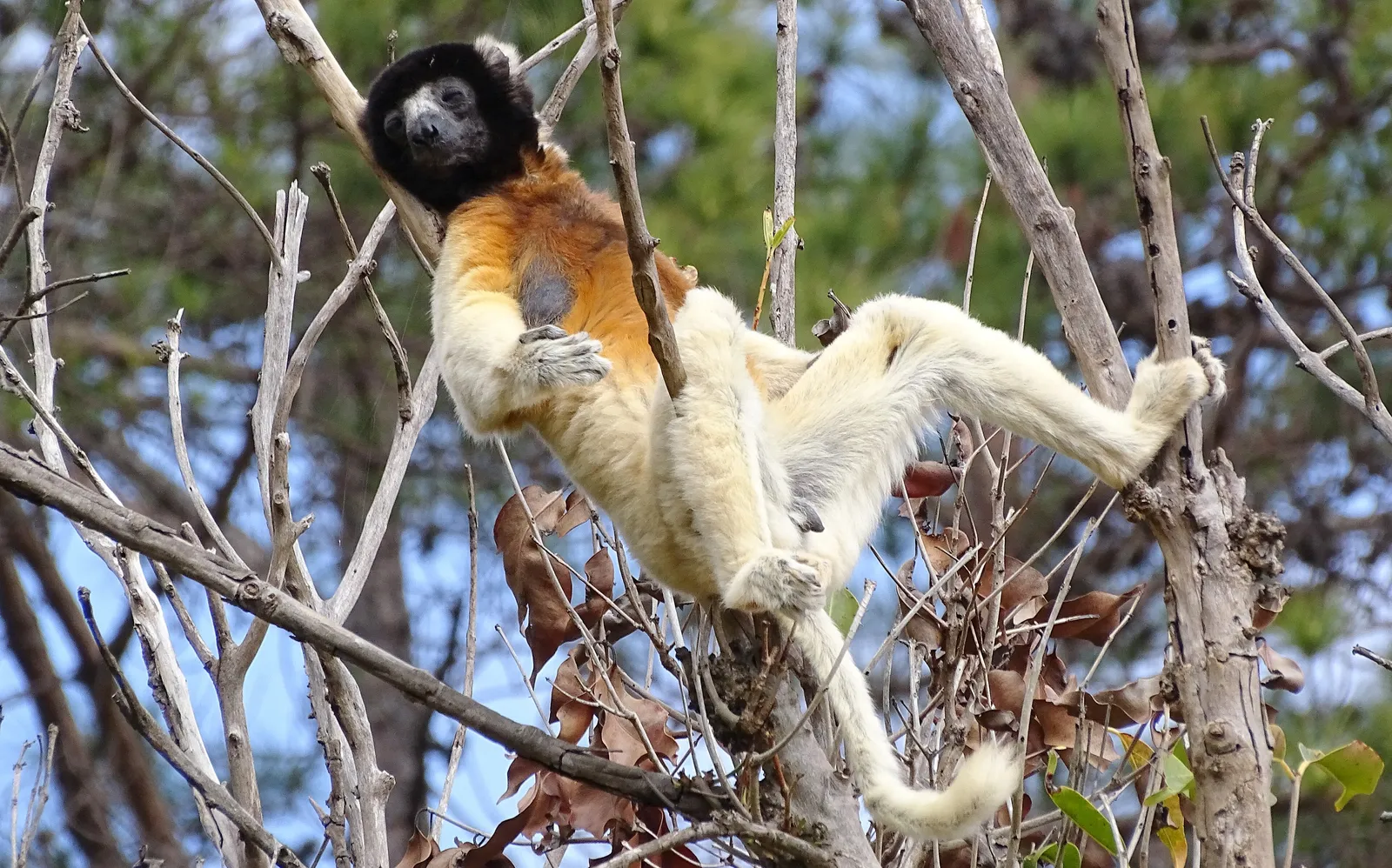
Standing in the spiny forest of the south — an alien landscape of octopus trees and the tall, candelabra Didierea that are found nowhere else on the planet — a sifaka lemur lands on a trunk two metres away with a sound like a soft handclap. It clings to the vertical bark, facing you, and turns its head slowly to one side with the patient, deliberate curiosity that characterises the family. The sifaka's eyes, large and amber and surrounded by a white-furred face, have the quality of genuine regard — a look that primate biologists describe as one of the more arresting experiences in their fieldwork, because it reads, however misleadingly, as recognition.
Madagascar separated from the African mainland roughly 160 million years ago and from the Indian subcontinent approximately 88 million years ago, leaving its animals to evolve in a long isolation that produced one of the most extraordinary wildlife assemblages on Earth. The island is home to around 107 species of lemur (the exact number shifts as new species are described), all of them endemic and found nowhere else. It hosts an estimated 250 or more species of reptile, roughly two-thirds of the world's chameleon species, more than 300 species of birds of which well over half are endemic, and a range of ecosystems — from rainforest to deciduous dry forest to the surreal spiny desert — that would, individually, rank as significant wildlife destinations. Together, they make Madagascar the single most important destination for biodiversity tourism on the planet.
The lemurs: a world apart
Lemurs evolved in Madagascar from a single ancestral population that arrived from Africa by raft across the Mozambique Channel, probably 50 to 60 million years ago, in the absence of the large carnivores and primates that occupy similar ecological niches on the mainland. In that vacancy, they diversified to fill roles that elsewhere belong to monkeys, sloths, and various other mammals: some are frugivores, some folivores, some nectar feeders, some insectivores. The result is a radiation of form and behaviour that encompasses the mouse lemur — at 30 grams, among the world's smallest primates — and the indri, the largest surviving lemur, whose haunting territorial calls carry for kilometres through the rainforest and sound, to many visitors, like nothing so much as the distilled cry of the forest itself.
The ring-tailed lemur, with its black-and-white ringed tail and its habit of sunbathing with arms outstretched, is the iconic Madagascar image. The dancing sifaka, which moves across open ground in a lateral bipedal leap that looks choreographed, is the one that stops conversation. The nocturnal species — aye-ayes with their elongated tap-searching middle fingers, sportive lemurs peering from tree holes, the dozens of mouse lemur species that can be found on night walks in virtually any Malagasy forest — are a different category of encounter entirely, requiring a red-filter headlamp and a guide who knows the precise trees where the animals reliably roost.
The national parks: accessing Madagascar's ecosystems
Madagascar's national parks and reserves are managed by Madagascar National Parks, and entry is through a structured permit system that funds the institution and the communities adjacent to the parks. Ranomafana in the central highlands is a rainforest reserve of exceptional bird and lemur diversity, most famous as the site where the golden bamboo lemur — a species previously unknown to science — was discovered in 1986. Andasibe-Mantadia, most accessible from the capital Antananarivo, is the best place to encounter the indri in its forest habitat, where morning calling sessions between neighbouring groups create a sonic experience that few other places on Earth can match.
In the south, Isalo National Park offers a dramatically different landscape — eroded sandstone massifs, canyons, and gallery forest — and the adjacent spiny forest reserves hold the extraordinary fauna of the most arid part of the island. Berenty Reserve, a privately managed tamarind forest near Fort Dauphin, remains one of the most concentrated lemur-watching destinations in the country, with habituated ring-tailed lemurs and sifakas moving through camp with total confidence. The Tsingy de Bemaraha — a UNESCO World Heritage Site of extraordinary limestone karst formations — in the west represents yet another ecosystem, with its own endemic lemurs and one of the most visually surreal landscapes anywhere in the world.
Reptiles: chameleons and the art of the slow look
Madagascar's chameleons are approximately half the world's known species in one island — around 100 to 110 species in total, with new ones still being formally described. They range from Parson's chameleon, the world's largest, found in the eastern rainforests, to the Brookesia micro and its relatives, the world's smallest known reptiles, which are barely large enough to stand on a fingertip. The variety in form, colour-change strategy, and habitat preference makes chameleon-watching in Madagascar a pursuit that could occupy a specialist's entire visit without approaching completeness.
Night walks in Malagasy forests are among the most rewarding wildlife experiences on the island. Guided by torchlight, a good guide can find sleeping chameleons (they turn pale at night, making them visible), geckos of improbable beauty, uroplatus leaf-tailed geckos flattened against bark with an almost supernatural camouflage, tenrecs rooting in the leaf litter, and the nocturnal lemurs described above. The density of endemism at the species level — the sense that almost every creature you encounter is found only here, the product of millions of years of isolated evolution — is the defining quality of a Madagascar night walk.
The birds: endemic families and oceanic oddities
Madagascar has five bird families found nowhere else in the world: the mesites (ground-dwelling birds of uncertain relationship to other families), the ground-rollers (subfossil-rich and visually spectacular), the asities (sunbird-like but structurally distinct), the vangas (a diverse radiation filling the niche of several mainland families), and the Malagasy couas (large cuckoos of the forest interior). Any of these alone would make Madagascar a significant destination for serious birders; together they create a birding itinerary of almost embarrassing richness.
The sheer density of endemic species creates a context in which every good forest walk produces new species. In the Masoala Peninsula — Madagascar's largest national park, covering a vast stretch of northeastern rainforest — the combination of forest interior, forest edge, coastline, and the Masoala Marine Park offshore makes for a multi-habitat experience that few places on Earth can offer. Birders who have visited the major tropical birding destinations consistently rank Madagascar among the most rewarding, not for any single iconic species but for the relentless accumulation of endemism at every level of the ecosystem.
Conservation: the most threatened biodiversity on Earth
Madagascar is simultaneously the world's most biodiverse island and one of the most deforested. The island has lost roughly 90 percent of its original forest cover, primarily to the slash-and-burn agricultural practice known locally as tavy, to charcoal production, and to cattle grazing. The consequence is that most of the lemur species, together with an enormous proportion of the island's endemic plants and animals, are classified as threatened or critically endangered by the IUCN. The indri, for instance, cannot survive in captivity — no zoo has ever successfully kept one alive for more than a year — which means its survival is absolutely dependent on the survival of its forest habitat.
The conservation response is one of the more complex in tropical biology, because it must address both the ecological emergency and the extreme poverty that drives tavy in a country where subsistence agriculture is the only livelihood available to millions of people. Ecotourism — structured to ensure that revenue reaches local communities and that guides are employed from villages adjacent to the parks — is among the more effective tools available. When a lemur is worth more to a village alive and in its forest than the land it occupies cleared for agriculture, the village has an incentive to protect the forest. This calculus is why the quality and ethics of your visit — who you travel with, where you stay, how the money flows — matters more in Madagascar than in almost any other destination.
Planning a Madagascar journey: routes and practicalities
Madagascar is best approached as a circuit rather than a single destination, since its ecosystems are geographically dispersed and a week in one park misses the extraordinary variety that the island offers. A classic route combines Antananarivo as the hub, Andasibe for rainforest and indri, Ranomafana for bamboo lemur and forest birds, Isalo for the sandstone landscape and dry forest, and the south for spiny forest and ring-tailed lemurs. This covers the major ecosystem types in a roughly linear route; the opposite direction works equally well. The Masoala Peninsula and Marojejy in the northeast add rainforest depth but require more time and logistical commitment.
The best season is April to November, avoiding the cyclone season and the heaviest rains. May and June are particularly good — less crowded, vegetation relatively open, animals active. October to December in the south brings the spiny forest to life with breeding activity. French is widely spoken alongside Malagasy, and a significant proportion of Madagascar's specialist guides have been trained through international conservation programmes and are deeply knowledgeable about the natural history of their parks. Our guides who work Madagascar circuits have consistently found it the most intellectually demanding and most emotionally affecting country they have worked in — a place that earns the superlatives applied to it.
Quick answers
How many lemur species exist, and will I see them all?
There are around 107 recognised species of lemur, with the count shifting as taxonomic work continues. No single visit will encounter all of them, partly because different species inhabit different ecosystems and require different habitats to see. A thorough circuit covering rainforest, dry deciduous forest, and spiny desert, with night walks at each, might yield 15 to 25 species. Specialist lemur tours designed around maximum species count can do considerably better, but for most visitors the quality of each encounter matters more than the total.
Is Madagascar difficult to travel?
Madagascar requires more logistical patience than many comparable destinations. Roads in many areas are poor, internal transport is limited, and the infrastructure outside Antananarivo and the main tourist circuits ranges from basic to absent. However, the national parks are well managed and the guiding standards at the major reserves are good. Travelling with a specialist operator who has local partner organisations resolves most of the logistical complexity and ensures that your guide is genuinely expert — which, in Madagascar, makes an enormous difference to what you see.
What is the indri, and why is it so famous?
The indri (Indri indri) is the largest living lemur, a black-and-white tailless primate that inhabits the eastern rainforests of Madagascar and is famous for its haunting, far-carrying territorial call. It is sacred to the Malagasy people and cannot survive in captivity — no individual has ever been successfully kept alive in a zoo for any sustained period. Seeing and hearing an indri group in the forest at Andasibe-Mantadia, their calls echoing through the canopy at dawn, is one of the most distinctive wildlife experiences in the world.
Is Madagascar safe for travellers?
Madagascar is generally safe for travellers within the tourist circuits. Petty theft is the primary concern in Antananarivo; outside the capital, crime against tourists is uncommon. Health precautions — malaria prophylaxis, water safety, standard tropical travel preparations — are important. The infrastructure limitations mean that good advance planning and reliable local partners matter more here than in countries with more developed tourism infrastructure, but none of this should deter a motivated traveller.
Do I need to be a naturalist to appreciate Madagascar?
No — but curiosity helps. Madagascar is one of those places that rewards attention at every level: even visitors with no prior interest in reptiles find themselves captivated by a Parson's chameleon or a sleeping gecko; even those who have never consciously watched birds find themselves memorising the distinctions between vanga species by the end of a forest walk. The best preparation is simply to arrive with an open mind and a guide who can translate what you are seeing into something meaningful.
Let the reading become a route.
When an article sparks something, our planners are the next step. Tell us what you are dreaming of.