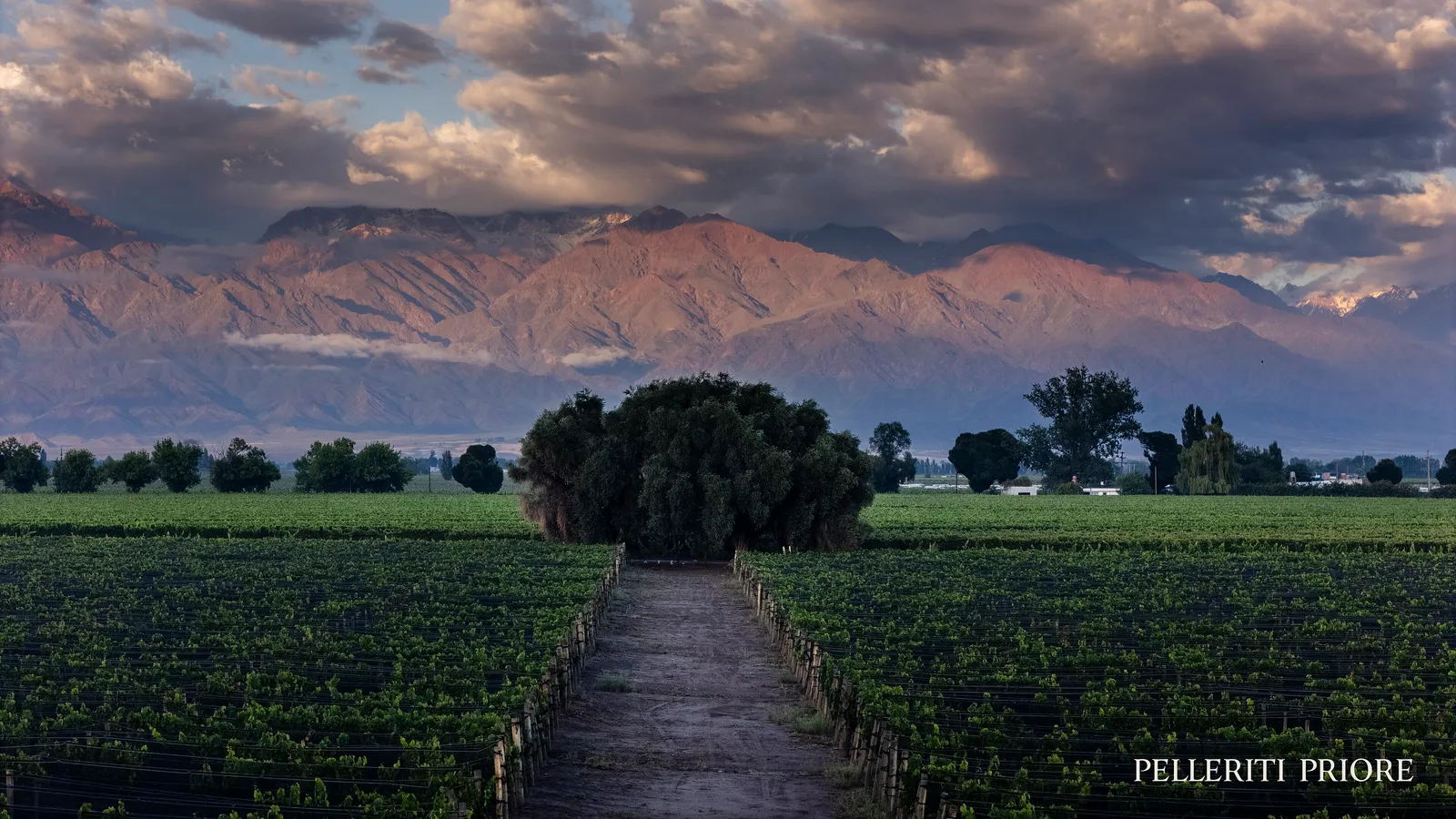
Mendoza and the High-Altitude Vineyards: Argentina's Wine Country at the Foot of the Andes
Mendoza produces some of the world's most celebrated Malbec from vineyards pressed up against the snow-line of the Andes — a wine culture of serious depth set inside a landscape of astonishing mountain drama.
The first thing a traveller arriving from Buenos Aires notices is the mountains. The Andes rise from the flat desert plain without preamble — not a range building gradually but a wall, appearing suddenly above the curvature of the earth as the plane descends, a continuous rampart of white and brown rock with Aconcagua, the Western Hemisphere's highest peak at 6,961 metres, visible above the rest on clear days as a broad, snow-capped pyramid. The city of Mendoza sits at 760 metres above sea level in the foothills, its streets lined with irrigation canals and plane trees, its grid laid out after an earthquake destroyed the colonial centre in 1861. It is an elegant, human-scaled city that holds its wine culture with the same ease that Burgundy holds its own — as something ordinary made extraordinary by practice over generations.
Mendoza produces roughly two-thirds of Argentina's wine, and the region has become in the last forty years one of the most important names in the global wine conversation, carried there primarily by Malbec — a grape that struggled in its native Cahors in France and found in the high-altitude soils and radical diurnal temperature swings of the Andes the conditions it needed to produce wines of genuine complexity and power. But the story is larger than any single variety. The Mendoza wine world includes Cabernet Sauvignon, Torrontés, Bonarda and, in the highest vineyards of Luján de Cuyo and the Valle de Uco, wines that are now mentioned alongside the finest bottles of the Old World.
Altitude and why it matters to the glass
The key to understanding Mendoza wine is the word 'high'. The main Mendoza wine zone sits between roughly 600 and 900 metres; the Valle de Uco, an hour south of the city, climbs between 900 and 1,500 metres, and some of its highest vineyards — in the subzones of Gualtallary and Paraje Altamira — exceed 1,400 metres. At this altitude, daytime temperatures are intense and sunny; nights drop sharply, sometimes by 15 to 20 degrees Celsius between afternoon and midnight. This diurnal range is critical: it slows ripening, preserves natural acidity and produces grapes with more complex aromatic development than warmer wine regions can achieve. The result in the glass is a Malbec of deeper colour, more restrained fruit and greater aging potential than its lower-altitude counterparts.
The UV radiation at high altitude is also significantly stronger than at sea level, which causes the grape skins to develop thicker cell walls as protection — an adaptation that translates into tannins with a texture and density that winemakers from lower regions find difficult to replicate. The combination of thin air, extreme light, the heat of the day and the cold of the night, moderated by the spring meltwater from the Andes that feeds the irrigation system, produces conditions that are genuinely and measurably different from those of any other major wine region on Earth.
The major wine zones: Luján de Cuyo, Maipú and the Valle de Uco
Luján de Cuyo, the 'Primera Zona' south of Mendoza city, is the historical heart of high-end Mendoza wine, home to some of the oldest Malbec vines in the world — ungrafted vines planted in the late nineteenth and early twentieth century that survived the phylloxera epidemic because the sandy soils of the region were inhospitable to the root louse. Old-vine Malbec from Luján — designated Malbec de Alto in the regional vocabulary — has an intensity and complexity that younger plantings cannot replicate. The bodegas here include some of the most storied names in South American wine: Catena Zapata, Achaval Ferrer, Clos de los Siete.
Maipú, east of the city, is flatter and warmer, producing wines of a more generous, fruit-forward style; it is also the centre of olive oil production in the region and holds some of Mendoza's oldest wine tourism infrastructure, with cycling-to-bodega routes that have become a ritual for visiting oenophiles. The Valle de Uco is the frontier: a vast, high-altitude valley opening south of the city toward the Andean foothills, its best subzones — Gualtallary, Los Árboles, La Consulta, Paraje Altamira — each producing wines with distinct soil expressions. The Valle de Uco is where the most experimental winemaking in Mendoza is happening, and where the wines command prices that have surprised even the producers themselves.
The bodegas: architecture, food and the visit
The great bodegas of Mendoza are not just places to taste wine; many are serious works of architecture in landscape settings that justify the trip independently of what is poured. Bodega Zuccardi Valle de Uco, which has repeatedly topped the list of the world's best vineyards, is a fortress of rough stone, rammed earth and concrete set in the Valle de Uco with the snow-capped Andes as its backdrop — a building that looks as if it grew from the ground rather than was placed upon it. Achaval Ferrer's older facility in Luján is a nineteenth-century bodega of stucco and barrel vaulting; Clos de los Siete, the wine project conceived across several estates by the Bordeaux consultant Michel Rolland, is one of the most photographed wine ventures on the continent.
Restaurant culture at the bodegas has matured into something serious. Zuccardi has a tasting menu that changes with the harvest and sources almost entirely from the Valle de Uco's own farms and gardens. Francis Mallmann, Argentina's most celebrated chef, has a restaurant at Siete Fuegos in the grounds of the Ruca Malen winery that built much of the international mythology of Argentine food and fire cooking. Even a standard asado lunch at a winery — red wine, flame-grilled beef, chimichurri, conversation — is one of the canonical eating experiences of South America.
Aconcagua and the high mountains
The wine country does not exhaust what the Mendoza region offers. An hour west of the city, the Ruta 7 climbs the Mendoza River canyon toward the Paso Los Libertadores — the main border crossing between Argentina and Chile — and into a mountain landscape of a scale and severity that the vineyards' pastoral orderliness has not prepared you for. The canyon walls close in, the river runs milky-green with glacial melt, and the road passes through rock formations of deep red and ochre that have been folded and faulted into vertiginous angles by the continental collision still underway.
The Parque Provincial Aconcagua encompasses the mountain itself and the high valleys around it. Aconcagua — at 6,961 metres the highest point in the Americas and outside Asia — is climbed by several hundred people each year via the Normal Route, a technically non-technical ascent that is nonetheless one of the most physically demanding undertakings available to non-technical mountaineers. Even for those with no ambition to reach the summit, the approach trek to base camp at Plaza de Mulas offers extraordinary high-mountain scenery and an encounter with genuine Andean altitude. The mountain looms over the landscape with an absoluteness of scale that the vineyards below cannot diminish.
The city: olives, empanadas and the covered streets
Mendoza city is one of the most pleasant in Argentina — a well-designed grid of wide boulevards and low buildings shaded by hundreds of thousands of plane trees and poplars, its streets equipped with irrigation channels (acequias) that carry Andean meltwater to sustain the urban canopy. The system was built by the indigenous Huarpe people centuries before Spanish colonisation and is maintained today as both functional infrastructure and civic heritage. Walking the city is a pleasure: the main pedestrian street, Sarmiento, holds a condensed version of Argentine café culture at its best, while the Parque General San Martín — designed by the French landscape architect Charles Thays at the turn of the twentieth century — is a roughly 400-hectare park of avenues, lakes and viewpoints that constitutes one of the finest urban parks in South America.
The food culture of Mendoza city extends well beyond the wine-country asado. The empanadas mendocinas — filled with beef, hard-boiled egg and olive, crimped and baked rather than fried — are the standard against which all other Argentine empanadas are measured. The Mercado Central holds a good cross-section of local produce: oils, dried fruits, nuts, cheeses from the Andean foothills, and the chivito (kid goat) that is the alternative red meat of the region. The restaurants on and around Arístides Villanueva and across the Godoy Cruz suburbs offer tables that take wine seriously in a way that matches the best of Buenos Aires.
When to visit and how the seasons shape the experience
The harvest — la vendimia — is the defining event of the Mendoza calendar, running from late February through March as the estates bring in grapes variety by variety. The Festival Nacional de la Vendimia, held in the first week of March, is a major civic celebration: the Fiesta de la Vendimia in the city's amphitheatre is a theatrical pageant of folklore, music and the crowning of the harvest queen, attended by tens of thousands of Argentines. Visiting during harvest means the chance to see working bodegas at full operation and, in some estates, to participate in the picking itself.
The warmest and most crowded months are December to February; March and April, post-harvest, are the preferred time for serious wine tourism — the estates are quieter, the valley is beautiful with coloured vines, and the weather remains warm and dry. Winter (June to August) brings snow to the ski resort of Las Leñas in the southern Mendoza range and to the Vallecitos ski area near the city, and the mountain scenery takes on an alpine quality that is entirely different from the summer experience. Spring (September to November) is warm, dry and increasingly busy as the tourism season opens, with wildflowers on the lower Andean slopes and the vines showing their first green.
Quick answers
Why is Malbec so associated with Mendoza specifically?
Malbec arrived in Argentina in the mid-nineteenth century and found in Mendoza's high-altitude desert climate — intense sun, dramatic diurnal temperature variation, low humidity and the irrigation provided by Andean meltwater — conditions that are arguably better suited to the grape than its homeland in Cahors, France. The thin air intensifies UV exposure, which builds tannin structure in the skin; the cold nights preserve natural acidity; and the sandy, alluvial soils of the Mendoza foothills drain well and force the vine roots deep, adding complexity. The result is a fuller, more powerful expression of the variety than the Old World typically produces.
How do I organise bodega visits?
Most premium bodegas require advance reservation and do not accept walk-ins. The most straightforward approach is to book through a reputable wine tour operator in Mendoza city, who will arrange transport and coordinate tasting appointments across several estates in a day. Self-drive is possible but impractical if you are tasting seriously; many visitors hire a remise (private car with driver) for the day. Cycling is viable in Maipú, where bodegas are relatively close together, but less practical in Luján de Cuyo or the Valle de Uco, where distances are larger.
Can I visit Aconcagua without climbing it?
Yes. The approach road from Mendoza city to the Horcones Valley entrance of the park takes about ninety minutes, and from the park entrance a well-marked trail leads to Laguna de los Horcones — a glacial lake with direct views of the mountain's south face — in about an hour's easy walking. The multi-day trek to base camp at Plaza de Mulas (4,370 metres) requires a trekking permit, several days and appropriate equipment, but is accessible to any fit, acclimatised trekker. The mountain dominates the landscape throughout the region and is visible from the main highway.
What is the best time to see the Andes in winter from Mendoza?
June to August brings snow to the Andes above the city and turns the mountain backdrop brilliantly white. The Valle de Uco is particularly striking in winter, with snow-covered peaks above dormant vines and the clarity of the cold air making the mountain detail unusually sharp. The ski resort of Las Leñas, about four hours south of Mendoza, is one of the best ski resorts in the Southern Hemisphere, with a season running from June to October.
Is Mendoza easy to combine with other Andes destinations?
Very much so. Mendoza is connected by a direct road and regular bus service to Santiago, Chile (about seven hours via the Paso Los Libertadores), making it a natural beginning or end point for any Andean circuit. To the south, the wine country of San Rafael and the trekking at Laguna Diamante are within a day's drive. Bariloche is accessible by overnight bus or a short flight. Mendoza also makes a natural stop on a Buenos Aires–Santiago overland crossing that is itself one of the classic South American routes.
Let the reading become a route.
When an article sparks something, our planners are the next step. Tell us what you are dreaming of.