Ollantaytambo: The Living Inca Town
At the head of the Sacred Valley stands the only Inca town whose original street grid is still inhabited. Its fortress, its canals and its stones tell the story of an empire that never finished building.
Most Inca sites are ruins in the strict sense: structures cleared of later occupation, maintained as archaeological parks, and understood primarily as history. Ollantaytambo is different. The grid of its original Inca blocks — the canchas, or rectangular walled enclosures — is still lived in. Families descend from the same layout the empire drew, and the stone water channels that run through the middle of the streets still carry water from the same sources. It is the only Inca urban plan in which the original organisation of space persists into daily life.
The town sits at the upper end of the Sacred Valley, at about 2,800 metres, where the valley narrows and the Urubamba River bends. Above it rises the ceremonial and military fortress whose unfinished upper terraces and enormous stone blocks remain among the most telling physical records of Inca ambition anywhere. Ollantaytambo is also the railhead for trains to Machu Picchu and the start of the Classic Inca Trail — which means that for many travellers it is a transit point rather than a destination, and that is a significant misreading of the place.
The Inca street plan and how to read it
The canchas of the lower town are the oldest continuously inhabited urban fabric in the Americas. Each cancha is a rectangular compound entered through a single trapezoidal doorway, with several buildings arranged around an interior courtyard. The family living there today uses the same layout the Inca designed: one entrance, shared space inside, the compound as the fundamental social unit.
Walking the grid, you can begin to decode the size distinctions — larger canchas in the centre were probably occupied by higher-status families or used for state functions, while smaller ones towards the edges were residential. The stone channels running down the centre of the alleys are both functional and deliberate, carrying clean water through the urban fabric in the Andean tradition of treating water as a managed resource rather than something that simply flows where it will.
The fortress and its unfinished work
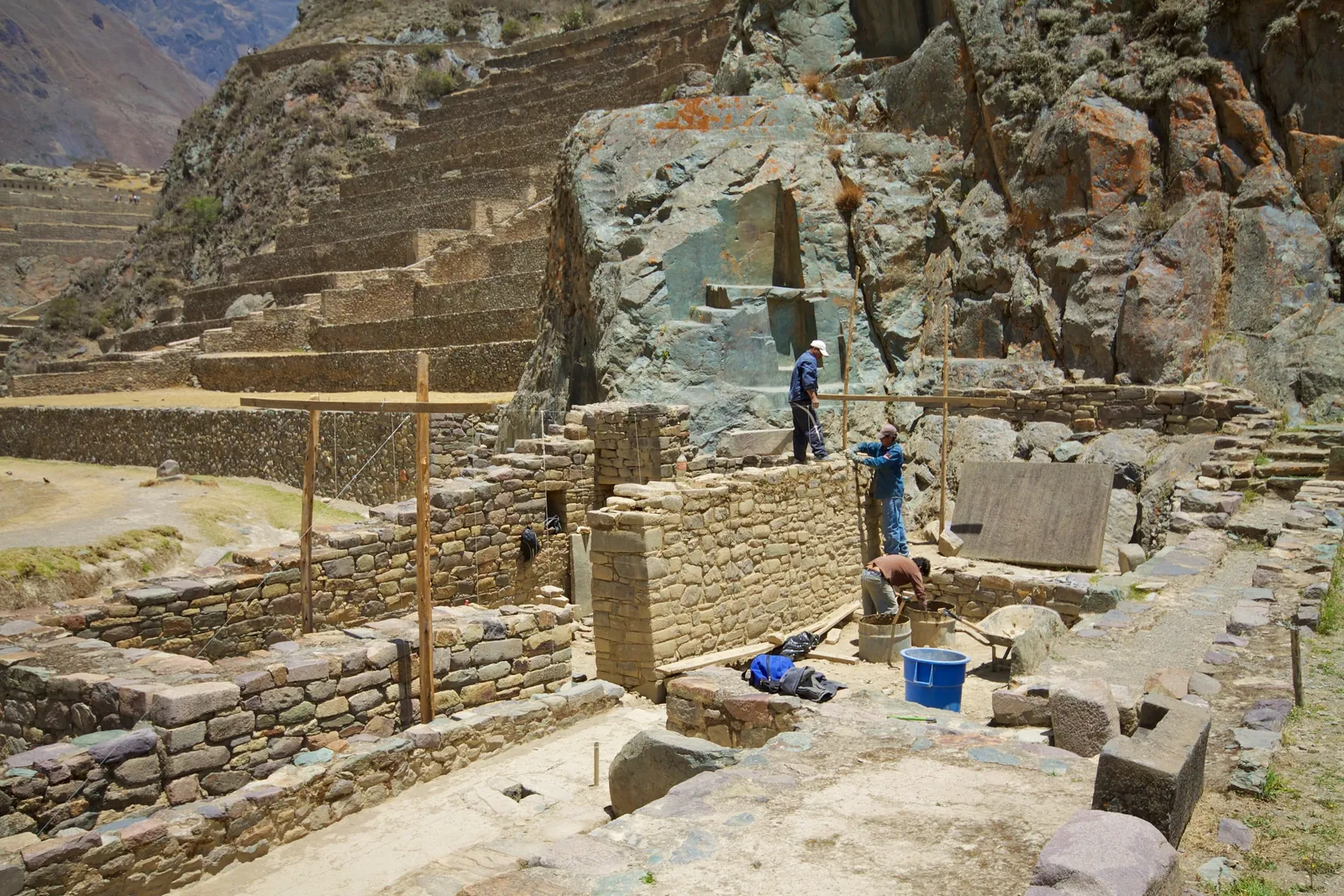
The Fortress of Ollantaytambo stands on a spur of rock above the town, approached by a broad staircase of agricultural terraces. The terraces themselves are feats of Inca hydraulic engineering — built up with fill, drained internally, and oriented to maximise warmth, they are not decorative but productive, and a system of channels still irrigates some of them.
At the top of the terraces begins the ceremonial platform whose six enormous pink granite monoliths are the most photographed element of the site. These stones — the largest weighing an estimated 50 tonnes — were quarried from the Cachicata quarry across the valley and several kilometres away, transported across the river, and hauled up the hillside by a workforce whose organisational demands stagger the imagination. The monoliths were intended to face a temple that was never completed: the Spanish conquest interrupted the construction, and Ollantaytambo is one of the places where you can see Inca ambition cut off mid-sentence.
The battle of Ollantaytambo
In January 1537, Ollantaytambo was the site of one of the few military defeats the Spanish suffered in the conquest of the Inca empire. Manco Inca, who had initially cooperated with the invaders before turning against them, used the fortress to stage a resistance that successfully repelled Hernando Pizarro's force. Manco's defenders flooded the plain below the fortress by diverting the river, making the cavalry charge that the Spanish relied on impossible.
The victory was short-lived. Pizarro withdrew, regrouped, and returned with a much larger force. Manco Inca retreated into the cloud forest at Vitcos and later established the last Inca resistance at Vilcabamba, deep in the jungle. But the battle of Ollantaytambo is an important corrective to any simple narrative of inevitable conquest: the Inca adapted, improvised and occasionally won, and the fortress above the town is as much a monument to that resistance as to the empire's grandeur.
Water and the management of the valley
No Inca site can be properly understood without attending to water. At Ollantaytambo, the canals that still run through the streets are not a charming survival — they are the evidence of a comprehensive hydraulic infrastructure that also fed the agricultural terraces, supplied the ceremonial fountains on the hillside and, during the battle, was weaponised by flooding the plain.
On the hillside opposite the fortress, a series of storehouses — qollqas — stand in a line exposed to the prevailing cold winds, an Inca refrigeration system designed to preserve food at altitude. The relationship between the irrigation system in the valley, the terraced agriculture on the slopes, and the storage infrastructure above is a complete picture of how the Inca fed a large population in difficult terrain. Reading Ollantaytambo is reading that system.
Arriving early, staying late
Ollantaytambo is visited on day trips from Cusco or as an overnight stop on the way to Machu Picchu, and the difference between these two experiences is dramatic. Day-trip crowds peak around midday, when tour buses from Cusco and arrivals from the train disembark simultaneously. Staying the night — the town has good smaller hotels in converted historic buildings — means walking the streets in the quiet of the early morning, when the water in the channels catches the first light and the few other people around are residents on their way to work.
On our journeys, Ollantaytambo is given proper time: a guided walk of the lower town to understand the cancha grid, a climb of the fortress in the morning light, and the rail journey from the town station, which provides its own perspective on the valley below as the train descends into the Urubamba canyon toward Aguas Calientes. It is one of the places in the Sacred Valley where slowing down returns the most.
Quick answers
Is Ollantaytambo really still inhabited in its original Inca layout?
Yes. The lower town's grid of canchas — rectangular walled family compounds entered through a single trapezoidal doorway — follows the original Inca urban plan, and families live in them today. The stone water channels through the streets also still carry water. It is the only Inca town whose original organisation of urban space survives into daily life.
How difficult is the climb to the top of the Ollantaytambo fortress?
The ascent involves a long staircase of agricultural terraces followed by steeper stone steps to the ceremonial platform. It is a moderately demanding climb, especially at nearly 2,800 metres altitude. Most fit, acclimatised walkers manage it in twenty to thirty minutes. The reward — close views of the great granite monoliths and a panorama down the Sacred Valley — is considerable.
Why did the Inca never finish the temple at Ollantaytambo?
Construction was interrupted by the Spanish conquest. The enormous pink granite monoliths at the top of the site were being assembled for a temple when Inca resistance collapsed and work stopped. The partially built state of the upper structure is one of the clearest places in the Andes where you can see an empire literally mid-project when its world ended.
Can the Classic Inca Trail be started from Ollantaytambo?
No — the Classic Inca Trail begins at Kilometre 82, roughly 20 kilometres down the valley from Ollantaytambo. However, the train journey to the trailhead departs from the Ollantaytambo station, and the town is the last significant overnight stop before the trail begins. A shorter two-day version of the trail starts from Kilometre 104, also accessible from the same station.
Let the reading become a route.
When an article sparks something, our planners are the next step. Tell us what you are dreaming of.