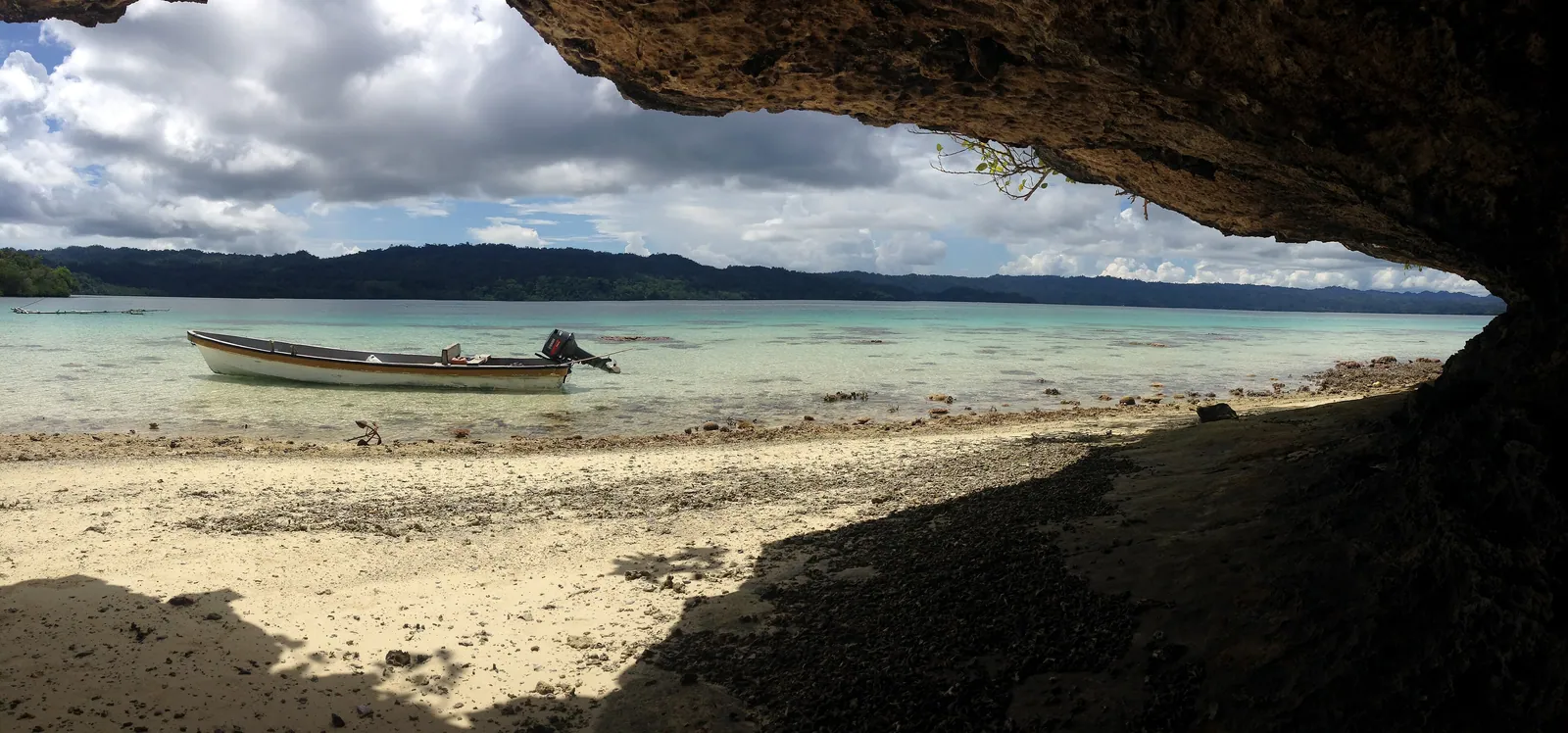
Palau and Micronesia: The Crystal Ocean of the Western Pacific
Palau has the most biodiverse reefs in the northern Pacific, a jellyfish lake with no natural predators found nowhere else on Earth, and a history of submarine warfare that turns every dive in the western Pacific into an encounter between the living and the dead.
There are places in the world where the word 'biodiversity' stops being an abstract concept and becomes a sensory experience of complete saturation. Palau is one of them. This small archipelago of around three hundred islands in the far western Pacific, some eight hundred kilometres east of the Philippines, has more fish species in its waters than the entire Caribbean. Its coral reefs, among the best preserved in the world, harbour more than thirteen hundred species of fish and more than seven hundred species of coral. For divers and snorkellers, Palau is frequently described quite simply as the best place on Earth.
But Palau is not only reefs. It has Jellyfish Lake, a marine lake whose water was isolated from the ocean around twelve thousand years ago and in which jellyfish — with no predators — evolved losing their stinging capacity, creating a unique ecosystem where human beings can swim literally inside millions of live jellyfish without any risk. It has Second World War wrecks — planes, ships and tanks — that are now artificial reefs of a haunting beauty. And it has an indigenous Palauan history of navigation, matrilineal clans and wood carving that very few travellers know. Micronesia, the vast maritime space to which Palau belongs, is the least understood and most extraordinary of the Pacific regions.
The coral reefs: the greatest biodiversity in the northern Pacific
Palau's position at the southwestern corner of the Coral Triangle — the region bounded by the Philippines, Indonesia and the Solomon Islands that has the world's greatest concentration of marine biodiversity — makes it one of the richest reefs in the northern hemisphere. The ocean currents that converge here bring nutrients from the depths and larval seed from neighbouring reefs, sustaining a diversity that resists comparison with any other dive destination. The Palau Walls — vertical coral formations that descend hundreds of metres from the reef crest — have layers of soft coral, giant sea fans, crinoids and barrel sponges that create a tapestry of colour and texture of an almost incomprehensible complexity.
Among the most celebrated sites is the German Channel, where tidal currents create an underwater flow that draws whitetip reef sharks, blacktip reef sharks, turtles, manta rays and schools of barracuda at densities that the world's most experienced divers rate as exceptional; Blue Corner, where the same current creates one of the best drift dives in the Pacific; and Blue Hole, a marine lake of crystalline saltwater accessible only through an underwater tunnel from the ocean.
Jellyfish Lake: swimming among sting-free jellyfish
Ongeim'l Tketau, known in English as Jellyfish Lake, is a marine lake on the island of Eil Malk that was isolated from the outer reef around twelve thousand years ago, when sea levels fell at the end of the last glacial period. The jellyfish of the species Mastigias papua etpisoni that live in it are a subpopulation that, having been separated from the reef, evolved in the absence of their natural predators. Over thousands of generations, their stinging cells became vestigial, producing the extraordinary situation of a lake with millions of jellyfish completely harmless to human beings.
The experience of swimming in Jellyfish Lake is one of the most surreal available in the natural world. The jellyfish — between one and thirty centimetres in diameter, translucent golden-orange — congregate in a dense band that follows the sun's movement to maximise the photosynthesis of the symbiotic algae living in their tissue. Swimming among them is to enter a cloud of silent, pulsing life, oblivious to your presence but in constant contact with your skin. Scuba diving is prohibited to protect the lake's stratified ecosystem; only snorkelling is permitted, which adds a dimension of breath-holding and buoyancy that makes the experience even more intimate.
The Second World War wrecks
In the western Pacific, the Second World War left a submarine legacy of a density and variety that has no parallel in any other ocean. Palau was an important Japanese stronghold and was attacked by American naval and air forces in Operation Desecrate One (March 1944) and Operation Stalemate II (September 1944, the Battle of Peleliu). The Japanese ships and planes sunk during these attacks — most of them in Palau's lagoon, at depths of between fifteen and forty metres — have been colonised by coral for eighty years and are today some of the most spectacular wrecks in the world.
The Iro Maru, a Japanese tanker of 143 metres, is covered in hard and soft coral at densities that rival any natural reef; its holds harbour smaller transport vessels and military equipment that time and coral have transformed into sculptures. The island of Peleliu also has an accessible battlefield on land, with bunkers, artillery pieces and remnants of military material that veterans of both countries have visited since the end of the war — one of the bloodiest battles in the Pacific theatre — in reconciliation ceremonies that continue to this day.
Palauan culture: clans, the abai and storyboards
Traditional Palauan society is matrilineal: inheritance, land and political power pass through the maternal line. Clans (kebliil) are led by women (bilenguul) who make the most important decisions in consultation with the clan's men. This structure, unusual in the Pacific and in the world, has survived centuries of outside contact and remains a real axis of political life in Palau.
The abai is the traditional men's meeting house, a wooden structure raised on stilts with a pitched roof and exterior paintings that narrate the history and legends of the clan. The oldest and most elaborate abai are genuine works of architectural and narrative art; their paintings represent battles, gods, rites and everyday scenes with an iconographic richness that ethnographers compare to the illustrated manuscripts of other cultures. The storyboard — a carved and painted wooden panel with narrative sequences from Palauan history and legend — is the contemporary and most accessible expression of this tradition, developed in the twentieth century as a commercialisable art form without losing its cultural content.
Micronesia beyond Palau: Yap, Pohnpei and the stone islands
Micronesia — the region encompassing the Federated States of Micronesia, Palau, the Marshall Islands, Kiribati, Nauru and the Northern Mariana Islands — is the most fragmented and least-known Pacific region. Yap, part of the Federated States of Micronesia, is famous for its limestone disc money (rai), used in prestige exchanges and still owned by families even though it no longer circulates; the largest specimens weigh several tonnes and remain where they always stood, on the paths between villages.
Pohnpei, also in the Federated States, has Nan Madol: a complex of artificial islets built from stacked basalt columns over the coastal reef, which was the capital of the Saudeleur dynasty between the thirteenth and seventeenth centuries and is considered the most impressive archaeological complex in island Oceania. UNESCO inscribed it as a World Heritage Site in 2016. The Marshall Islands, with their history of American nuclear tests on Bikini Atoll between 1946 and 1958, have their own singular and painful chapter in the history of the twentieth-century Pacific.
How to travel to Palau and what to expect
Palau has an international airport in Koror with connections from Manila, Seoul, Tokyo, Guam and some Chinese cities. Flights from Europe generally connect via Manila or Tokyo. Koror is the main town and the hub of all tourist services; the official capital is Ngerulmud, on the island of Babeldaob, but it is a small administrative city. Most diving and activities are organised from Koror.
Palau has one of the world's most advanced environmental tourism laws: in 2018 it introduced the Palau Pledge, a statement of environmental and cultural responsibility that visitors sign on their passport stamp on arrival, committing to behave respectfully towards the natural and cultural environment. The no-fishing zones surrounding most of the country — the Palau National Marine Sanctuary, declared in 2015, protects eighty percent of national waters — have allowed Palau's reefs to remain among the best-preserved in the Pacific. The dry season runs from November to April; the monsoon season, from May to October, brings more rain but also calmer seas for diving.
Quick answers
Can I dive in Palau without certification?
Many of Palau's best dive sites require PADI or equivalent certification, as they have strong currents or depths that make them unsuitable for beginners. However, snorkelling in Jellyfish Lake, in the lagoon and on several shallow reefs is extraordinary and requires no certification. For those without experience, introductory diving in Palau (Discover Scuba) allows supervised dives at more accessible sites.
Are the Jellyfish Lake jellyfish always sting-free?
The Mastigias papua etpisoni jellyfish of Jellyfish Lake have evolved with virtually no functional stinging cells and are harmless to humans in normal conditions. However, the deeper layers of the lake have an anoxic zone with ammonia where visitors must not swim; scuba diving is prohibited precisely to prevent visitors from disturbing these stratifications. The jellyfish population can also vary: in 2016 it suffered a collapse due to an El Niño event that raised water temperatures; it recovered by around 2018.
What is the Palau Pledge and is it mandatory?
The Palau Pledge is an environmental and cultural commitment that all visitors to Palau sign on their passport stamp at entry, promising to behave responsibly towards the archipelago's nature and culture. Introduced in 2018, it is mandatory and available in several languages. It is the first instance in the world of such a commitment being formalised as part of a country's entry process, and has been widely praised as a model for sustainable tourism.
Can Nan Madol be visited from Palau?
No. Nan Madol is on the island of Pohnpei in the Federated States of Micronesia, a different country from Palau. From Palau you can fly to Pohnpei via Guam. Nan Madol is visitable by boat from the town of Kolonia; some parts of the complex, however, have restricted access for conservation reasons. It is one of the most extraordinary archaeological sites in the Pacific and merits a dedicated itinerary.
How many days are needed to experience Palau properly?
A week is the minimum reasonable stay for divers wanting to cover the main sites: the German Channel, Blue Corner, Jellyfish Lake, some wrecks and coral gardens. Two weeks allow exploration of the rock islands, Palauan village life and the more remote parts of the archipelago. Travellers who combine Palau with Yap or other Micronesian islands will need additional time and flights.
Let the reading become a route.
When an article sparks something, our planners are the next step. Tell us what you are dreaming of.