Rano Raraku: The Quarry Where the Moai Were Born
Almost every moai on Easter Island came from a single volcanic crater. Walk its slopes and you find the great workshop of Rapa Nui caught mid-task — hundreds of statues at every stage, including the largest ever attempted.
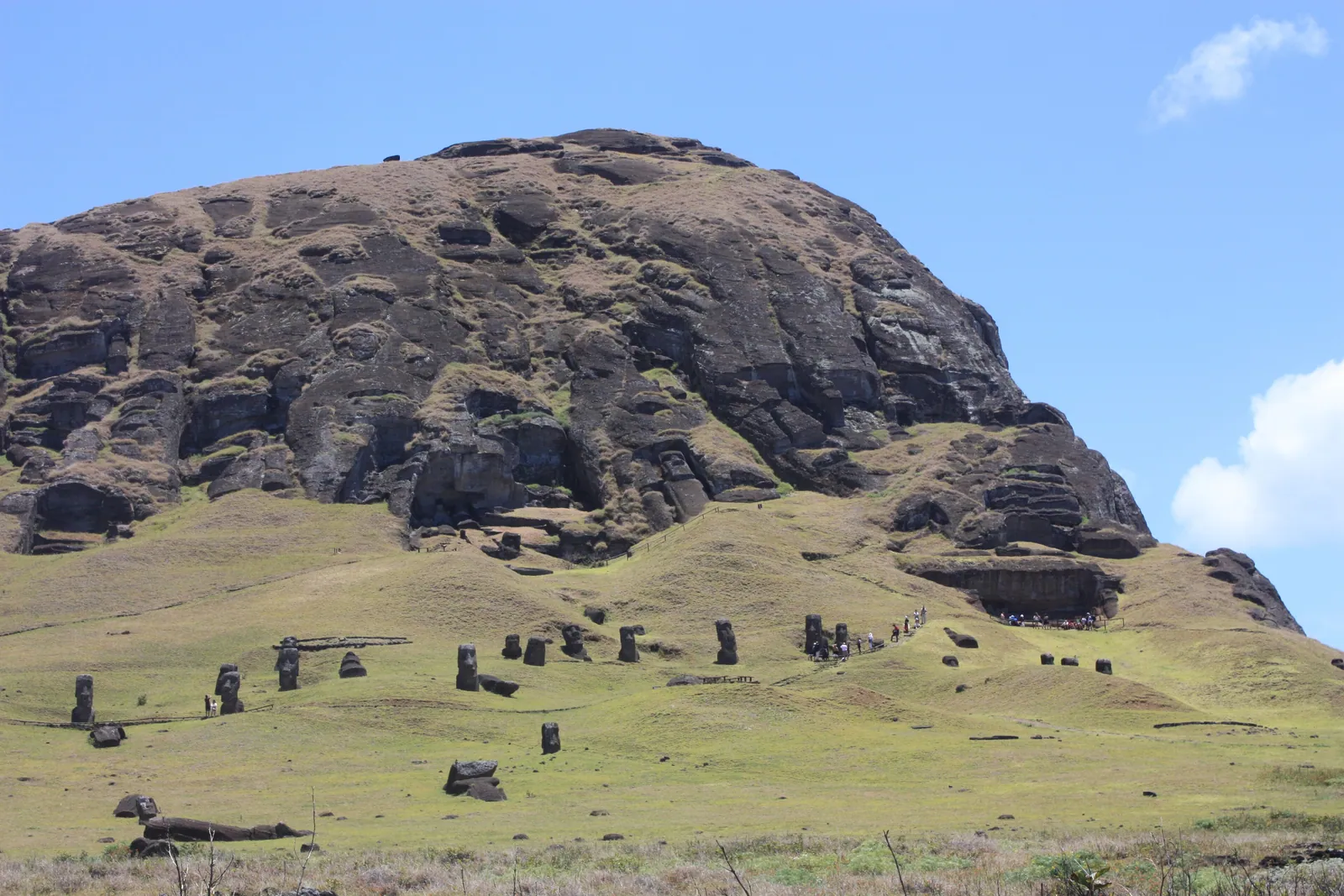
If Rapa Nui has one essential place, it is Rano Raraku. This extinct volcano on the island's eastern side is the quarry from which the overwhelming majority of the island's nearly 900 moai were carved. Its slopes hold close to four hundred statues — more than anywhere else on the island — in every stage of completion, from blocks barely roughed out of the rock to finished figures standing upright, waiting for a journey that never came.
Rano Raraku is not a ruin so much as an interrupted day of work. The carvers downed their basalt picks and never returned, and the result is the clearest window anywhere into how the moai were actually made. On The Pacific Arc, the quarry is a centrepiece of the Rapa Nui destination — and it can be entered only once on a national park ticket, so it is a place to give real time.
Why this volcano became the workshop
Rano Raraku is made of lapilli tuff, a soft volcanic stone formed from compacted ash. That softness was everything: it could be carved with the harder basalt hand-picks called toki, which still lie scattered across the site in their hundreds. Almost no other rock on the island offered the same workability at the same scale.
The quarry therefore became a single, intensively used production centre serving the whole island. Statues were cut from the rock face here, finished in detail, and then moved out — sometimes many kilometres — to ahu on the coast. The wide roads radiating from Rano Raraku, with fallen moai lying along them, trace those ancient journeys.
Statues at every stage
What makes Rano Raraku extraordinary is that it preserves the whole sequence of work at once. On the rock faces you can see moai still attached along their backs, the carvers having shaped the face, ears and torso while the figure lay horizontal in the quarry, leaving only a keel of stone to be cut through last.
Lower down stand the famous figures sunk to the shoulders or chin in the slope. These were not buried deliberately and they are not unfinished heads: they are completed statues that had been detached and stood upright in pits so that their backs could be finished, after which centuries of erosion packed sediment around them. Excavations have shown their full bodies, often carved with intricate designs, still in the ground.
El Gigante and the limits of ambition
High on the quarry lies the statue known as El Gigante, the Giant — a moai still attached to the bedrock that, had it been completed and raised, would have stood roughly 21 metres tall and weighed on the order of 150 to 200 tonnes. It is by far the largest moai ever attempted.
Whether El Gigante could ever have been moved is doubtful, and it may represent the point where ambition outran what the island's logistics could deliver. Either way, it is a humbling thing to stand beside — a measure both of Rapa Nui confidence and of the moment that confidence met its ceiling.
Tukuturi: the moai that does not fit
Among the upright figures at Rano Raraku is one unlike all the others. Tukuturi is a kneeling moai, carved not from tuff but from red scoria, with a rounded head, a beard-like feature and its hands on its thighs in a posture associated with traditional kneeling song. It looks far more like the wider Polynesian sculptural tradition than the classic Rapa Nui form.
Tukuturi may be one of the last moai carved, or one of the earliest, or simply an exception — scholars disagree. What it shows clearly is that the moai tradition was not static, and that Rano Raraku records experiment as well as production.
Walking the crater, and visiting well
Rano Raraku has two faces. The outer slope is the great statue field most visitors picture. But the volcano also holds a crater with a small reed-fringed lake inside it, and a second cluster of moai stands on the interior slopes — a quieter, greener scene that many travellers miss.
Because the quarry can be entered only once per park ticket, and because the light and atmosphere change so much through the day, this is not a place to rush. Marked paths protect both the statues and the soft, erodible ground. Pair Rano Raraku with nearby Ahu Tongariki — its fifteen restored moai stand barely a kilometre away — and the relationship between workshop and finished monument becomes wonderfully clear, exactly as it is presented on our journey.
Quick answers
Why are the moai at Rano Raraku buried up to their shoulders?
They were not buried on purpose. The shoulder-deep figures are completed statues that had been detached from the quarry and stood upright in pits so their backs could be finished. Over the following centuries, erosion and sediment gradually built up around them. Excavations have revealed their full bodies, often elaborately carved, still beneath the soil.
How many moai are at Rano Raraku?
Close to 400 moai are at Rano Raraku, more than at any other location on Easter Island. They span every stage of work, from figures barely begun in the rock face to finished statues standing on the slopes. The quarry effectively preserves the entire moai-making process frozen in place.
What is the largest moai ever made?
The largest moai is El Gigante, an unfinished statue still attached to the rock at Rano Raraku. Had it been completed and raised it would have stood about 21 metres tall and weighed in the region of 150 to 200 tonnes. It was never detached, and it is uncertain whether it could ever have been moved.
Let the reading become a route.
When an article sparks something, our planners are the next step. Tell us what you are dreaming of.