Reading the Landscape from a Moving Vehicle
A window on a slow overland journey is not a screen to look past. It is a text — layered, continuous, and legible to anyone who learns a little of its grammar.
The hours between the places on an itinerary are not dead time. On a slow overland journey — a long road across a high plateau, a railway line winding down from the mountains, a ferry crossing a wide lake — those hours are the journey itself, and the window beside your seat is its central text. Almost everything you need to understand a landscape is written there, if you know how to read it.
Most travellers spend the between-places hours in ways that are more comfortable and less rewarding: a book, a film, sleep, the interior of their own thoughts. These are not wrong choices. But the traveller who learns a little of the landscape's grammar — who understands what the shape of a hillside tells, why a village sits where it does, what the colour of a river says about the mountains it came from — finds those same hours transformed into something continuous with the journey's purpose.
This is a practical guide to that reading: the geological, ecological and human signs that pass outside the window of any slow overland crossing, and the questions that make them legible.
The shape of the land beneath the skin
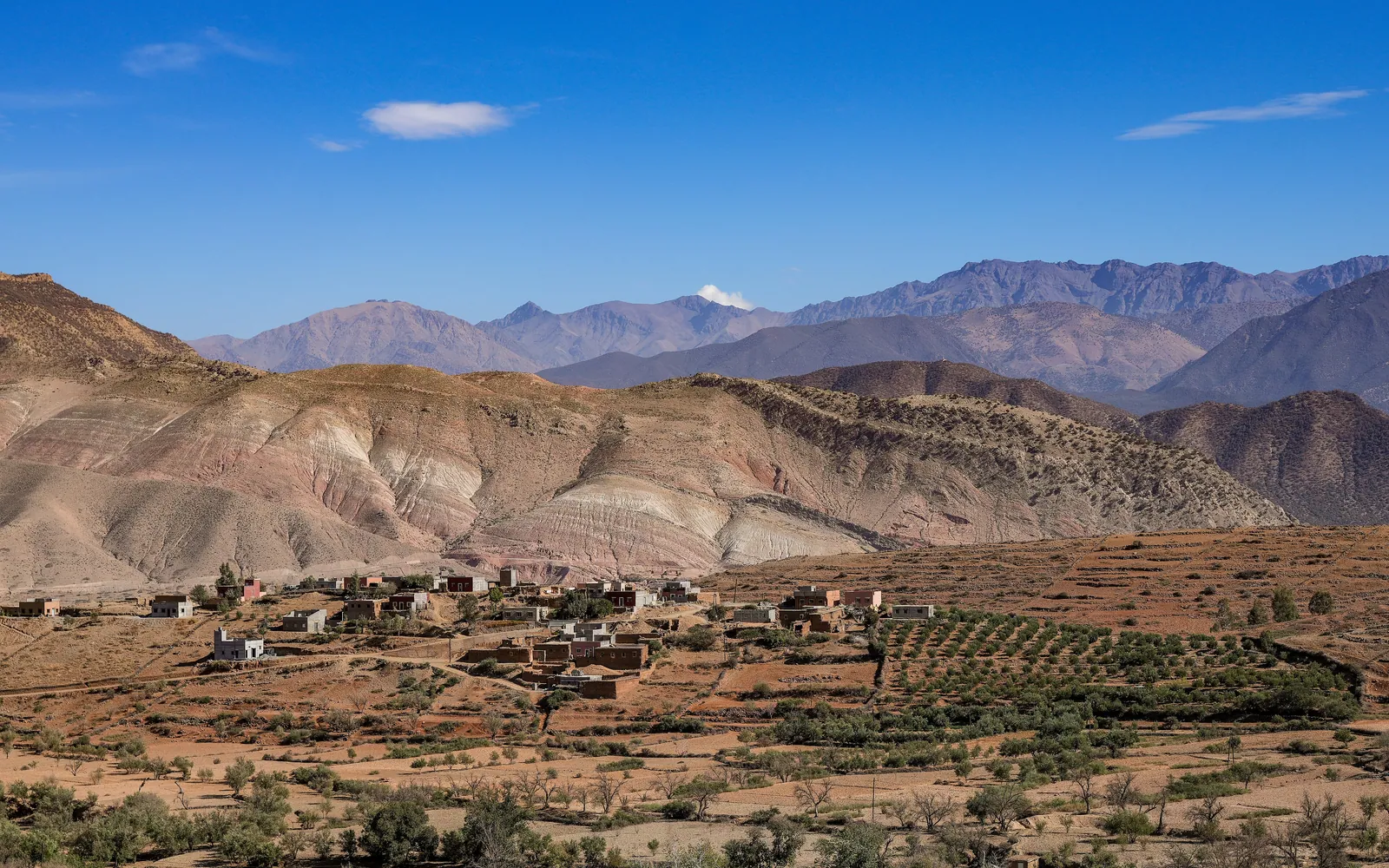
Geology is the first grammar of any landscape, and it is written large enough to read from a moving vehicle. The shape of a mountain — whether it is rounded and ancient or sharp and raw — tells you its age. The old ranges of Scotland and the Appalachians are smooth because hundreds of millions of years of erosion have ground them down; the young Alps and Andes and Himalaya are jagged because the forces that raised them are still active and erosion has only begun its work. When you cross from old hills to young ones, you are crossing a page in deep time.
Rock colour speaks too: the red of iron-bearing sandstone, the white of limestone, the dark grey of volcanic basalt. The Atacama's particular yellows and ochres are the signature of an ancient sea bed lifted to the sky; the black plains of Iceland are last century's lava. The traveller who has seen enough varied landscapes begins to read these colours the way a reader recognises fonts: not as decoration, but as information about what the land is made of and what it has been through.
Where water goes, and why it matters
Water shapes a landscape more powerfully than any other force except tectonic movement, and its effects are visible from every moving window. A river that runs straight is almost certainly following a human channel; a river that meanders freely is choosing its own path through flat and yielding ground. The width and colour of a river tells you where it has come from: the milky turquoise of a glacial river, laden with ground rock; the brown of a river that has crossed agricultural plains; the clear black of a river from a peat bog.
The absence of water is equally revealing. The tree line on a mountain marks the altitude above which precipitation falls as snow year-round and the growing season becomes too short for forest. The sudden shift from green to brown at the edge of an irrigated valley marks, precisely, the line where water reaches and where it does not. In the great arid zones of Central Asia and the Atacama, you can trace the civilisations that existed and the ones that failed by following the old watercourses — the dry channels that still scar the land, marking where enough water once ran to sustain a city.
Why villages sit where they sit
Human settlement has its own grammar, and it is among the most readable of all from a moving vehicle. A village perched on a hillside rather than in the valley below it was sited for defence — not to be convenient to its fields but to see an enemy coming. A village strung along a single road grew up as a service point for traffic. A village spread in a rough circle around a central square or well was organised around the common resource at its heart.
The direction a settlement faces tells you about its prevailing climate: south-facing in the northern hemisphere to catch the low winter sun; sheltered behind a ridge from the direction of the dominant wind. The age of a settlement can sometimes be read in its walls: mud brick in a dry landscape, stone where the quarry is close, the characteristic curve and whitewash of a desert town designed to hold the coolness of the night into the heat of the day. These patterns repeat across every continent and every climate, once you know to look for them.
The signs of a changing ecology
A slow overland crossing in almost any part of the world today is also a journey through a landscape in transition. The signs are not always comfortable, but they are important to be able to read. The retreating snowline on a range you can compare to historical photographs. The scrubline that has moved uphill since the last survey, marking warmer growing conditions at altitude. The absence of a tree species from a forest that, according to older maps, should contain it.
Equally legible are the signs of recovery: a valley that was overgrazed two decades ago and is now rewilding; a river that runs cleaner than it once did because the tanning factories upstream have closed; the return of a bird species to a wetland from which it had disappeared. A slow journey gives you enough hours in a landscape to see these transitions — to register not just what a place looks like today but what it is in the process of becoming. This is a form of attention that a fast connection between two airports cannot produce, and it is not a small thing.
Making the window active
The difference between seeing and reading a landscape from a moving vehicle is a matter of questions. A traveller who asks why that range is shaped the way it is, why the road takes that particular line through the hills, why that valley is irrigated and the adjacent one is not — that traveller is doing something different from the one who looks without questioning. The question does not need an immediate answer; it can wait for a conversation with the guide, or a note that is looked up that evening. The question itself keeps the eye active.
The most useful single habit is to look at the horizon first, then work inward: get the large shape of the landscape in your mind before attending to the detail. On a long crossing, this means setting aside the first ten minutes of each new section of road or rail to simply look at the geometry — where the high ground is, where the drainage goes, how the light falls — and letting the detail fill in as the hours pass. This is slow observation in its most literal form: using the time that a slow journey provides to build an understanding that a fast one never could.
What to carry for the window hours
A small amount of preparation multiplies the value of the window hours enormously. A good topographic or physical map of the route, studied the evening before a long drive or rail leg, lets you anticipate what is coming and recognise it when it arrives. A brief reading about the geology or ecology of the region — fifteen minutes in a good travel guide — provides the vocabulary for what you will see. Binoculars, underrated by most travellers, turn distant hillsides and far banks into the same close-reading experience as everything nearby.
The journal is the other essential tool. Notes taken at the window — a sketch of a ridge line, the name of a river, a question about a village that was there and then gone — preserve impressions that would otherwise blur into the general texture of a long day. And those notes, read weeks or months later, do something that photographs from the same window almost never can: they return not just what the landscape looked like but what it felt like to be moving through it, watching it change, reading it as you went.
Quick answers
How can I learn to read a landscape before a journey?
A little geography goes a long way. Fifteen minutes with a physical map of the region you are crossing, plus a brief reading about its geology or ecological zones, gives you the vocabulary to understand what you see. Many good travel books about overland crossings — Patrick Leigh Fermor on the Balkans, Eric Newby on the Hindu Kush, Dervla Murphy across many mountain ranges — are excellent training in how to look at a landscape while moving through it.
Is it worth bringing binoculars for road and rail journeys?
Yes, and most travellers are surprised how much they add. Binoculars turn a distant valley or far escarpment into the same quality of close observation as the foreground, and on a long overland crossing they multiply the range of what can be read from a moving seat. A lightweight pair, kept to hand rather than buried in a bag, will be used far more than you expect.
What is the single most useful thing to look for in an unfamiliar landscape?
Where the water goes. Water organises everything else in a landscape — where people live, where they grow food, where the roads run, where the vegetation survives and where it does not. If you understand the drainage pattern of a region — which way the rivers flow, where the wetlands are, where the dry zones begin — you understand the logic behind most of what you see above and around it.
How do I stay attentive on a very long drive or train journey?
By working in intervals rather than trying to sustain continuous attention, which is not how the mind works. Look actively for twenty or thirty minutes, then rest, then look again. Give yourself tasks — count the rock types you can identify, sketch the profile of the range to the north, note the changes in vegetation cover every hour. Active looking of this kind is far less tiring than passive staring, and it generates the memories that last.
Let the reading become a route.
When an article sparks something, our planners are the next step. Tell us what you are dreaming of.