Reading the Weather While You Travel
Apps give you a forecast; experience gives you a read. Here is how to understand weather in the field — in mountains, deserts and polar latitudes — and why the guide's eye often beats the algorithm.
A weather app is a useful thing, until it is not. In a Patagonian valley where the microclimate changes from hour to hour, in the high Andes where an afternoon storm builds with alarming speed above the snow line, or in the Central Asian steppe where the satellite coverage that feeds the forecast is sparse, an app gives you yesterday's data dressed as tomorrow's prediction. The traveller who can also read the sky, the wind and the landscape has something the app does not: a read that is local and immediate.
This article is not a meteorology course. It is a practical guide to the weather cues that matter most on a grand expedition journey — the signs that a high-mountain afternoon is turning, the pattern that marks a desert day worth starting early, the tell that a polar channel crossing will be calmer than forecast. Most of these are things your guide already knows. Understanding the vocabulary helps you follow the conversation and make better decisions when the question is whether to set out.
Why mountain weather is different
Mountains make their own weather, in ways that lowland forecasts cannot fully capture. Air rises over a high ridge, cools and condenses into cloud; wind accelerates through passes and valleys; the temperature drops roughly six degrees Celsius for every thousand metres of altitude. A valley-floor forecast for a sunny day in the Andes may accurately describe what is happening below two thousand metres while a full storm builds above four thousand, invisible to the algorithm and very relevant to the walker.
The practical consequence is that mountain days should be planned for early starts and early finishes, before the afternoon convective storms that are a feature of the tropical Andes and the high Himalayan approaches from late morning onwards. Watch the high ridges: the first capping clouds on the summit zone — a lenticular cap, a flag cloud streaming from a peak — are early warnings that the upper atmosphere is disturbed and deteriorating conditions are likely. Your guide will read these signs before they become a forecast.
Reading a desert day
Desert weather has its own logic. The challenge in the Atacama or the Namib is rarely rain — the world's driest places receive almost none — but temperature swing and wind. The Atacama sees near-freezing nights and midday temperatures thirty degrees warmer; the Namib's afternoon winds are predictable in direction but not in intensity. A desert day starts cold and ends hot, and the most pleasant hours — and the best light — are the early morning and the hour before sunset.
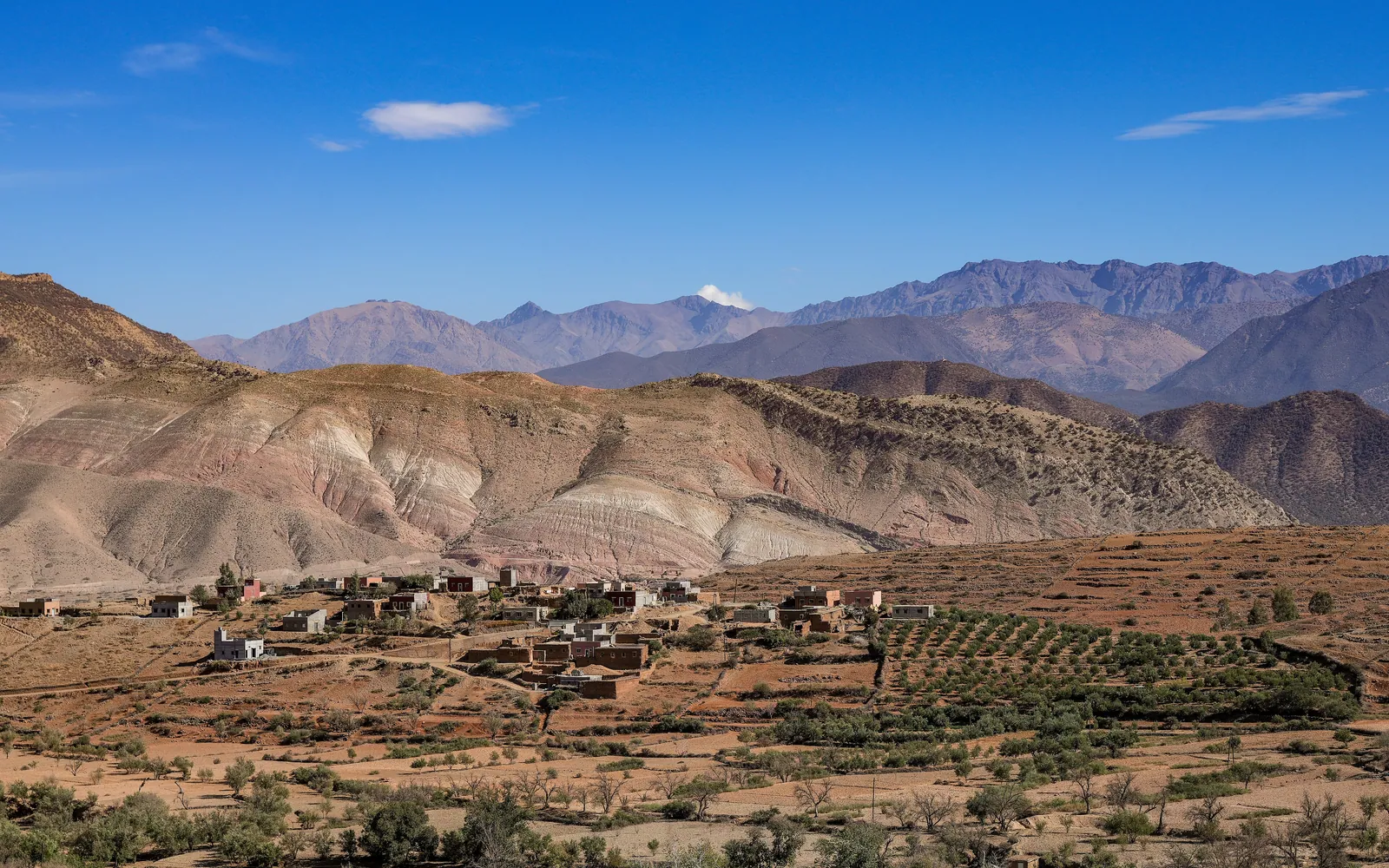
Sand and dust carried on wind — common in Morocco's pre-Saharan fringe and in the Gobi approaches of Central Asia — can reduce visibility, coat optical equipment and make breathing unpleasant. Watch the colour and texture of the horizon: a hazy ochre tinge where the sky meets the desert floor on a normally clear day is often a suspended-dust indicator. Your guide will know whether this is a diurnal rhythm or the sign of approaching winds worth heeding.
Polar and ocean weather: expect change
Antarctic and sub-Antarctic weather is among the world's most volatile. The Southern Ocean is not governed by the land masses that moderate temperate weather, and pressure systems move through it with a speed and force that means a calm morning can become a rough afternoon with little warning. The rule on expedition ships is to go ashore early, with the guide's read of the forecast and the swell, and to hold the flexibility to delay or cancel a Zodiac landing if conditions change.
One practical skill for polar environments is reading the sky for the coming hours rather than the day. A mackerel sky — high, rippled cirrocumulus cloud — often precedes a weather front by twenty-four to forty-eight hours. An abrupt wind shift from a steady direction can mean a pressure system is approaching or passing. These are not precise predictions, but they are the sailor's art of preparing for what is coming rather than reacting to what has arrived.
When the app fails
Weather apps fail for several reasons on a grand journey. Coverage depends on weather stations, and the regions between stations — remote mountain valleys, the open ocean, the steppe between cities — are where interpolation fills in what measurement cannot reach. Apps also speak in probabilities that assume a specific location, while a day's walk may cross several distinct microclimates. A 30 percent chance of afternoon rain means something very different in Scotland than in Patagonia, where the same probability often means a near-certainty in a particular valley.
The practical workaround is to use the app as one source of information, not the only one. Check it for the broad picture — a front arriving, a multi-day clear spell, the general wind direction — and then ask the guide for the local read. Guides who operate in the same landscapes repeatedly develop a feel for the patterns that no algorithm learns: the specific time the afternoon clouds build over a particular range, the months when morning fog burns off reliably, the valley where the wind is always stronger than it seems it should be.
Dressing for uncertainty
The best response to uncertain mountain or polar weather is a layering system that can respond to whatever arrives. The principle is to be able to add or subtract quickly: a lightweight fleece over a base layer, a wind shell over that, an insulated jacket and a waterproof outer shell available in the top of the daypack. This is not about carrying more; it is about carrying the right sequence of layers so that a cold morning, a warm midday, a wet afternoon and a cold evening are all within the wardrobe you already have on your back.
Protect extremities early, before they are cold: fingers, toes and ears lose heat much faster than the body's core, and once they are cold they are harder to warm. A pair of thin liner gloves takes almost no space in a daypack pocket and converts a miserable cold-hand hour into a comfortable one. The mountains and the polar shore reward the traveller who prepares for the day's worst hour, not the day's average.
Quick answers
How reliable are weather apps in remote mountain and polar regions?
Useful for the broad picture — approaching fronts, multi-day patterns, general temperature range — but less reliable for precise timing and local intensity in regions between weather stations. Mountain valleys, the polar ocean and the open steppe all create microclimates that apps average away. Use the forecast as one input alongside the guide's local read, and treat afternoon mountain weather especially as something to observe in real time rather than predict with confidence.
What are the main weather hazards I should know about on an Andean trek?
The primary hazard is the afternoon convective thunderstorm, which builds above the snow line from late morning and can arrive with remarkable speed. Start walking early, aim to be descending by early afternoon, and watch the high ridges for the first capping clouds on the summits. Lightning at altitude and sudden rain reducing trail visibility are the main concerns; neither is dangerous if you build a schedule that keeps you below the exposed upper ground before the storm season builds.
Why does my guide sometimes ignore the forecast?
Not ignore, but interpret. A guide who has worked the same landscape across many seasons has observed patterns the app cannot know: the valley where wind always comes from the north after a front, the peak whose summit cloud reliably signals a six-hour window of stability, the coastal channel that calms most mornings regardless of what the offshore forecast says. This accumulated local knowledge is not superstition — it is pattern recognition from repeated observation, and it is one of the most valuable things an experienced guide carries.
Let the reading become a route.
When an article sparks something, our planners are the next step. Tell us what you are dreaming of.