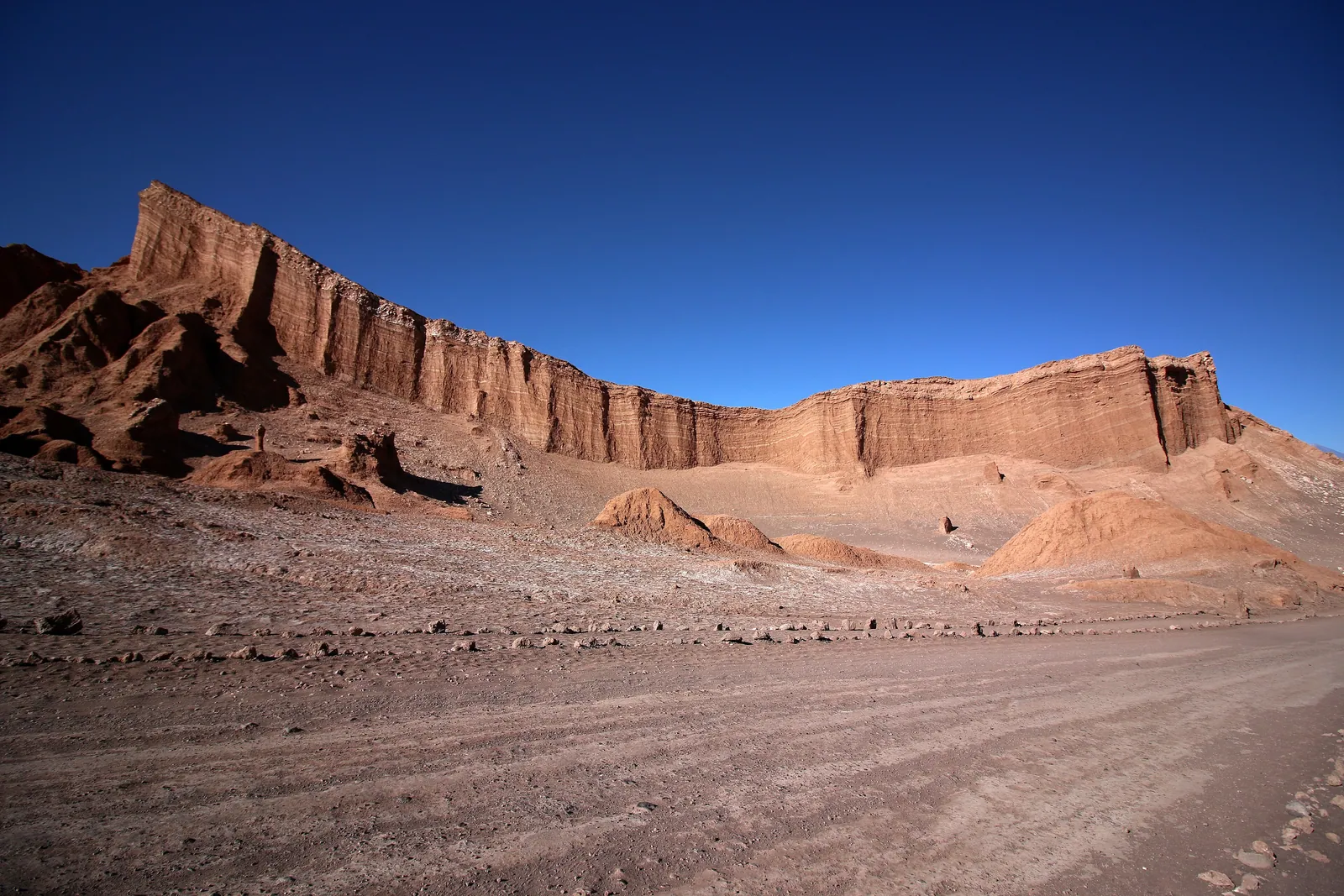
Reading Valle de la Luna: The Atacama's Moon Valley
The Valley of the Moon is the Atacama's classic first evening — but its salt ridges and folded rock tell a long geological story. A field guide to what you are actually looking at, and how to watch the light.
Valle de la Luna — the Valley of the Moon — is a basin of wind-carved rock, salt and dune just west of San Pedro de Atacama, and it is the traditional opening evening of an Atacama week. Travellers come for the sunset, when the light turns the ridges gold and then violet, and they are rarely disappointed.
But the valley is more than a sunset viewpoint. Its strange, lunar terrain is a legible record of geology in slow motion — ancient lake beds lifted and folded by the rise of the Andes, then sculpted by tens of thousands of years of wind and salt. Learn to read it, and the evening becomes a lesson in deep time as well as a beautiful one.
How a valley comes to look like the Moon
Valle de la Luna lies within the Cordillera de la Sal, the Salt Mountains — a range made not of granite but of sediment laid down on the floor of vanished lakes millions of years ago. As the Andes rose, those flat beds of clay, gypsum and rock salt were squeezed, tilted and buckled, so that strata which once lay horizontal now stand on end or fold back on themselves in great frozen waves.
On top of that buckled foundation, the desert went to work. With virtually no rain to soften it, the landscape is shaped almost entirely by wind and by salt — water seeping in, evaporating, and leaving crystals that crack the rock apart from within. The result is a terrain of knife-edge ridges, hollowed caverns and pale crusts that genuinely resembles a planetary surface, which is why NASA has used the wider Atacama to test Mars rovers.
What to look for on the ground
Three features repay close attention. The first is the salt itself: in the quiet of late afternoon you can sometimes hear the valley faintly cracking and ticking as the cooling rock contracts and salt crystals shift. The second is the great amphitheatre and the so-called Three Marys — eroded salt-and-clay formations that show, in cross-section, just how violently the old lake beds were folded.
The third is the dunes. Along one flank of the valley, wind has piled fine sand into a long, sweeping dune whose crest catches the last light with particular drama. The interplay is the whole point of the place: hard folded rock, soft mobile sand, and a white bloom of salt over both, all of it lit by a sun dropping fast toward the Pacific.
Watching the light: the sunset hour
The Valle de la Luna sunset is a guided late-afternoon excursion from San Pedro, and the timing is deliberate. As the sun lowers, its light strikes the ridges at an ever-shallower angle, raking across the terrain so that every fold and furrow throws a long shadow. The colours move through gold and amber to deep orange and, in the minutes after the sun has gone, a soft violet that settles over the whole basin.
Behind you, the Licancabur volcano and the wall of the Andes often glow pink at the same moment — a phenomenon worth turning around for, as many first-time visitors face only the sunset and miss it. Bring a warm layer: the temperature drops sharply the instant the sun is down, and the desert that felt baking an hour earlier turns cold quickly.
A gentle excursion, well placed in the week
Valle de la Luna is, by Atacama standards, an easy outing. It sits at a modest altitude close to San Pedro, involves only light walking, and demands no early start. That makes it the natural choice for a first or second evening — a way to see the desert at its most beautiful while the body is still settling into the altitude and the harder, higher excursions wait their turn.
On Andes to Antarctica and The Pacific Arc, the Atacama Desert leg tends to open here, with a sunset in the Valley of the Moon, precisely because it asks so little and gives so much. It is the desert's gentle handshake — the evening that tells you, before any geyser or salt flat, what kind of landscape you have come to.
Practicalities and protecting the valley
Valle de la Luna is a protected area within the Los Flamencos National Reserve, and access is managed: entry is by the official route, on marked trails, and the salt formations are fragile and not to be climbed. Caves and viewpoints can be busy at sunset, so a good guide will time your arrival to find space and the best angle on the light.
Practical kit is simple. Bring water, sun protection for the bright approach, sturdy shoes for the crusted ground, and a warm layer and small torch for the walk back after dark. The valley is close enough to San Pedro that you are back in the village for dinner — a fitting end to a first day in the Atacama.
Quick answers
Why is it called the Valley of the Moon?
Valle de la Luna earns its name from its terrain — a basin of wind-carved rock, salt crusts and dunes that genuinely resembles a lunar or planetary surface. The landscape is so otherworldly that the wider Atacama Desert has been used by NASA to test instruments and rovers bound for Mars. The valley's folded salt strata are ancient lake beds lifted by the rise of the Andes.
When is the best time to visit Valle de la Luna?
Late afternoon, for the sunset. As the sun lowers, its light rakes across the ridges and the colours move through gold and orange to a soft violet, while the Andes behind often glow pink. It is a guided excursion from San Pedro de Atacama with only light walking, which makes it ideal for a first or second evening while you are still acclimatising.
Is Valle de la Luna a difficult excursion?
No — it is one of the gentlest outings in the Atacama. It sits at a modest altitude near San Pedro, involves only easy walking on marked trails, and needs no early start. That is why it is usually scheduled early in an Atacama stay. Bring water, sun protection, sturdy shoes and a warm layer, since the temperature drops sharply once the sun is down.
Let the reading become a route.
When an article sparks something, our planners are the next step. Tell us what you are dreaming of.