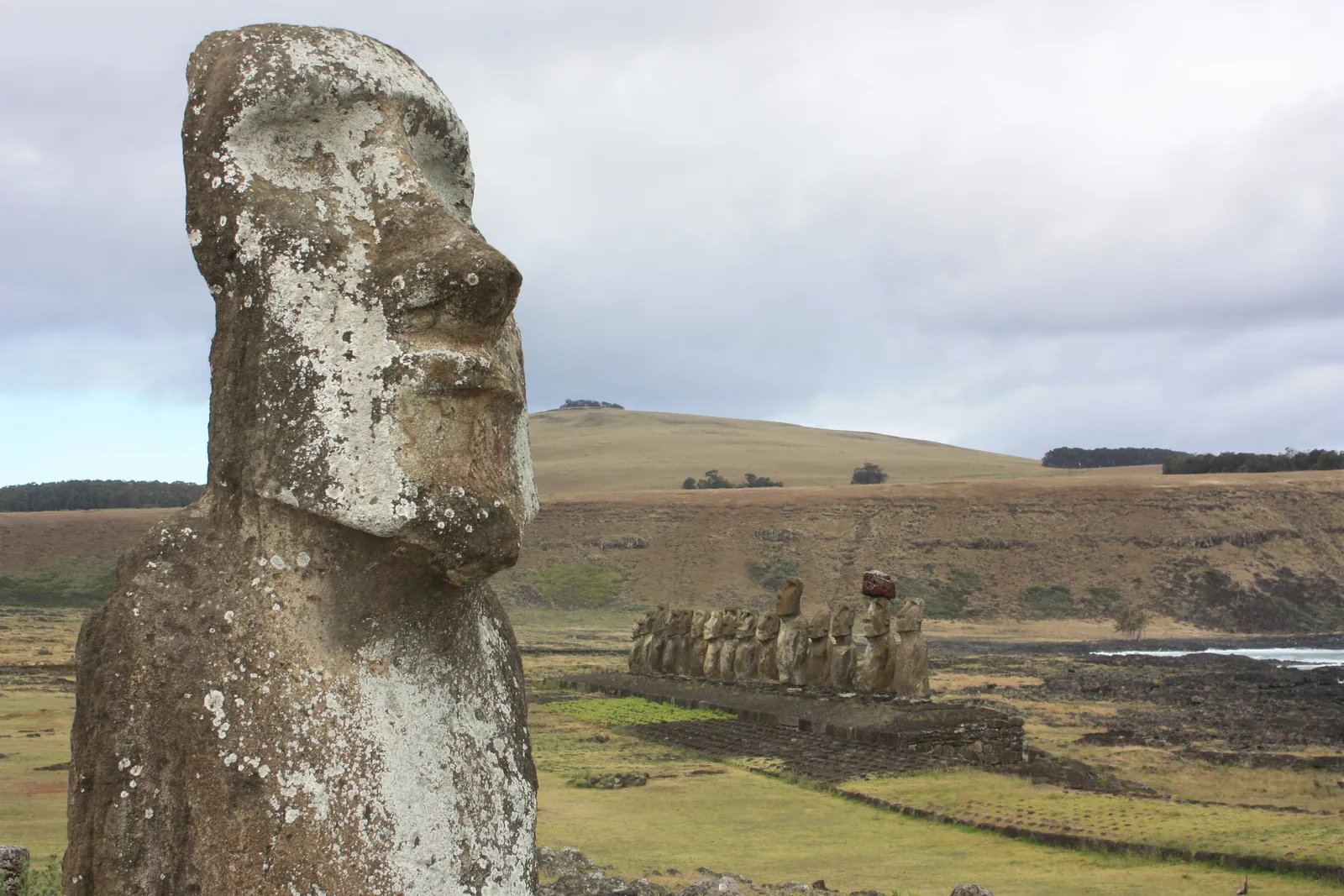
Rethinking the Collapse of Rapa Nui
For decades Easter Island was told as a parable of self-destruction — a society that wrecked its own environment and crashed. Recent research tells a more careful, and more humane, story. Here is what changed.
Many travellers arrive on Rapa Nui carrying a single, dramatic story: that the islanders cut down their last tree, fought ruinous wars, and brought about their own collapse before Europeans ever arrived — an island-sized cautionary tale of ecological suicide. It is a powerful narrative. It is also, as the evidence has accumulated, looking increasingly unreliable.
The honest position today is that the old collapse story oversimplifies, and in places contradicts, what the archaeology shows. The deforestation was real and so was profound hardship, but the picture of a society that wiped itself out before contact does not hold up well. The most devastating blows came after Europeans arrived. On The Pacific Arc this more accurate, more respectful version is the one our guides tell.
The story as it was usually told
The classic account runs like this. Settlers reached a forested island and prospered. Obsessed with building ever more moai, rival clans stripped the land of trees — to move statues and to farm — until the forest was gone. Soil eroded, food failed, society fractured into warfare, the moai were toppled, and the population crashed catastrophically, all before the first European ship appeared in 1722.
Popularised in influential books, this version made Rapa Nui a global metaphor for environmental self-destruction. Its appeal is obvious: a closed island, a clear lesson. But a tidy parable and an accurate history are not the same thing, and specialists in Rapa Nui archaeology have grown steadily more uneasy with it.
What the deforestation really involved
The island did lose its forest — that much is not in dispute. Rapa Nui was once covered in palms and other trees, and by the time of European contact it was largely treeless. But the cause was not simply reckless felling. A major factor was the Polynesian rat, which arrived with the settlers and whose population exploded; rats ate the palm nuts and prevented the forest from regenerating, so trees that were cut were never replaced.
Crucially, the Rapa Nui adapted rather than collapsed. They developed sophisticated farming for a hard environment: rock gardens and stone mulch, called manavai and lithic mulching, that retained moisture, sheltered crops from wind and released minerals into thin soil. Losing the forest was a serious change, but the islanders engineered their way to a workable life on the land they had.
The evidence against a pre-contact crash
Several lines of evidence undercut the idea of a population collapse before 1722. Studies of where people lived and farmed suggest the island sustained a substantial population, with no clear sign of a dramatic die-off in the centuries before contact. Analysis of the agricultural landscape points to a community managing its resources, not one in free fall.
The 'warfare' story has also been questioned. The obsidian objects long described as spear points, the mata'a, were probably general-purpose tools for cultivation and craft rather than weapons of mass conflict. And the toppling of the moai was a long, partly post-contact process bound up with religious and social change — not simply the wreckage of a war.
What actually devastated the island
The genuine catastrophe is well documented, and it came from outside. European contact brought introduced diseases to which the islanders had no immunity. Then, in the 1860s, Peruvian slave raids abducted a large share of the population, including much of the ruling and knowledge-holding class; the few survivors who returned brought epidemics with them.
Between disease, slaving, emigration and the loss of land to outside interests, the Rapa Nui population fell to barely a hundred people by the 1870s. This — not a self-inflicted pre-contact collapse — is the demographic disaster. The island's hardest chapter was colonial, and saying so plainly is a matter of historical accuracy.
Why the better story matters to a traveller
This is not academic hair-splitting. The old narrative quietly blames the Rapa Nui for their own near-destruction, when the decisive harm was done to them. It also obscures the real achievement: a people who adapted intelligently to a difficult, shrinking resource base and endured.
And endure they did. The Rapa Nui survived the nineteenth century, kept their language and genealogies, and are a living community today. Travelling here with the accurate story in mind changes the moai from monuments to a vanished folly into what they are — the work of a resilient people whose descendants still walk the island. That is the Rapa Nui our journey is built to honour.
Quick answers
Did the people of Easter Island really destroy their own environment?
The island did lose its forest, but the simple story of reckless self-destruction is now widely doubted. Introduced rats, which ate palm nuts and stopped the forest regenerating, were a major cause, and the Rapa Nui adapted with sophisticated farming techniques. They engineered a viable life rather than simply collapsing into ruin.
What really caused the Rapa Nui population to crash?
The catastrophic population decline came after European contact, not before it. Introduced diseases, and especially the Peruvian slave raids of the 1860s, devastated the island. By the 1870s the Rapa Nui population had fallen to roughly a hundred people. The decisive harm was colonial, not a pre-contact self-inflicted collapse.
Were the moai toppled in a civil war?
The toppling of the moai, known as huri moai, was a long process tied to religious and social change, including the rise of the birdman cult, and it continued into the period after European contact. It is better understood as profound cultural change than as the simple debris of a single catastrophic war.

Let the reading become a route.
When an article sparks something, our planners are the next step. Tell us what you are dreaming of.