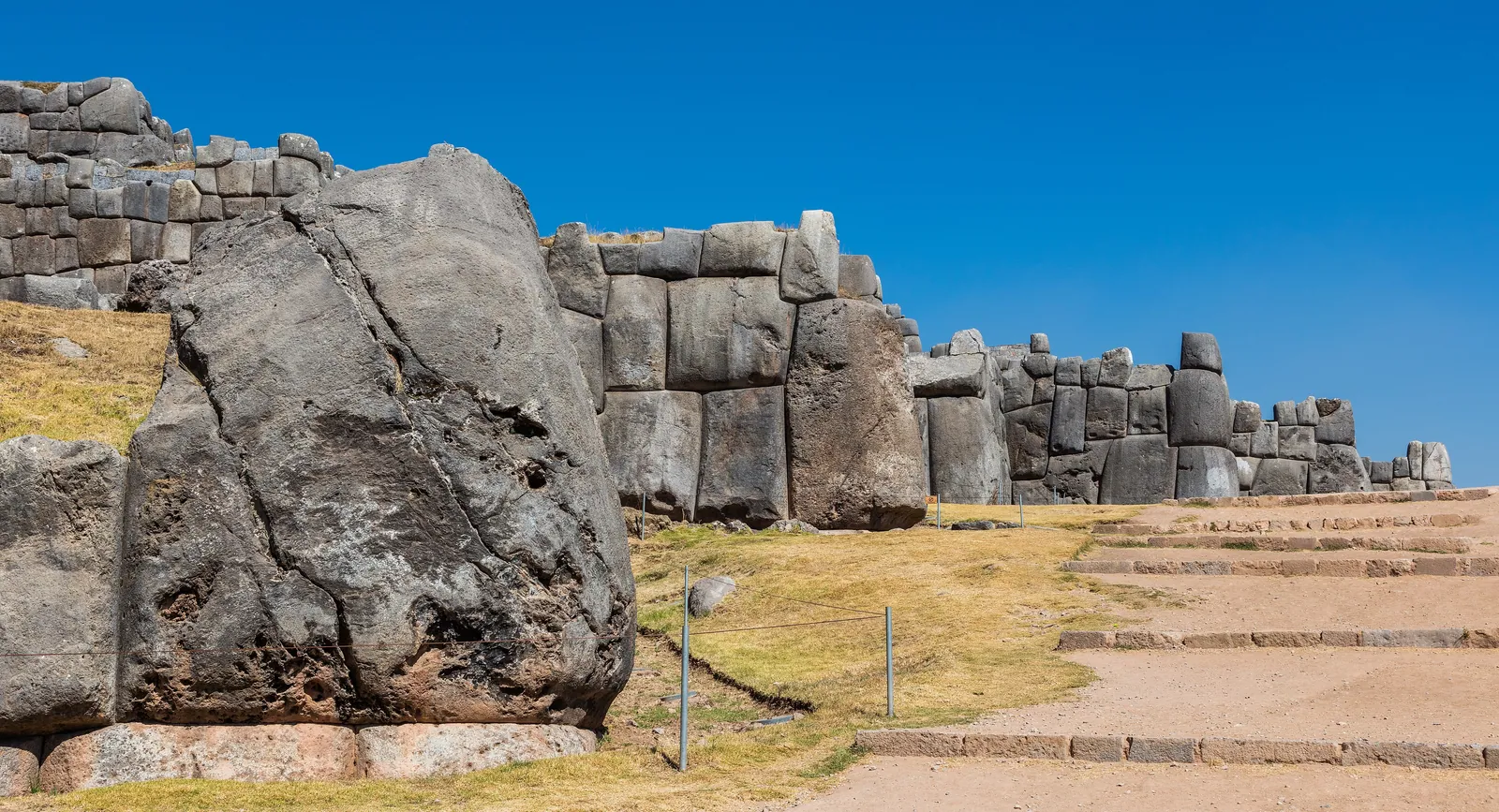
Sacsayhuaman and the Inca Monuments Above Cusco
On the hills above Cusco stand four Inca monuments that most visitors rush past in a morning. Read them slowly and the city below becomes legible in a way it was not before.
The steep streets of Cusco lead upward, and if you follow them north of the city they deliver you to the hilltops that ring the old capital. Here, within a few kilometres of each other, stand four Inca sites that together form a kind of outer constellation to the city below: Sacsayhuaman, the great terraced complex whose zigzag walls hold the largest stones the Inca ever moved; Qenqo, a limestone outcrop carved into a labyrinth of channels and chambers; Puca Pucara, a red-walled military waystation; and Tambomachay, the ceremonial fountain whose water still runs.
Most travellers visit them in a single morning, moving through each in twenty minutes and leaving with little more than an impression of size. That is a pity, because each site rewards close attention in a different way, and the four together — read as a system around the sacred capital — tell a story about Inca ideas of landscape, ceremony and power that no amount of museum-going replaces. On our journeys the hills above Cusco are approached slowly, with a guide who knows how to look at stonework, and on foot wherever possible.
Sacsayhuaman: the largest stones
Sacsayhuaman is the most dramatic site above Cusco and one of the most physically stunning in the Inca world. Its three zigzag terraces of limestone — the walls following a repeated V-pattern that created defensive salients — are built from stones of extraordinary size. The largest of them weighs an estimated 125 tonnes; the average is much smaller, but still enormous. The walls reach up to nine metres high and the stones are fitted so precisely, without mortar, that a piece of paper cannot be slid between them.
The site is sometimes described as a fortress, sometimes as a ceremonial complex, and the evidence is complex enough to sustain both. The Spanish chronicle tradition associates it with military use, and the zigzag walls make tactical sense as a defended terrace line. But the interior was also a setting for large ceremonial gatherings — the Inca Raymi festival, celebrating the sun at the winter solstice, is still held here today — and the scale of the construction argues for a significance beyond the purely military. It was, like most great Inca constructions, probably both.
How the stones were moved
The question that Sacsayhuaman asks most insistently is: how? The largest limestone blocks were quarried from outcrops several kilometres away and hauled up to the hilltop by a workforce that historians estimate in the tens of thousands. The Inca had no wheeled vehicles, no draft animals capable of moving such weights, and no iron tools. They used ropes, wooden sledges, earthen ramps, and the coordinated labour of an imperial system that could mobilise enormous numbers of people through the mit'a, the obligatory service that subjects owed the state.
The precision of the fitting — each stone cut to a unique shape to interlock with its neighbours — is as impressive as the weight. Inca stonemasons worked by abrasion rather than by cutting with metal chisels, shaping each surface by rubbing it against its counterpart until the fit was perfect. The result is walls that have survived earthquakes that demolished the Spanish colonial structures built from the stones the conquistadors removed. The Spanish used Sacsayhuaman as a quarry for centuries; what remains is perhaps a third of the original construction.
Qenqo: the carved rock
A short walk east of Sacsayhuaman, a large natural limestone outcrop emerges from the hillside and reveals itself, on closer inspection, to have been comprehensively shaped by human hands. Qenqo — the name means labyrinth or zigzag in Quechua — is not a built structure but a carved one: channels, niches, steps and passages cut directly into the rock, creating a complex underground chamber beneath the carved upper surface.
The channels carved into the top of the outcrop are thought to have directed liquids — chicha, the fermented maize drink, or perhaps blood from sacrificial animals — in ritual contexts. The underground chamber, reached by a narrow passage, has a flat altar-like surface and carved niches in its walls. The interpretations of Qenqo's precise function remain contested, but it is clearly a place where the Inca engaged with the natural rock itself as sacred material, shaping rather than displacing it. After the polished walls of Sacsayhuaman, its rougher, more intimate quality is arresting.
Puca Pucara and Tambomachay
A few kilometres further along the road above Cusco, Puca Pucara — the red fortress — is a compact military waystation of pinkish stone, probably used as a guard post and rest house on the royal road leading north. Its walls and storage rooms are modest compared to Sacsayhuaman, but the site commands a wide view of the valley approaches to the city and illustrates the Inca practice of layering ceremonial and military functions across the landscape.
Across the road, Tambomachay is the most intimate of the four. A series of terraced niches and channels in a natural spring-fed alcove carries clean water in three distinct flows that converge in a sequence of polished stone spouts. The water still runs, as it has run for five centuries. The Inca held springs and water sources as sacred, and Tambomachay is one of the best-preserved examples of a huaca — a sacred place — organised around the movement and display of water. Its stillness and the sound of the water make it, for many visitors, the most memorable of the hilltop sites.
Walking the circuit
The four sites can be walked as a circuit from Cusco in three to four hours at a comfortable pace, with the ascent from the city to Sacsayhuaman being the most demanding stretch. The walk is rewarding in its own right: the path rises through neighbourhoods at the edge of the city, past walls where the Inca stonework simply continues into domestic buildings, and emerges onto the hillside with a widening view back over the Cusco basin.
A combined ticket — the Boleto Turístico del Cusco, or tourist pass — covers all four sites, as well as many other sites in the region. Allow the morning rather than an hour: Sacsayhuaman alone deserves time if you want to do more than photograph the big stones, and the walk between Qenqo and Tambomachay through open hillside is pleasant enough to justify not rushing. The hilltops above Cusco are one of the few places in the region where you can be outdoors, at altitude, looking down at the city, and feel the scale of the empire the Inca built around this place.
Quick answers
How heavy are the stones at Sacsayhuaman?
The largest single stone at Sacsayhuaman weighs an estimated 125 tonnes — some accounts put individual stones even higher. The average stone in the main terraces is considerably smaller but still enormous by any standard. All were quarried from outcrops several kilometres away and moved without wheeled vehicles or iron tools, using ropes, earthen ramps and organised mass labour.
Is Sacsayhuaman a fortress or a ceremonial site?
Almost certainly both, and the distinction may be less meaningful in Inca terms than in ours. The zigzag terraces make tactical sense as defended walls, and the site was used militarily during the Spanish conquest. But it was also a major ceremonial space — the Inca Raymi festival is still held there — and the scale of the construction goes far beyond what military use alone would justify. Inca sacred and political functions typically overlapped.
Can the four hilltop sites be visited on foot from Cusco?
Yes. Sacsayhuaman is a steep but manageable walk of about thirty to forty minutes from the city centre. From Sacsayhuaman, the path continues to Qenqo, then to Puca Pucara and Tambomachay along the road north — a total circuit of three to four hours. The walk is at altitude (Cusco is at roughly 3,400 metres), so a few days of acclimatisation first makes an enormous difference.
Why is so much of Sacsayhuaman missing?
The Spanish used Sacsayhuaman as a convenient quarry for centuries after the conquest, removing its stones to build the colonial city below. Smaller stones were easier to take and went first; the enormous lower terrace blocks were too heavy to move easily and mostly remain. Estimates suggest that only about a third of the original structure survives. What remains is still among the most impressive Inca construction anywhere.
Let the reading become a route.
When an article sparks something, our planners are the next step. Tell us what you are dreaming of.