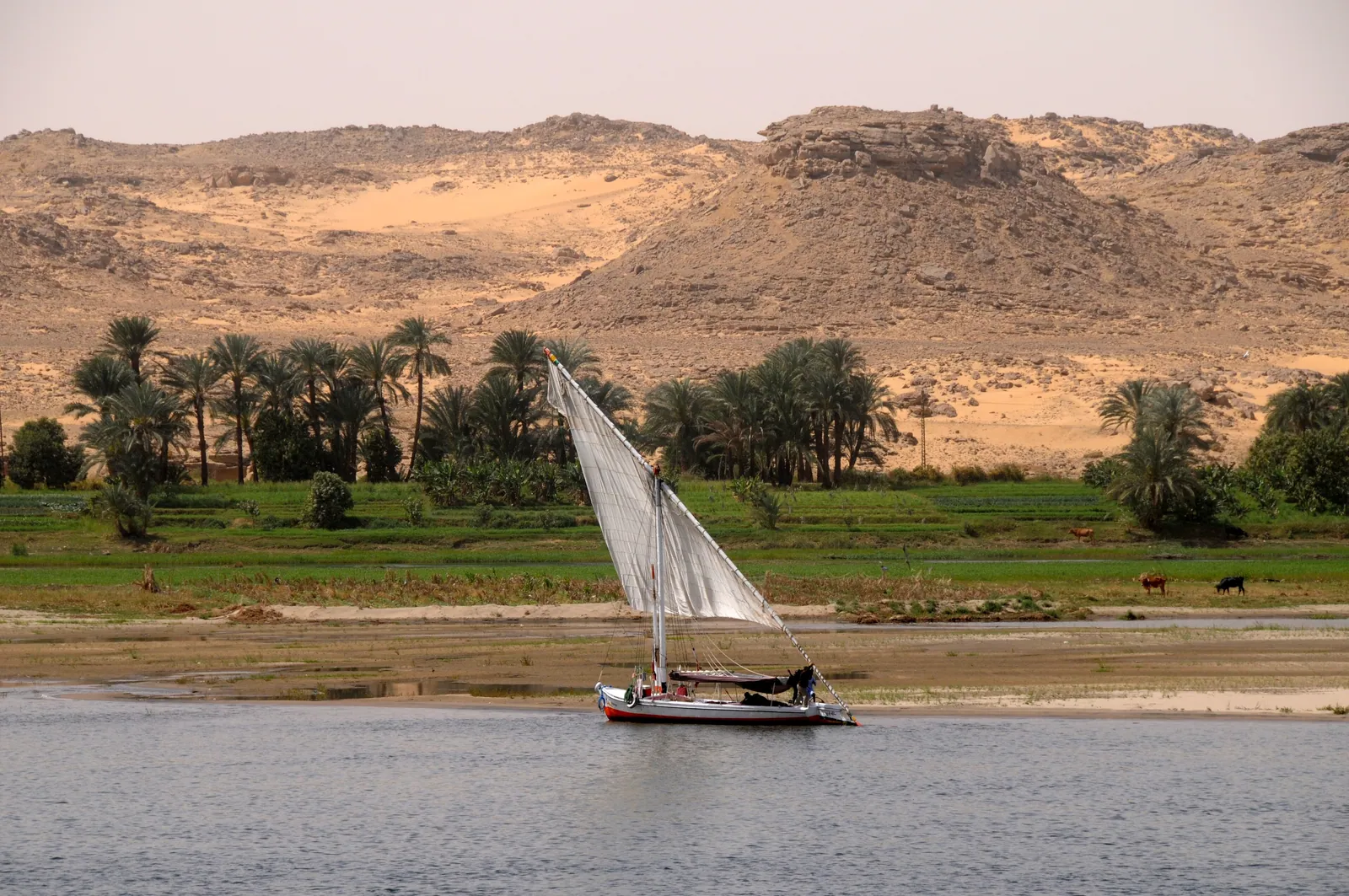
Sailing the Nile by Dahabiya
Before the cruise ship there was the dahabiya — a small, wind-driven sailing boat that carried the first travellers upriver. Here is why we still choose it, and what days under sail between Luxor and Aswan are like.
A dahabiya is a shallow-draught Nile sailing boat with two lateen sails, a handful of cabins and a flat shaded deck. It is the vessel that carried nineteenth-century travellers — Florence Nightingale and Amelia Edwards among them — slowly upriver, and it remains the most graceful way to sail the stretch of the Nile between Luxor and Aswan.
The difference from a standard river cruiser is one of scale and tempo. A dahabiya carries perhaps a dozen guests rather than two or three hundred, moves with the wind and current rather than against a deadline, and can moor at sandbanks and village landings the large ships sweep past. You trade the swimming pool and the floor show for silence, and on the Nile that is a very good trade.
What a dahabiya is
The name comes from the Arabic for 'the golden one', a memory of the gilded barges of Ottoman-era notables. A modern dahabiya keeps the historic form — a long, low wooden hull, two raked masts carrying triangular lateen sails — but adds en-suite cabins, a shaded sun deck and a small saloon. Most carry between eight and twelve guests.
Because it is small and shallow, a dahabiya behaves quite differently from a cruise ship. It sails when the wind serves and is gently towed by a small tender when the wind fails, so the engine noise that underlies a big-boat cruise is largely absent. The result is a deck from which you mostly hear the river, the rigging and the birds.
The route between Luxor and Aswan
The classic dahabiya voyage runs the roughly 200 kilometres of Nile between Luxor and Aswan, usually upstream from Luxor so the prevailing north wind is behind you. It typically takes three to five nights, and the unhurried pace is the point: this same stretch is the heart of pharaonic Egypt.
Between the two cities lie temples that the big ships often skip for want of a mooring — Esna, with its hypostyle hall sunk below the modern town; Edfu, the most complete temple in Egypt, dedicated to the falcon god Horus; and Kom Ombo, standing right at the water's edge and shared unusually between two gods, Sobek the crocodile and Horus the elder. A dahabiya can stop at all of them, and often at quiet hours.
A day on board
Days fall into an easy rhythm. Mornings and late afternoons are given to temples and villages, reached by a short walk or a ride from a riverbank mooring; the hot middle of the day is spent under sail, with lunch on deck as the green ribbon of cultivation slides by on both banks. Evenings are quiet — dinner, the stars, perhaps a fellucca crew singing from a passing boat.
Moorings are part of the pleasure. A dahabiya can tie up against an empty sandbank for a swim, or at a small village where the captain knows the family, far from any town. There is no nightclub and no shop; the entertainment is the river itself, which over a few days proves to be more than enough.
Why the river still matters
Egypt is, in the old phrase, the gift of the Nile. The river's annual flood once laid down the silt that fed the country, and almost the entire population still lives within a few kilometres of its banks. To travel by water is to follow the axis along which the whole civilisation was strung — temples, towns and tombs all reading from the river outward.
Sailing it slowly also restores the original scale of ancient travel. The pharaohs moved their courts, their armies and their building stone by boat; pilgrims and traders did the same for millennia. A dahabiya is the nearest a modern traveller can come to that experience, and it reframes every temple you visit as a place that was always meant to be reached from the water.
How we sail the Nile
On The Great Rift, the second chapter of the journey is given over to several unhurried days aboard a traditional dahabiya between Luxor and Aswan. It sits deliberately after the intensity of Cairo and Giza — a stretch of the route designed to slow the pulse before the journey climbs south into the Ethiopian highlands.
We favour smaller boats and quieter moorings, with a guide travelling on board so the temples are explained in sequence rather than rushed. For travellers who want only this leg, the Egypt-and-the-Nile module can be joined on its own; for those continuing, the dahabiya is the gentle hinge between the desert north and the green highlands ahead.
Quick answers
How long does a dahabiya trip on the Nile take?
A typical voyage between Luxor and Aswan runs three to five nights, sailing upstream so the prevailing north wind helps. That is enough to visit the temples of Esna, Edfu and Kom Ombo at an unhurried pace and to enjoy several quiet riverbank moorings along the way.
How is a dahabiya different from a Nile cruise ship?
A dahabiya is a small wind-driven sailing boat carrying roughly eight to twelve guests; a Nile cruiser is a multi-deck motor ship carrying many times that number. The dahabiya is quieter, sails with the wind, and can moor at sandbanks and villages the large ships cannot reach. It has fewer onboard facilities, which most travellers find a fair exchange.
When is the best time to sail the Nile?
October to April brings the most comfortable temperatures in southern Egypt, with warm days and cool nights. The summer months of June to August are very hot in Upper Egypt and better avoided for a sailing trip, where much of the day is spent on an open deck.
Let the reading become a route.
When an article sparks something, our planners are the next step. Tell us what you are dreaming of.