Sea Ice and Icebergs: Reading the Frozen Ocean
The ice around Antarctica is not a single thing — it is a world of shifting forms, from vast tabular bergs to the crunching grease of a new-forming sea. Learning to read it transforms every moment spent in the Southern Ocean.
The first iceberg changes everything. There is a moment on a southbound Antarctic voyage — usually somewhere in the Drake or just clear of it — when a white shape appears on the horizon and does not resolve into a cloud or a wave crest. It sits there, massive and still, the colour of old bone in grey light or dazzling blue-white in sun, and the ship's pace seems to slow involuntarily. Everyone comes to the rail. Whatever was going on below decks stops.
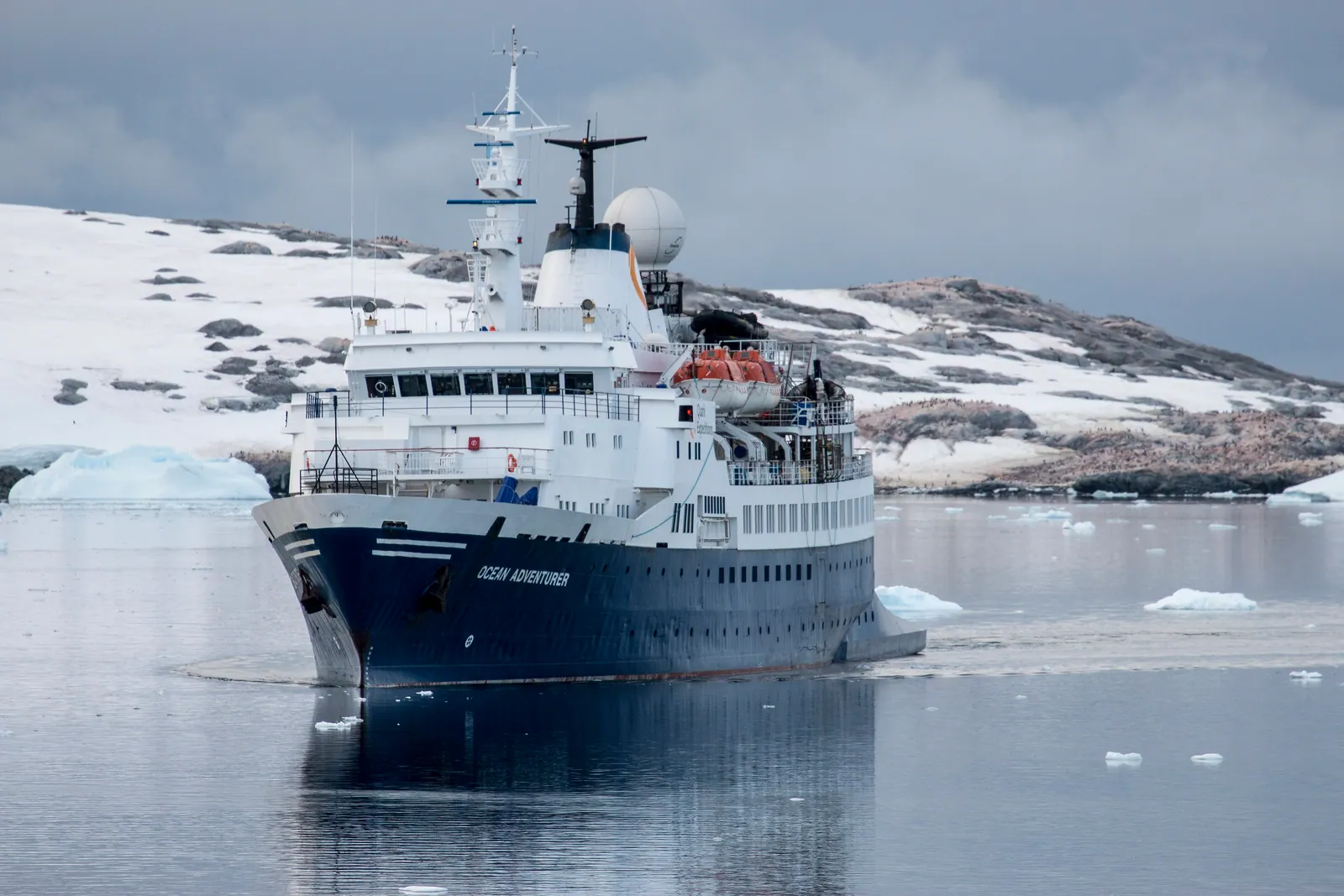
From that moment the ice becomes a constant companion and an endlessly changing one. The Southern Ocean in summer presents every form of frozen water: the table-flat immensity of a calved ice shelf, the sculptured chaos of pack ice, the churning grey slush of new-forming sea ice, and the intimate, turquoise grottoes of a bergy bit low enough to peer into from a Zodiac. Reading ice — understanding what you are looking at and why it matters — is one of the most rewarding things a traveller can do on an Antarctic voyage.
Icebergs: where they come from and how they move
All icebergs are calved from glaciers or ice shelves — they are freshwater ice, accumulated as snow over thousands of years and compressed until it flows. When the seaward face of a glacier or ice shelf fractures under stress, a section breaks away: an iceberg. The process produces pieces of all sizes, from the kitchen-table chunk of a bergy bit to the tabular bergs calved from the great ice shelves of Antarctica's continental rim, which can be hundreds of kilometres across and visible to radar as navigational hazards.
A large tabular berg may take years to melt, drifting in the circumpolar current and eventually breaking apart as it reaches warmer water. What a traveller sees on the Antarctic Peninsula has often been in the ocean for months or years already, sculpted by waves and melt into forms the calving glacier never suggested: arches, pedestals, the deep blue of refrozen meltwater captured in cracks, the vivid turquoise of ice dense enough to absorb all wavelengths of light except the shortest. The colour of ice is information about its history.
Why Antarctic ice is blue
The electric blue seen in old, compressed Antarctic ice — in the walls of a Zodiac-accessible bergy bit or in the freshly exposed face of a calving glacier — is one of the genuinely extraordinary things about the continent. It is not a trick of the light, though the light intensifies it. It is physics: very dense, bubble-free ice absorbs the red and yellow wavelengths of sunlight and scatters the blue. The bluer the ice, the older and denser it is, the more air has been squeezed out of it under the weight of centuries of snow above.
Ice that is white, by contrast, is full of tiny air bubbles — light bounces off them in all directions, producing white. Glacier ice near the surface and recent snowfall are white for this reason. The progression from white through pale blue to deep azure, visible on the exposed face of any large berg or glacier wall, is a compressed record of years to decades of accumulation. On a Zodiac excursion, floating beside a berg and placing your gloved hand against it, you can sometimes feel the temperature differential between the cold air and the colder ice — a sensation that connects you very directly to something formed before any living person was born.
Sea ice: the flat ice that forms on the ocean itself
Sea ice is quite different from icebergs. It is saltwater that freezes at the ocean surface, and it forms seasonally — expanding across millions of square kilometres of the Southern Ocean each austral winter and retreating dramatically in summer. An expedition voyage into the Antarctic Peninsula in the height of summer encounters sea ice in its reduced state: a loosening mosaic of floes that the ship pushes through, a grinding and hissing and occasional deep creak as the hull works.
Early in the season, the pack ice is denser and its distribution more variable, which can restrict access to certain bays and anchorages, or close the approach to the Weddell Sea entirely. Ice pilots and expedition captains read satellite imagery daily during a voyage to find the leads — narrow channels of open water threading through the ice — and the places where conditions favour a landing. Sea ice is not a fixed obstacle; it is an active, moving medium, and navigating it well is a combination of technology, experience and patience.
Ice and the ecosystem: why frozen water is life
Sea ice is not merely a physical feature of the Southern Ocean — it is an ecological engine. The underside of sea ice is colonised by ice algae, which form the base of a food web that runs through krill to penguins, seals and whales. Antarctic krill, the keystone crustacean of the entire ecosystem, depend on sea ice as a nursery and feeding ground, sheltering under floes and grazing on the algae attached to their undersides.
This means the extent and timing of sea ice has consequences that cascade through the entire food web. Seasons with less ice or ice that retreats early affect krill abundance, which affects everything that eats krill. The penguins, seals, whales and seabirds an expedition visitor sees are not decorations on the landscape; they are indices of a system whose health is written, in the most literal sense, in the extent of the ice. Watching a krill swarm pink the water beneath a floe edge, or a minke whale threading the ice to reach an opening, makes the connection immediate.
Bergy bits, growlers and Zodiac safety
Not all ice is iceberg-scale. The Southern Ocean in summer is full of smaller fragments: bergy bits are pieces typically less than five metres high and up to fifteen metres across; growlers are barely above the waterline and often tinted green by algae, making them hard to spot. Both are remnants of larger icebergs, and both present real navigational hazards, particularly at night when visibility is limited.
For Zodiac excursions in ice-scattered water, guides navigate carefully and maintain watch for submerged ice. The 90 percent rule often cited — that ninety percent of an iceberg's mass is below the surface — is more nuanced in practice, since a flat floe sits closer to the surface than a tall berg. But the principle holds: most of what you are looking at from a Zodiac is below you. The experience of moving quietly through a field of bergy bits at low speed, ice pressing gently against the rubber hull, is one of the most viscerally memorable things an Antarctic voyage offers — and one of the most carefully managed.
Quick answers
What is the difference between an iceberg and sea ice?
An iceberg is freshwater ice that has calved from a glacier or ice shelf and is floating in the ocean. Sea ice is saltwater that has frozen at the ocean surface. They form differently, look different up close, and play different ecological roles. An iceberg can persist for years; sea ice forms and melts seasonally, expanding across millions of square kilometres in winter and retreating in summer.
Why is Antarctic ice sometimes bright blue?
Very dense, compressed glacier ice absorbs the red and yellow wavelengths of sunlight and scatters blue, so ice that has had all its air bubbles squeezed out appears vivid blue or blue-white. The denser and older the ice, the more intense the colour. White ice, by contrast, is full of air bubbles that scatter all wavelengths equally. The blue of an Antarctic iceberg is a direct record of the age and density of the ice.
Is it safe to go near icebergs in a Zodiac?
Yes, when done by experienced guides under the protocols used by reputable expedition operators. Guides navigate at low speed, maintain distance from ice faces that could calve, and keep watch for submerged ice. Icebergs can roll unpredictably if they become unstable, so guides assess stability before approaching. The experience of drifting beside a large bergy bit in a Zodiac, with the turquoise ice a metre from your hand, is one of the defining memories of an Antarctic voyage.
Does sea ice affect when and where you can travel in Antarctica?
Yes, significantly. Sea ice extent varies from season to season and within a season, and it affects which bays, channels and anchorages are accessible. Early in the season, denser pack ice may restrict access to the eastern side of the peninsula or the Weddell Sea. By late season, the ice has retreated and conditions often allow travel farther south. Ice pilots and captains track satellite imagery daily and plan routes around current conditions — variability is built into the itinerary, not treated as a disruption.
Let the reading become a route.
When an article sparks something, our planners are the next step. Tell us what you are dreaming of.