Staying in a Riad in Marrakech
A riad is the traditional courtyard house of the Moroccan medina, and staying in one is the truest way to sleep in Marrakech. Here is what a riad is, how it works, and why it suits a slow journey.
A riad is a traditional Moroccan town house built around an interior garden or courtyard, with rooms facing inward and few or no windows on the street. Across the Marrakech medina, many of these old houses have been carefully restored as small guest houses, and staying in one is the most authentic and atmospheric way to experience the old city from the inside.
The appeal is not only beauty. A riad is a piece of architecture designed for a specific climate and a particular way of living, and to stay in one is to understand how the medina actually works. For a traveller on a slow, immersive journey, it offers something a conventional hotel cannot: a quiet, private centre within the noise and density of the old city.
What a riad actually is
The word riad derives from the Arabic for garden, and that is the heart of the building: an open central courtyard, traditionally planted with fruit trees, and often with a fountain or small pool at its centre. Rooms are arranged on one or more floors around this courtyard, opening onto it rather than onto the street, and the roof is usually a usable terrace.
This inward design is deliberate. It gives the household privacy from the public lane, and it is well suited to a hot, dry climate: the courtyard draws in cooler air, the fountain and greenery temper the heat, and the thick walls keep interiors shaded. The plain street facade conceals what can be a richly decorated interior of carved plaster, painted wood, tilework and tadelakt, the polished lime plaster characteristic of Moroccan rooms.
Riad, dar and the difference
Strictly speaking, a riad is a courtyard house with a true interior garden, while a dar is the more general term for a traditional medina house, often with a smaller, paved central light-well rather than a planted garden. In practice the guest-house trade uses riad fairly loosely for almost any restored courtyard property.
What matters more to a traveller than the precise term is scale and character. Most riads are small — a handful of rooms around a single courtyard — which means a quiet, personal atmosphere and attentive hosting, but also that no two are alike. Each restored house has its own proportions, decoration and history, and that individuality is part of the experience.
What staying in one is like
Daily life in a riad centres on the courtyard. Breakfast — typically Moroccan breads, pancakes such as msemen, preserves, fruit and mint tea — is usually served there or on the roof terrace. The courtyard stays cool and shaded through the day, a calm retreat from the medina, while the terrace comes into its own at sunset, with views over the rooftops toward the Koutoubia minaret and, on clear days, the Atlas.
There are practical things to know. Riads sit within the medina, so the final approach is almost always on foot down lanes too narrow for cars; staff meet guests and carry luggage from the nearest vehicle access. Interiors can be dim by design, stairs are often steep and uneven, and rooms vary in size. None of this detracts from the experience — but it is the trade for sleeping in a genuine historic house.
Choosing well
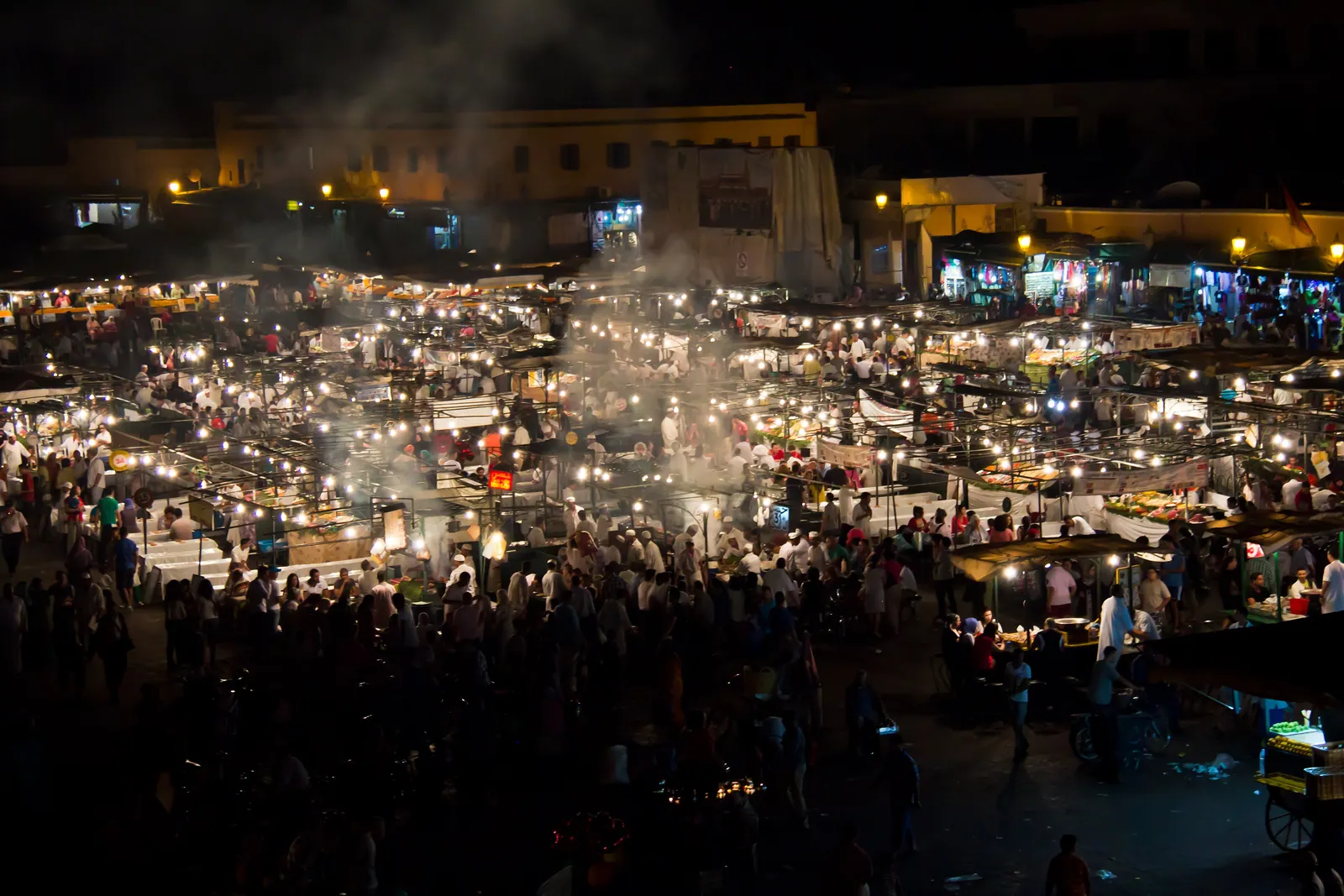
A few considerations help. Location within the medina shapes the stay: a riad deep in the residential lanes is quieter but a longer walk from the square, while one nearer Jemaa el-Fnaa is more convenient but livelier. A roof terrace is worth seeking out, as is a courtyard with real planting rather than a bare light-well.
Hosting makes the difference between a pleasant night and a memorable one. The best riads are run by attentive owners or managers who help with directions, arrange a guide or a hammam, and explain the house and its neighbourhood. On a guided journey this is handled for you — accommodation is chosen for character, comfort and a sound location within the old city.
Why a riad suits The Long Way East
On The Long Way East — the journey from Madrid that crosses from Spain into Morocco — the days in Marrakech are spent in a riad within the medina rather than a hotel outside the walls. This is a deliberate choice. A grand journey is built around slow, immersive travel, and waking inside the old city, to its sounds and light, is part of understanding it.
There is also a thread of continuity. The courtyard house, with its inward garden and shaded rooms, belongs to the same architectural tradition the journey has already encountered in the patios and palaces of Andalusia. To sleep in a Marrakech riad after crossing from Spain is to feel that shared inheritance directly, in the place where it still shapes everyday life.
Quick answers
What is the difference between a riad and a hotel?
A riad is a traditional Moroccan courtyard house, usually small, with rooms arranged inward around a central garden or light-well rather than facing the street. Compared with a conventional hotel it offers more character, a quieter and more personal atmosphere, and a genuine sense of the medina's architecture. The trade-offs are smaller scale, fewer facilities, and a location within the old city reached on foot.
Can you reach a riad by car?
Usually not all the way. Riads sit within the medina, whose lanes are largely too narrow for vehicles. Cars and taxis can reach the nearest accessible point, and from there the final stretch is on foot down the lanes. Riad staff routinely meet guests at the vehicle drop-off and carry luggage to the house, so the short walk is straightforward.
Is a riad a comfortable place to stay?
Yes, though comfort takes a traditional form. Restored riads can be beautifully finished, with cool shaded courtyards, roof terraces and individually decorated rooms. Interiors are often deliberately dim, stairs can be steep, and rooms vary in size, since the building is a genuine historic house rather than a purpose-built hotel. For most travellers the atmosphere and authenticity more than outweigh these quirks.
Let the reading become a route.
When an article sparks something, our planners are the next step. Tell us what you are dreaming of.