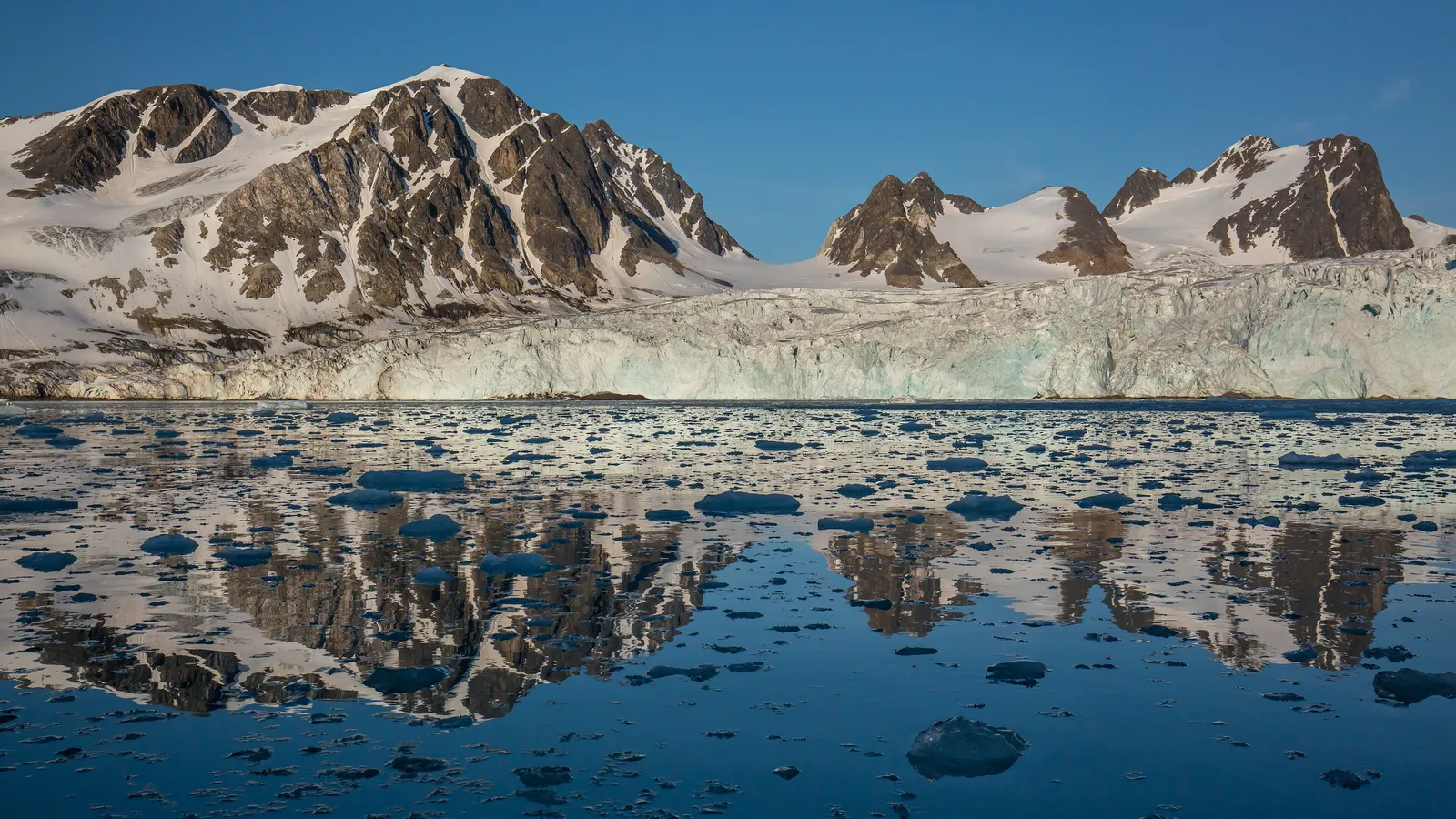
Svalbard and the High Arctic: At the Uttermost North
Less than a thousand kilometres from the North Pole, the Svalbard archipelago brings together polar bears, tidewater glaciers, the midnight sun and a history of explorers and whalers that saturates every fiord.
There are places on Earth where nature concedes nothing to the decorative. Svalbard is one of them. At 78 degrees north latitude, in the middle of the Arctic Ocean between mainland Norway and the North Pole, this Norwegian archipelago is one of the few corners of the planet where polar bears outnumber permanent human residents. Its glaciers calve directly into the sea; its mountains, stripped of every tree, plunge into fiords of an almost black blue; in summer the sun does not set for weeks, and in winter it does not rise. It is a landscape with no equivalent further south.
The capital, Longyearbyen, has roughly two thousand inhabitants and is the world's northernmost permanently settled town with any travel infrastructure worth speaking of. From here depart the expedition ships that cruise the western coast of the main island, Spitsbergen, and occasionally push further north, into latitudes where sea ice determines what is possible and the history of the first polar explorations becomes completely intelligible. For those who have travelled to Antarctica, Svalbard offers the opposite pole in every sense: the Arctic has land where the south has drifting ice, and it has a human past where the south has only science.
The archipelago: geography and climate
Svalbard encompasses a group of islands totalling more than sixty-one thousand square kilometres, though the great majority of visitors know only Spitsbergen, the main island. More than sixty percent of the archipelago is permanently covered by glaciers. The Gulf Stream moderates the climate just enough to keep the western fiords navigable in summer — a remarkable anomaly for these latitudes: at the same latitude on the Siberian side of the Arctic, ice is year-round. The result is a biodiversity that is notable for the high Arctic: well over a hundred and fifty species of vascular plants burst briefly into colour in summer, stippling the tundra with flowers.
The expedition season in Svalbard runs from June to September. In June and July the sun does not set at all — the midnight sun transforms each night into a long, oblique day, with a golden light that photographers pursue obsessively. In August and September the days begin to shorten, the first pans of sea ice drift through the fiords and there is a higher probability of spotting polar bears on land. Wildlife is the engine of any expedition itinerary: besides the polar bear, Svalbard harbours the Svalbard reindeer (an unusually stocky and approachable subspecies), the Arctic fox, the walrus and millions of seabirds nesting on the volcanic tuff cliffs.
The polar bear: encounters and protocols
Svalbard has one of the largest polar bear populations on earth, estimated at around three thousand individuals sharing the archipelago and the adjacent sea ice. On land, polar bears are unpredictable and potentially dangerous, and the archipelago's rules reflect this: leaving the established zone around Longyearbyen without a firearm or without an authorised armed guide is prohibited by Norwegian law. On expedition ships, sightings from deck are frequent, and landings on shore are planned with a guide who always carries a rifle as a precautionary measure.
What distinguishes Svalbard from other Arctic regions is the density of these encounters. On a week-long cruise along Spitsbergen's west coast, several sightings are a reasonable expectation, some of them very close as bears approach to inspect the ship with that mixture of curiosity and self-possession that characterises them. Arctic bears are solitary animals outside the breeding season, and an adult male can weigh more than six hundred kilograms. Their presence in that landscape of ice and rock is the most powerful reminder possible that this is a place where the food chain does not have humans at the top.
The glaciers and the ice front
Seeing a glacier from shore is one thing; approaching the active front of a tidewater glacier in a zodiac inflatable is something of an entirely different order. In Svalbard, the glacier fronts of Monacobreen or Kronebreen produce that spectacle of physics in real time: the deep groaning that precedes a calving, a second of silence, and then the cascade of water and ice as a block the size of a building separates and falls. Anyone who has witnessed this once does not forget it.
Glacial retreat in Svalbard is measurable and documented: the majority of the archipelago's glaciers have lost mass continuously since the nineteenth century, and the rate has accelerated markedly in recent decades. Some fronts that appear, in photographs from old expeditions, to have reached the inner end of a fiord have since retreated several kilometres. This reality does not diminish the beauty of the place — it makes it more urgent — and the expeditioners who come here arrive knowing that they are witnessing a landscape in transformation.
The history: from whalers to polar explorers
Svalbard has no indigenous population; it was discovered by Europeans in the sixteenth century — the Dutch explorer Willem Barentsz reached it in 1596 — and its subsequent human history is a history of extraction and exploration. During the seventeenth and eighteenth centuries, Spitsbergen's bays were the centre of European Arctic whaling: tens of thousands of bowhead whales were processed here, and the ruins of the Dutch whaling stations at Smeerenburg, and the try-works, are still visible. Marine wildlife did not fully recover until well into the twentieth century.
In the twentieth century, Svalbard became a staging ground for the great polar exploration races. Roald Amundsen used Spitsbergen as a base for his attempts to reach the North Pole by air, and it was from here that he departed in 1926 aboard the airship Norge for the first verified transpolar flight. The expeditions of Nansen, Andrée and other explorers who passed through Longyearbyen left a documented and genuinely moving history that visitors with a historical sensibility will appreciate deeply in the local museum.
The northern lights and the polar night
If Svalbard's summer is the domain of the sun that never sets, autumn and winter are the realm of total darkness and, with it, the aurora borealis. From late October to mid-February the archipelago lives in permanent polar night, lit only by the moon, the stars and, at its finest, the green, white and sometimes red curtains of the northern lights. Auroral activity depends on the solar cycle and atmospheric clarity, but Svalbard, by virtue of its latitude, sits directly beneath the auroral oval, making it one of the best places on Earth to witness the phenomenon.
Travelling to Svalbard in winter requires the right preparation and equipment — temperatures drop frequently to minus twenty or minus thirty degrees Celsius — but the experience of the polar night is radically unlike anything else. The silence achieves an unusual depth; the light changes continuously as the moon traverses the sky; dog sleds and snowmobiles are the standard means of transport on land. Some travellers who have made the summer expedition return in winter simply to meet the other face of this archipelago.
How to plan a trip to Svalbard
Longyearbyen is the only practical point of entry, reached by direct flight from Oslo — the journey takes around three hours — with SAS and Norwegian. From there the options are several: a small-ship expedition of a week or more cruising the fiords is the most immersive experience; day trips and multi-day land excursions are also available for those who prefer not to embark. The June-to-August season is the most popular and the best for wildlife and glaciers; September offers sea-ice possibilities and the first auroras.
The Svalbard Global Seed Vault, carved into the permafrost of a mountain outside Longyearbyen, stores more than a million seed samples from around the world — the largest collection of agricultural biodiversity on the planet — and is visitable in limited circumstances. Svalbard also has one of the world's most unusual legal frameworks: the Svalbard Treaty of 1920 permits citizens of signatory nations to reside and work in the archipelago without a visa, a geopolitical singularity that has produced the small Russian community of Barentsburg, some forty kilometres from Longyearbyen.
Quick answers
Is Svalbard safe to visit?
Svalbard is safe for travellers who observe its protocols. Within the established zone around Longyearbyen no special measures are required, but outside it Norwegian regulations require an armed person or an authorised armed guide in the group, due to the presence of polar bears. Expedition ships meet these requirements by default, and shore guides always carry the necessary safety equipment.
When is the best time to go for polar bear sightings?
Polar bears are visible throughout the expedition season (June–September), but August and September offer more onshore sightings, as the sea ice retreats and bears come to the coast to feed. In June and July bears may be hunting on sea ice further north, which can require the ship to navigate greater distances to find them.
Do I need a visa to visit Svalbard?
No. Svalbard has a special status under the 1920 Svalbard Treaty: nationals of signatory countries — which include most of the world's nations — may enter without a visa. However, the standard route passes through mainland Norway (Oslo), whose Schengen rules apply to entry into the Norwegian state.
What is the difference between travelling to Svalbard and to Antarctica?
The most fundamental difference is that the Arctic has inhabited land and a dominant terrestrial predator — the polar bear — while Antarctica is an ice continent whose main wildlife is marine and coastal. Svalbard has human history (whalers, miners, explorers); Antarctica has no indigenous population and no permanent civilian settlements. Both offer glaciers, icebergs and extraordinary wildlife, but the character of the journey is very different.
What kit is needed for a summer Svalbard expedition?
Layering is the key: even in summer, temperatures at sea and with wind chill can drop below zero. Expedition ships generally supply flotation suits for zodiac landings, but you will need tall waterproof boots, thermal base layers, fleece mid-layers and a waterproof, windproof outer shell. Water-resistant hiking boots are essential for shore walks.
Let the reading become a route.
When an article sparks something, our planners are the next step. Tell us what you are dreaming of.