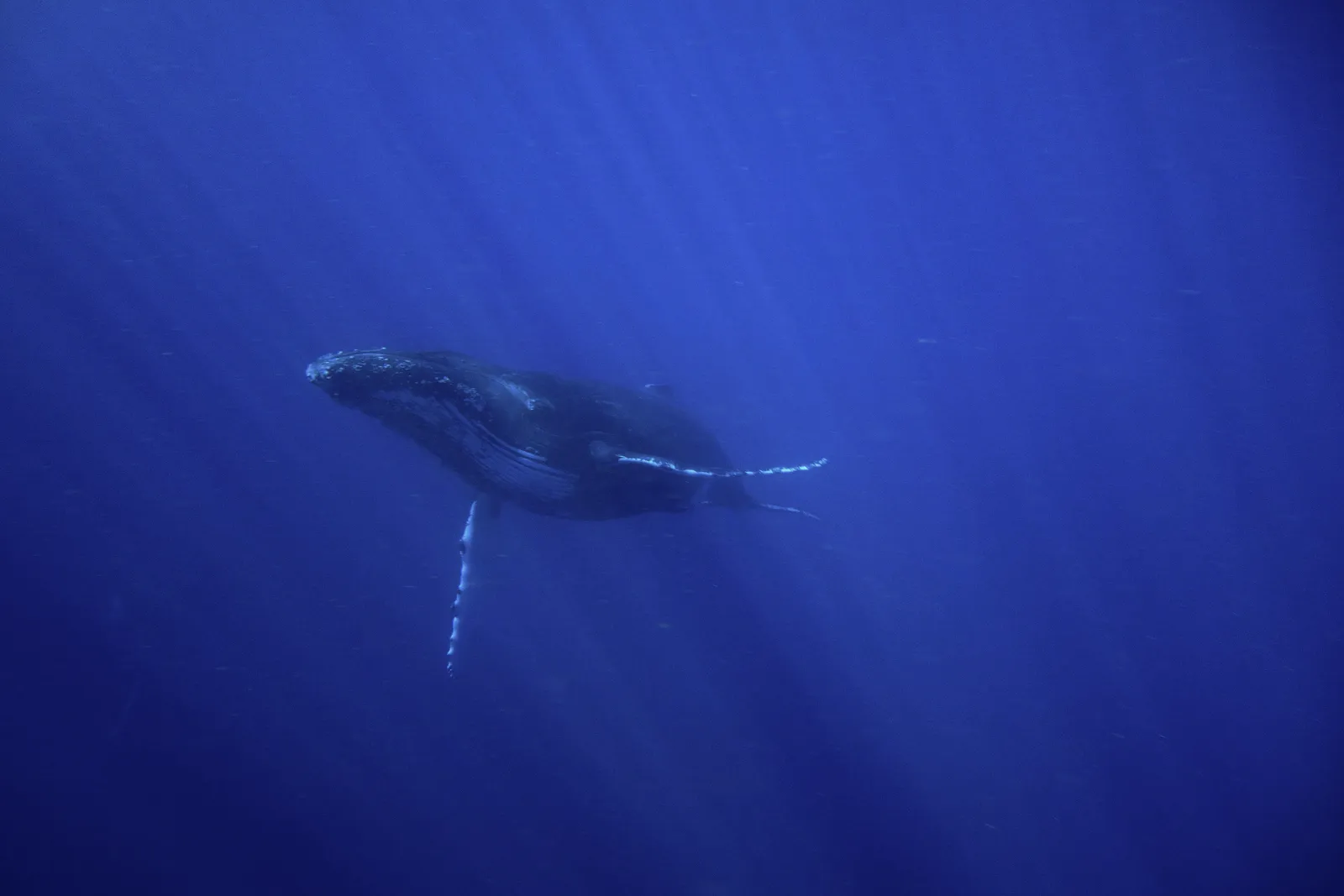
Swimming with Humpback Whales in Tonga
Between July and October, humpback whales gather in the warm waters of the Vava'u and Ha'apai island groups to breed and calve. For a short season, carefully regulated in-water encounters offer one of the most extraordinary wildlife experiences in the Pacific.
A humpback whale in open water is a different animal from a humpback seen from a ship. At sea level, in the clear warm waters of Tonga, the scale of the animal becomes fully apparent in a way that binoculars and a deck rail cannot convey. The flippers alone — white, knobbly, extending a third of the body's length — are larger than most people. The eye, set into a knobbled head, regards you with an attention that is not indifference. And then, with a single gentle sweep of the tail, the whale descends into the blue beyond sight, and the water is quiet again.
Tonga offers one of the very few places in the world where it is both legal and sustainably managed to enter the water with wild humpback whales. The kingdom's regulatory framework, developed over decades of working with conservation scientists and whale-watching operators, restricts the number of boats per whale encounter, limits the duration of in-water interactions, and requires licensed guides. The result is a wildlife encounter that is genuinely intimate and genuinely wild — the whales choose to engage or not, and the encounter belongs to them.
Why humpbacks come to Tonga
Humpback whales spend the southern hemisphere winter — roughly May to October — in tropical and subtropical waters for breeding and calving, after migrating north from their summer Antarctic feeding grounds. Tonga, in the central South Pacific, lies directly in the path of the population known as Oceania humpbacks, a subpopulation that breeds in the waters of the western and central Pacific and feeds in the Southern Ocean.
The island groups of Vava'u and Ha'apai are particularly favoured. Their sheltered bays, shallow reefs and warm, clear water provide ideal conditions for mothers with calves and for the courtship and competitive group behaviour of males seeking to mate. The annual aggregation is now reliably predicted, and the whale-watch season runs from roughly July to October, peaking in August and September. During this period, encounters with whales on almost any given day on the water are close to certain.
The Tongan whale-swim regulations and why they matter
Not everywhere in the world where humpbacks occur allows in-water encounters, and not everywhere that allows them manages them responsibly. Tonga's system, established under the Ministry of Fisheries, allows licensed operators to run swim-with-whale experiences under strict rules: a maximum of four swimmers in the water at any time, no touching, no chasing, no approaching a resting or mother-and-calf pair from in front or blocking their path, and a minimum distance requirement until the whale indicates willingness to interact.
These rules exist not to restrict the experience but to make it sustainable. Humpbacks that are chased or startled quickly learn to avoid boats; humpbacks that are approached carefully and on their own terms often become curious and stay. The Tongan operators who have built their businesses on this distinction are among the most conservation-conscious in the Pacific, and the health of the local population — stable and in some years growing — is partly a reflection of management that treats the whales' choices as the governing variable.
What a whale-swim day looks like
A typical day on the water begins early. Small, liveaboard vessels or day boats operate out of Neiafu in Vava'u or the Ha'apai island chain, and the search for whales starts as soon as the boat is clear of the harbour. Experienced guides spot blooms — the exhalations that rise metres into the still morning air — from considerable distance, and the approach is made at idle speed, from the side, never from directly ahead of the whale.
When the boat stops, the guide reads the whale's behaviour. A whale that is sounding — diving steeply — may not be available; a resting whale, logging at the surface, may tolerate approach. When the guide gives the signal, swimmers slip quietly over the side and hover in a loose group, not swimming toward the whale but letting it determine what happens next. Sometimes nothing does, and the whale sounds gently and disappears. Sometimes the whale approaches, rolls sideways to look, opens one enormous eye, and stays. The duration of an interaction is measured in minutes; the memory lasts considerably longer.
Mother-calf pairs and the high season
The most sought-after encounters are with mother-calf pairs, which are present through much of the season and represent humpback behaviour rarely seen in the wild from in the water. A Tongan calf, born in the warm winter waters, spends its early weeks close to its mother, nursing constantly and learning to surface and breathe. The mother's behaviour around divers varies: some are entirely relaxed, some are protective enough to keep the calf close.
August and September are generally the peak months in Vava'u, when the density of whales is highest and the mix of breeding groups, mothers with calves and curious juveniles is most varied. Operators who work Vava'u year on year develop precise knowledge of individual whales — recognisable by their tail flukes — and can often predict where specific animals will be found. A guide who knows a whale by name is a guide who understands it as an individual with preferences and habits, and that knowledge changes the encounter entirely.
Vava'u versus Ha'apai: choosing where to base
Tonga's two main whale-swim destinations each have distinct characters. Vava'u, the northern group, has the most established infrastructure — the largest number of operators, better accommodation, easy domestic flights from Tongatapu, and the sheltered harbour of Neiafu. It is the more accessible choice and typically the better option for first-time visitors. The season here is reliable, the operators experienced, and the whale concentrations strong.
Ha'apai, the middle group, is flatter, emptier and harder to reach — inter-island flights are less frequent and the accommodation simpler. But Ha'apai has a different character on the water: fewer operators, smaller groups, and a sense of genuinely open-ocean encounter not always available in the busier bays of Vava'u. Travellers who have swum with whales in Vava'u and want a rawer, less structured experience often return for Ha'apai. Neither is better; they are different intensities of the same experience.
Quick answers
Is swimming with humpback whales in Tonga safe?
Yes, when conducted by licensed, responsible operators within the regulatory guidelines. Humpback whales in Tonga are not aggressive toward swimmers. The risks are the ordinary ones of open-water swimming — currents, sun, physical fatigue — which are managed by guides and competent water skills. You do not need to be a strong swimmer, but you need to be comfortable in open water, able to use a mask and snorkel, and willing to follow guide instructions quickly.
When is the best time to swim with humpback whales in Tonga?
The season runs from roughly July to October, with August and September generally regarded as the peak months for both whale density and the variety of behaviours — competitive groups, mothers with calves, curious juveniles. July can have spectacular encounters but fewer whales early in the season; October sees some animals beginning their return south. Booking ahead is strongly advised as licensed places are limited and the season fills.
Is it ethical to swim with wild whales?
When conducted under Tonga's regulatory framework, the consensus among marine conservation scientists is that it can be. The key factors are: no chasing, no touching, no blocking path or separating mother and calf, limited swimmers per encounter, and short, guide-controlled interactions. Tonga's system is regularly cited as a model for responsible cetacean tourism. Choosing an operator with a genuine conservation commitment — one that removes boats when a whale shows discomfort — is the traveller's responsibility.
Do I need previous diving or snorkelling experience?
Snorkelling experience is strongly helpful — you need to be able to float comfortably, breathe through a mask and snorkel, and keep still in open water. You do not need SCUBA certification; encounters are at the surface. Being a strong swimmer helps if conditions are rough. Most operators provide a pre-trip briefing, equipment and a guide who will assess comfort levels before allowing anyone in the water.
Let the reading become a route.
When an article sparks something, our planners are the next step. Tell us what you are dreaming of.