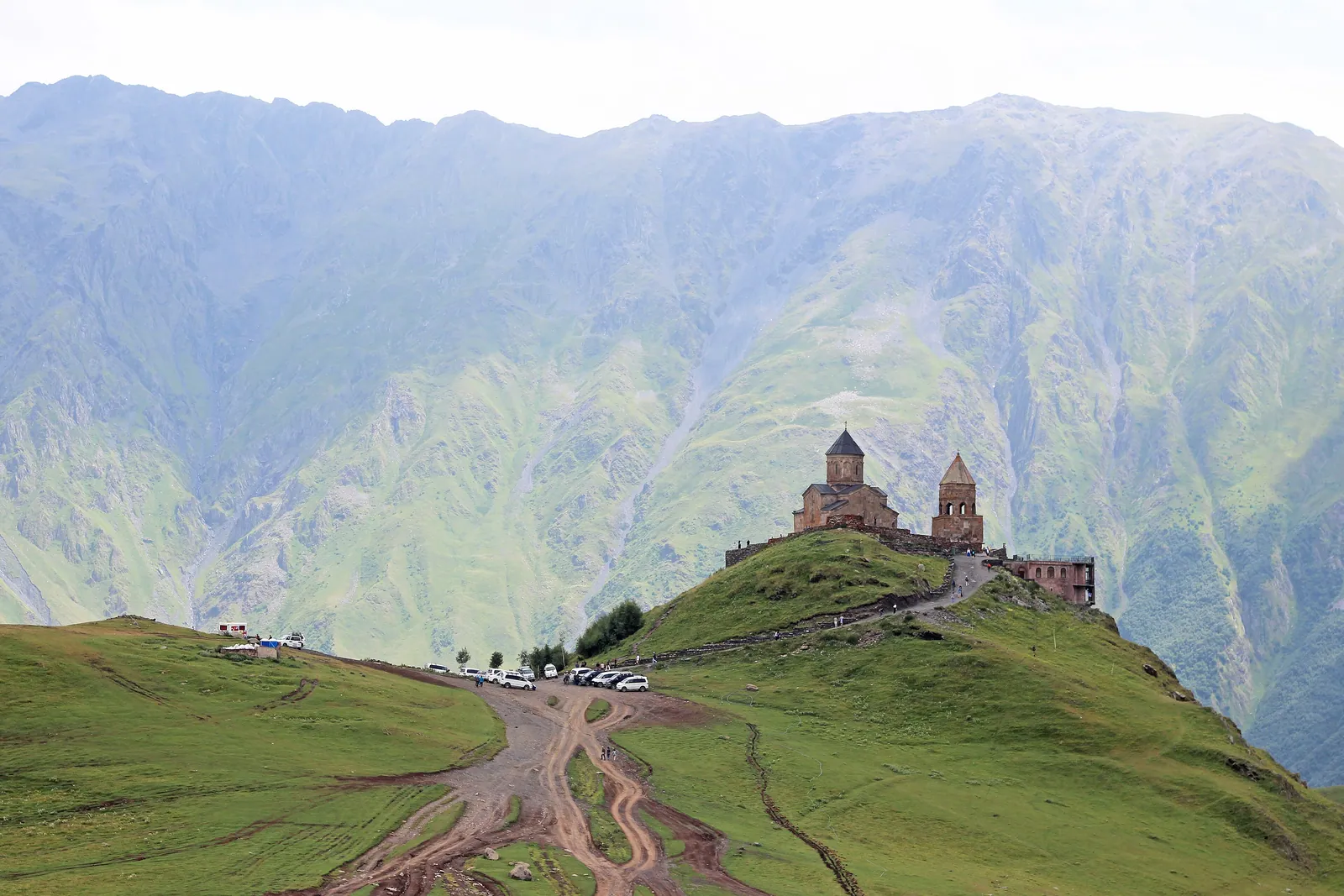
Tbilisi: Old City, Junction of Worlds
Perched above the Mtkvari river, Tbilisi's old city is one of the most atmospheric in the Caucasus — a district of wooden balconies, Persian bathhouses, Orthodox churches and a mosque, built by a city that has always sat between empires.
Tbilisi was founded, according to Georgian tradition, in the 5th century by King Vakhtang Gorgasali, who is said to have discovered its sulphurous hot springs while hunting — the thermal water that still rises beneath the old town and still fills its bathhouses today. Whether or not the legend is literally true, the springs are real, and they explain why a city was built in this particular gorge: the warmth, the water, and a defensible position above a river bend that controlled the east–west route through the South Caucasus.
That route mattered enormously. Tbilisi stands on one of the oldest land crossings between Europe and Asia, and the city that grew here was for most of its history a contested prize — held by Romans, Persians, Arabs, Byzantines, Mongols, Ottomans, Safavids and Russians in succession, each leaving architectural and cultural traces in a historic fabric that has survived, remarkably, almost intact. The old city of Tbilisi is not a restoration; it is an accretion, built and rebuilt over fifteen centuries by a city that has absorbed influence from every direction and made something distinctively its own of it.
The balconies and the wooden city
The image most associated with Tbilisi's old town is its wooden balconies: carved, latticed, overhanging structures that project from the facades of the 19th-century merchant houses, their wood weathered to grey and amber, draped in flowering vines in summer. These are not ornamental; they were and often still are the principal living and working space of the house, a semi-outdoor room where the family ate, socialised and slept in the warm months, facing the narrow lanes below.
The neighbourhood most dense with them is Abanotubani — the bathhouse quarter — and the streets that climb from it toward the Metekhi church. The houses are often in a state somewhere between charming and derelict, their balconies requiring constant repair against the damp of the thermal district, and the combination of ruin and abundance is part of what gives the quarter its atmosphere. Walking the lanes at dusk, when the light is warm and the cooking smells rise from the courtyards, is one of the essential Tbilisi experiences.
The bathhouses of Abanotubani
The thermal springs of the old city rise in the Abanotubani district, where they are channelled into a row of domed bathhouses whose brick-and-plaster domes protrude from the hillside like the tops of subterranean monuments. The most famous is the Chreli-Abano, or Sulphur Baths, a complex of several private rooms built in a Persian style and still operational. The water is naturally warm — around 37 degrees Celsius — and mildly sulphurous; the baths are as much a social institution as a hygienic one.
The Tbilisi bathhouses have been drawing visitors since the medieval period. The poet Alexander Pushkin bathed here in 1829 and wrote that he had never experienced anything more luxurious. Visiting a private room in one of the Abanotubani bathhouses — where an attendant scrubs you with a coarse mitt, a procedure called a kisi, before you soak in the mineral water — is one of the more distinctive things to do in any Caucasus city, and a practice that connects directly with the hammam culture the same road carried from Persia westward into Ottoman Istanbul.
Churches, a mosque and a synagogue
The old town's religious geography is one of the most striking things about it. Within a few hundred metres of each other stand Orthodox churches whose foundations go back to the 5th century, a 17th-century Sunni mosque that has functioned without interruption since its construction, an Armenian apostolic church, and one of the oldest functioning synagogues in the world — the city's Jewish community has been here since at least the 5th century, predating the Arab conquest that brought Islam to the region.
The Metekhi Church, on its clifftop above the Mtkvari, is the most dramatically sited: a 13th-century basilica rebuilt and strengthened across the following centuries, looking across the river to the old Persian fortress of Narikala. The Jvari Mosque, in the lower lanes of Abanotubani, is distinguished by its twin minarets and the diversity of its congregation — Azerbaijani and Georgian Shia Muslims from across the city gather here for Friday prayers. The coexistence of these communities in one quarter is not incidental; it is the product of a history of forced tolerance imposed by successive empires, and of a genuine urban pluralism that persists.
The fortress of Narikala and the walls
Above the old town, stretching along the ridge that divides Tbilisi from its eastern suburbs, the ruins of the Narikala fortress form the city's skyline. The fortress was begun by the Persians in the 4th century, enlarged by the Arabs in the 7th and 8th, rebuilt by the Safavids and then extensively damaged in a Russian powder magazine explosion in 1827 that left large sections of the walls in picturesque ruin. It remains the most visible relic of the city's pre-Russian strategic history.
The walk up to Narikala from the old town — steep but short — rewards with a view that explains the city's position completely: the gorge of the Mtkvari curving through the city, the domes of the bathhouses below, the Metekhi cliff opposite, and to the south the plains that lead toward the high passes of the Trialeti range. It is the view from which a military planner, or a merchant deciding where to build a warehouse, would have understood why this place existed.
Eating and drinking in the old city
Georgian food is among the most distinctive in the Caucasus, and the old city has the densest concentration of restaurants worth eating in. Khinkali — large, juicy dumplings folded into a topknot, traditionally filled with spiced pork and beef — are the dish most visitors encounter first; the correct method is to hold the knot, bite a small opening in the wrapper, drink the juice, then eat the filling and wrapper leaving the tough top. Khachapuri, cheese-filled bread in several regional variations, is everywhere. The Adjaruli version — a boat-shaped loaf floating on a pool of melted cheese and topped with a raw egg — is the most famous.
Natural wine has become a significant part of Tbilisi's cultural identity, partly because Georgia claims to be the world's oldest wine-producing country — a claim with legitimate archaeological support — and partly because the amber wines made in the traditional qvevri clay vessels are genuinely different from anything produced in Western European winemaking. The old city has a concentration of natural wine bars clustered around Shardeni Street and the lanes near the Anchiskhati Church, and an evening moving between them, eating and drinking in roughly equal measure, is one of the best ways to end a day in Tbilisi.
Quick answers
Is Tbilisi's old city walkable?
Yes, very much so. The historic core — from the Metekhi cliff in the south to the Sioni Cathedral in the north, and from the river to the Narikala hillside — is compact enough to cover on foot in a day, and most of the key sights are within fifteen minutes' walk of each other. The hills above Abanotubani require some climbing, but the streets are well maintained and the distances short.
What is the sulphur bath experience like?
Tbilisi's sulphur baths, concentrated in the Abanotubani district, offer private rooms where you can soak in naturally warm, mildly sulphurous water. The full experience includes a kisi massage, in which an attendant scrubs the skin with a coarse mitt before washing you down. It is not uncomfortable — more vigorous than a typical spa treatment — and the water, at around 37 degrees, is pleasantly warm without being overwhelming. Rooms are booked by the hour and are affordable by any standard.
How does Tbilisi relate to the Silk Road?
Tbilisi sits on one of the oldest land crossings between Europe and Asia, and the South Caucasus was a branch of the Silk Road trade network. The city's history — held by Romans, Persians, Arabs, Mongols, Ottomans and Russians in succession — reflects its position as a contested junction on east–west overland routes. On our long Silk Road journeys, Tbilisi is where the European and the Asian parts of the route meet, and its layered religious and cultural geography makes that junction visible.
What language is spoken in Tbilisi?
Georgian is the official language, written in its own unique script, one of the oldest in the world. Russian is widely understood among the older population and in service industries. English is increasingly spoken, especially in tourist areas, restaurants and hotels. The Caucasus has a strong tradition of hospitality to travellers, and getting around the old city is straightforward even without Georgian or Russian.
Let the reading become a route.
When an article sparks something, our planners are the next step. Tell us what you are dreaming of.