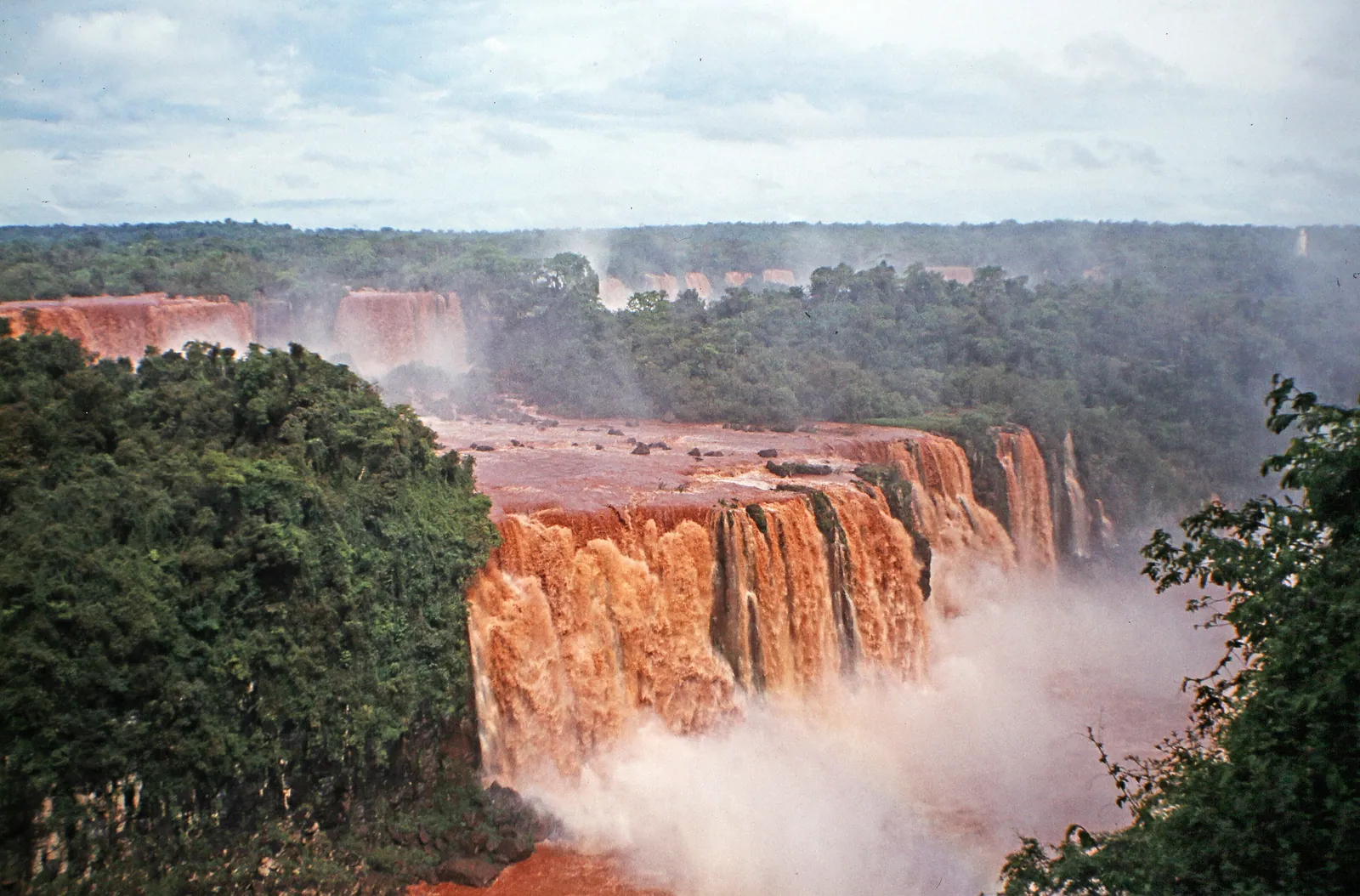
The Amazon Rainforest and Its Wildlife: Inside the Greatest Forest on Earth
The Amazon holds around 10 percent of all species on Earth in less than 1 percent of its surface. Understanding why — and how to enter it — changes the way you see the living world.
From the air, the Amazon basin appears as an unbroken green carpet extending to every horizon, featureless and repetitive in the way that the ocean looks featureless from altitude — an illusion of simplicity produced by the scale of what lies beneath. Down in the forest itself, the impression reverses entirely. Every cubic metre of the Amazon contains a negotiation of extraordinary complexity: light and competition and predation and symbiosis playing out simultaneously at every level, from the fungal networks threading the leaf litter to the harpy eagles hunting in the canopy sixty metres above. The richest terrestrial ecosystem on Earth does not announce itself with obvious drama. Its drama is the density of life itself.
The Amazon rainforest spans roughly 5.5 million square kilometres across nine countries — Brazil holding approximately 60 percent, with Colombia, Peru, Venezuela, Bolivia, and others sharing the remainder. It contains an estimated 390 billion individual trees belonging to around 16,000 species, produces roughly 20 percent of the world's freshwater discharge into the oceans, and is home to an estimated 10 percent of all species on the planet. Those numbers are reproduced so often that they risk becoming abstract; the more useful thing to know is that a single hectare of Amazon forest can contain more tree species than are native to all of Europe, and that new species — insects, plants, fish, birds — continue to be formally described from the basin every year.
The architecture of the forest: understanding the layers
The Amazon is not a single habitat but a vertical stack of distinct ones, each supporting its own community of species. The forest floor receives less than two percent of the sunlight that falls on the canopy; it is a world of shadows, decomposition, and specialist adaptation. Here the giant anteater moves through the leaf litter with a focused efficiency, dismantling termite mounds; the peccary roots in small family groups; the fer-de-lance viper lies so still on the forest floor that experienced trackers tell their guests not to walk without looking down. The understorey above it — shrubs, young trees, and woody climbers — filters a little more light and supports a different community of birds, including antbirds that specialise in following army ant swarms to pick off the insects they flush.
The canopy itself, at roughly 30 to 40 metres, is where most of the photosynthesis happens and most of the animal life lives. Spider monkeys move through it with a swinging, hand-over-hand grace that makes the transitions between trees look effortless; toucans perch on exposed branches scanning for fruit with their absurd, useful bills; parrots pass overhead in screeching flocks on schedules that the local guides know by heart. The emergent layer above the main canopy — a scattering of individual trees that rise above the general level, their crowns exposed to full sun — is the hunting ground of harpy eagles, the largest eagles in the Americas, whose wingspan of up to two metres makes them capable of taking prey the size of a small monkey or a sloth.
The river system: a forest defined by water
The Amazon River and its tributaries form the largest river system on Earth by volume, draining roughly 40 percent of South America. During the annual flood season — which typically peaks between March and June in the central Amazon — the river rises by an average of nine to twelve metres in many areas, inundating the adjacent forest and creating the várzea: seasonally flooded forest in which trees have evolved to survive months of inundation, fish enter the forest canopy to feed on seeds and fruits, and river dolphins navigate what is, for much of the year, dry land.
The pink river dolphin, or boto (Inia geoffrensis), is one of the most extraordinary animals in the Amazon: an entirely freshwater cetacean that navigates complex, flooded forest environments using echolocation of remarkable precision. It is also one of the most culturally significant animals in Amazonian indigenous tradition, associated in the folklore of many riverine peoples with magic and shapeshifting. Botos are frequently visible from boats on the main river channels, surfacing to breathe with a rollicking motion that makes them look more playful than purposeful. Black caimans — the largest predators in the Amazon, growing to lengths of four to five metres — rest on the banks in the early morning before the heat drives them into the water.
The sound and the senses: experiencing the forest
The Amazon is experienced first through sound. The pre-dawn chorus in the Amazon basin is one of the natural world's most overwhelming productions: howler monkeys producing calls that carry for kilometres through the still air, toucans barking, mixed antbird flocks moving through the understorey with an accompanying noise like scattered applause, the bass percussion of a woodpecker somewhere in the middle distance. Then, as the light comes, the forest shifts from acoustic to visual: the first birds of the morning arrive at fruiting trees with the urgency of animals who know that the good fruit is claimed early.
The mistake that many first-time Amazon visitors make is to expect the forest to perform for them in the way that an African savanna does — predators in open sight, drama enacted at close range. The Amazon requires a different mode of attention: slower, more lateral, attuned to the small as readily as the large. The three-toed sloth clinging to the high cecropia branch, barely distinguishable from the pale bark, is one of the most abundant mammals in the forest; most visitors walk past dozens of them. A morning walk with a guide who sees the forest rather than through it is a recalibration of observation that many travellers describe as one of the most lasting effects of an Amazon visit.
Where to go: the accessible Amazon
The Amazon is too large and too varied to generalise about, but for most international visitors the primary access points are Manaus in the Brazilian state of Amazonas, Iquitos in Peruvian Loreto, and the Madre de Dios region of southeastern Peru (accessed from Puerto Maldonado). Each offers a different character: the Manaus area is where the Rio Negro meets the main Amazon, and the phenomenon of the 'meeting of the waters' — where the black-water Negro and the brown-water Solimões run side by side for several kilometres before mixing — is one of the most visually striking things in South America. The Peruvian Amazon around Iquitos is accessed entirely by river or air, and the lodges along the tributaries of the Amazon here are among the best-established wildlife-watching operations in the basin.
The Madre de Dios, at the southwestern edge of the basin where the Andes meet the lowland forest, is one of the most biodiverse regions on Earth, and Manu National Park — one of the largest protected areas in Peru, and a UNESCO World Heritage Site — holds one of the most intact Amazonian ecosystems accessible to visitors. Access to the core zone is restricted and requires a licensed guide; the transitional zones offer exceptional birding, mammal watching, and the famous macaw clay lick at Blanquillo, where hundreds of parrots and macaws gather each morning to consume mineral-rich clay in one of the great spectacles of the Amazon.
Deforestation and the forest's future
The Amazon has lost approximately 17 to 20 percent of its original extent to deforestation, primarily in the southern and eastern 'arc of deforestation' where agricultural conversion — particularly for soy and cattle — has advanced most rapidly. The consequences are not purely local: the Amazon functions as a climate regulator for the entire continent, recycling moisture through a phenomenon of 'flying rivers' that sustains rainfall as far south as the Pampas and as far west as the Andes. Scientists have identified a tipping point — generally placed at around 20 to 25 percent deforestation — beyond which the Amazon may shift from a net carbon absorber to a net carbon emitter, a transformation that would have global climatic consequences.
The response is politically complex but not without precedent for success. Brazil's deforestation rate declined sharply between 2004 and 2012 under a combination of federal enforcement, satellite monitoring, and supply-chain pressure on the soy and beef sectors, before rising again after 2018. Indigenous land rights, which have been shown to be among the most cost-effective mechanisms for preventing deforestation, are central to any viable long-term solution. The Amazon is neither doomed nor saved; it exists in a state of contested negotiation between extraction and conservation in which international attention — including the decision to travel there, spend money, and understand what the forest is — is not without consequence.
Planning an Amazon journey: lodges and logistics
The best Amazon experiences are based in lodges set in primary or high-quality secondary forest, with experienced local guides who have grown up in the forest and know it at the level of individual trees and individual animal territories. Lodge stays of four or five nights allow the rhythm of the forest to establish itself and give enough time for multiple ecosystems — river, várzea, terra firme upland forest — to be visited. Two or three nights is the minimum for a meaningful experience; it takes at least a full day simply to begin to see.
The choice of region matters enormously. For bird diversity alone, the Peruvian Amazon around Manu or Iquitos is arguably unrivalled; for river-dolphin sightings and the meeting-of-the-waters spectacle, the Manaus area is the natural choice; for the combination of accessibility and intact forest, the Tambopata region of Madre de Dios has a strong claim. July to October is generally the driest window in the southern Amazon and is preferred for trail-based wildlife walks; the wet season floods the forest, reduces trail access, but opens the várzea ecosystem to canoe exploration in ways that the dry season does not allow. Either season has its compelling argument; the Amazon is not a place where one visit is ever enough.
Quick answers
Is the Amazon dangerous?
The Amazon is a wild environment with hazards that require respect — venomous snakes, stinging insects, and strong river currents being the most relevant for visitors. A reputable lodge and a qualified guide manage these risks effectively, and the actual rate of serious incidents among organised tour visitors is very low. The forest is not a place for solo unguided travel without significant experience, but within the framework of a well-organised lodge stay, the Amazon is less dangerous than its reputation suggests.
What wildlife is most reliably seen in the Amazon?
Monkeys (howler, spider, squirrel, woolly, depending on region), caimans, river dolphins, macaws and parrots, toucans, and a huge variety of birds are seen on most Amazon visits with a competent guide. Sloths are extremely common but easily overlooked. Tapirs, peccaries, giant otters, and anacondas are seen regularly at good lodges but less predictably. Jaguars are present throughout the Amazon but are rarely seen due to the forest cover; the Pantanal or the lodges on certain Peruvian tributaries where jaguars have become habituated to boats are better for jaguar sightings specifically.
Which is the best Amazon lodge for wildlife watching?
Several lodges in the Manu National Park buffer zone and the Tambopata National Reserve in Peru, and lodges on the upper tributaries of the Amazon near Iquitos, are consistently regarded as the best for wildlife diversity and guide quality. The key variables are the quality of the forest immediately around the lodge, the experience of the naturalist guides, and the range of habitats accessible on day excursions. A specialist operator who knows the lodges personally can give a recommendation tailored to your priorities — birds, mammals, photography, or a general immersion.
What is the best time of year to visit the Amazon?
June to October is generally the dry season in the southern Amazon and is preferred for trail-based wildlife watching and comfortable travel. The wet season (roughly November to May) offers a completely different experience: the flooded várzea is accessible by canoe, water levels reach the forest canopy, and certain wildlife species — particularly fish and river dolphins — are more active and visible. Many experienced naturalists prefer the wet season for its rawness and variety. Both are valid, and the 'best' time depends on what you most want to see.
Do indigenous communities benefit from Amazon tourism?
When tourism is structured to involve indigenous communities — through employment as guides, cultural visits that are genuinely initiated and controlled by the communities, and revenue sharing — it can be a positive economic force. The best Amazon lodges have formal partnerships with local and indigenous communities. It is worth asking operators specifically how their operations are structured, who owns the land, and how income is distributed. Poorly managed tourism can be extractive; well-managed tourism is one of the more concrete arguments for maintaining forest rather than clearing it.
Let the reading become a route.
When an article sparks something, our planners are the next step. Tell us what you are dreaming of.