The Best Seasons in the Himalaya: A Month-by-Month Guide
The Himalaya has two reliable windows and one great obstacle. A clear-eyed guide to the mountain year — when the air is clearest, when the monsoon closes the valleys, and when the rhododendrons bloom.
If you want one answer: the best times to travel in the Himalaya are autumn — roughly October and November — and spring, roughly March to May. Autumn brings the clearest, most stable skies of the year; spring brings warmth, flowers and longer days. Between them lies the summer monsoon, which from about June to September draws cloud over the peaks and rain across the valleys.
But the mountain year is more textured than two seasons and a gap. Altitude, the monsoon's timing and the direction a valley faces all shift the picture. This guide walks through the year so you can match the season to the kind of mountain journey you want.
Autumn: the clearest skies (October–November)
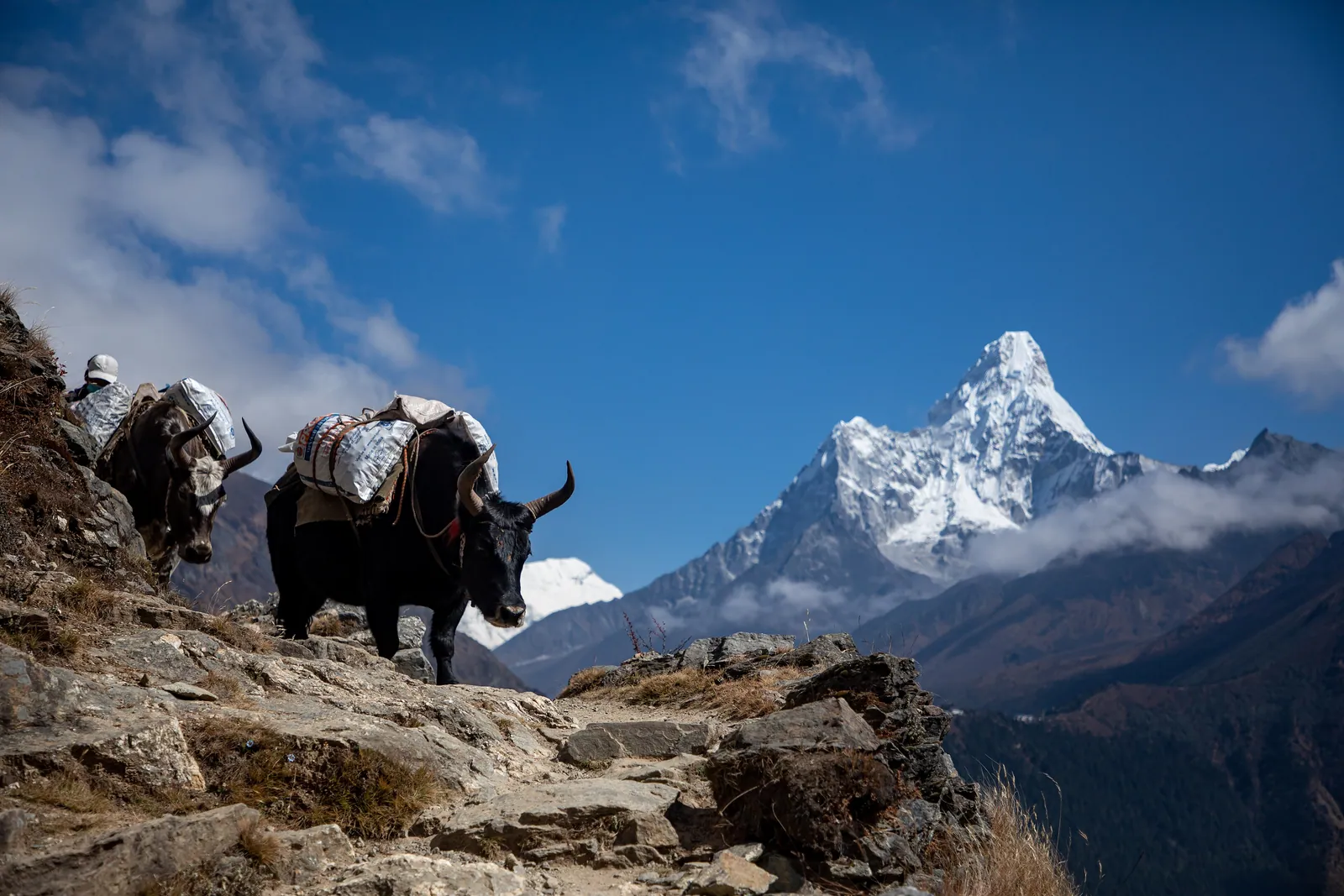
Autumn is the Himalaya at its most photogenic. The summer monsoon has just withdrawn, washing the dust from the air and leaving the high peaks sharp against deep blue skies. Days are mild, nights are cold and dry, and the trails and viewpoints are at their busiest precisely because the conditions are so dependable.
This is the season most travellers picture when they imagine the mountains — and the one that most rewards anyone whose chief aim is to see the great peaks clearly. The Long Way East times its Himalayan and Tibetan-plateau sections for these stable windows, when the chance of an open, cloudless morning toward the giants is at its highest.
Spring: warmth and flowers (March–May)
Spring is the second great window, and in some ways the gentler one. The air is warmer than in autumn, the days are lengthening, and the lower and middle hillsides come alive — Nepal's rhododendron forests, the national flower among them, bloom in great drifts of red, pink and white through March and April.
Skies in spring are a little hazier than the diamond clarity of autumn, as pre-monsoon heat lifts dust and the occasional afternoon cloud builds. The trade-off is comfort and colour. For travellers who care as much about the living valleys as the summits, spring is often the more rewarding choice.
The monsoon: when the valleys close (June–September)
From about June to September the summer monsoon governs the Himalaya. Warm, moisture-laden air sweeps up from the Indian Ocean, releases its rain against the mountain wall, and draws a near-permanent ceiling of cloud over the high peaks. Trails turn to mud, leeches appear in the forests, and views are unreliable for days at a stretch.
It is not a dead season everywhere. The valleys are intensely green, wildflowers carpet the meadows, and a few regions in the Himalayan rain shadow — landscapes shielded from the monsoon by the peaks themselves — stay relatively dry. But for most mountain travel the monsoon months are the ones to avoid, and our high journeys do not run their Himalayan sections then.
Winter: cold, clear and quiet (December–February)
Winter brings its own austere beauty. Skies are often crystalline, the crowds vanish, and the lower valleys can be walked in stillness. The cost is cold — nights at altitude are severe — and snow, which closes the high passes and many upper trails entirely from roughly December through February.
Winter travel in the Himalaya therefore means staying lower and accepting short days and hard frosts in exchange for solitude and clarity. It suits a particular temperament. The high passes that a journey like The Long Way East crosses are not reliably open in deep winter, which is one more reason the route favours autumn and spring.
Reading altitude into the calendar
Season and altitude work together. The same week that is balmy in a 2,000-metre valley can be bitterly cold on a 5,000-metre pass, and snow lingers high long after the lower trails have cleared. When you read a mountain itinerary, picture the season at the heights it actually reaches, not at its lowest town.
This is why our Himalayan planning is specific rather than seasonal-by-rule. We schedule the high-altitude days of The Long Way East for the windows when the passes are open and the air is clearest, and pair the calendar with honest acclimatisation. The right month is the one that fits both the mountain and the height you mean to climb to.
Quick answers
When is the best time to visit the Himalaya?
Autumn (around October to November) and spring (around March to May) are the two best windows. Autumn offers the clearest, most stable skies and the sharpest mountain views; spring brings warmth, longer days and blooming rhododendron forests at lower elevations. The summer monsoon, roughly June to September, brings cloud and rain and is generally best avoided for mountain travel.
Can you travel in the Himalaya during the monsoon?
It is possible but rarely ideal. The monsoon months bring heavy cloud, rain, muddy trails and unreliable views of the peaks. A few regions in the Himalayan rain shadow stay relatively dry and can be visited, but most mountain itineraries — including the Himalayan sections of our journeys — are scheduled for the clearer spring and autumn windows instead.
Why are the high passes closed in winter?
Winter snow accumulates on the high routes from around December to February, blocking passes and upper trails and making travel above roughly 4,000 to 5,000 metres unsafe or impossible. Lower valleys can still be walked, with cold nights and short days. Because journeys such as The Long Way East cross passes above 5,000 metres, they run in the snow-free spring and autumn seasons.
Let the reading become a route.
When an article sparks something, our planners are the next step. Tell us what you are dreaming of.