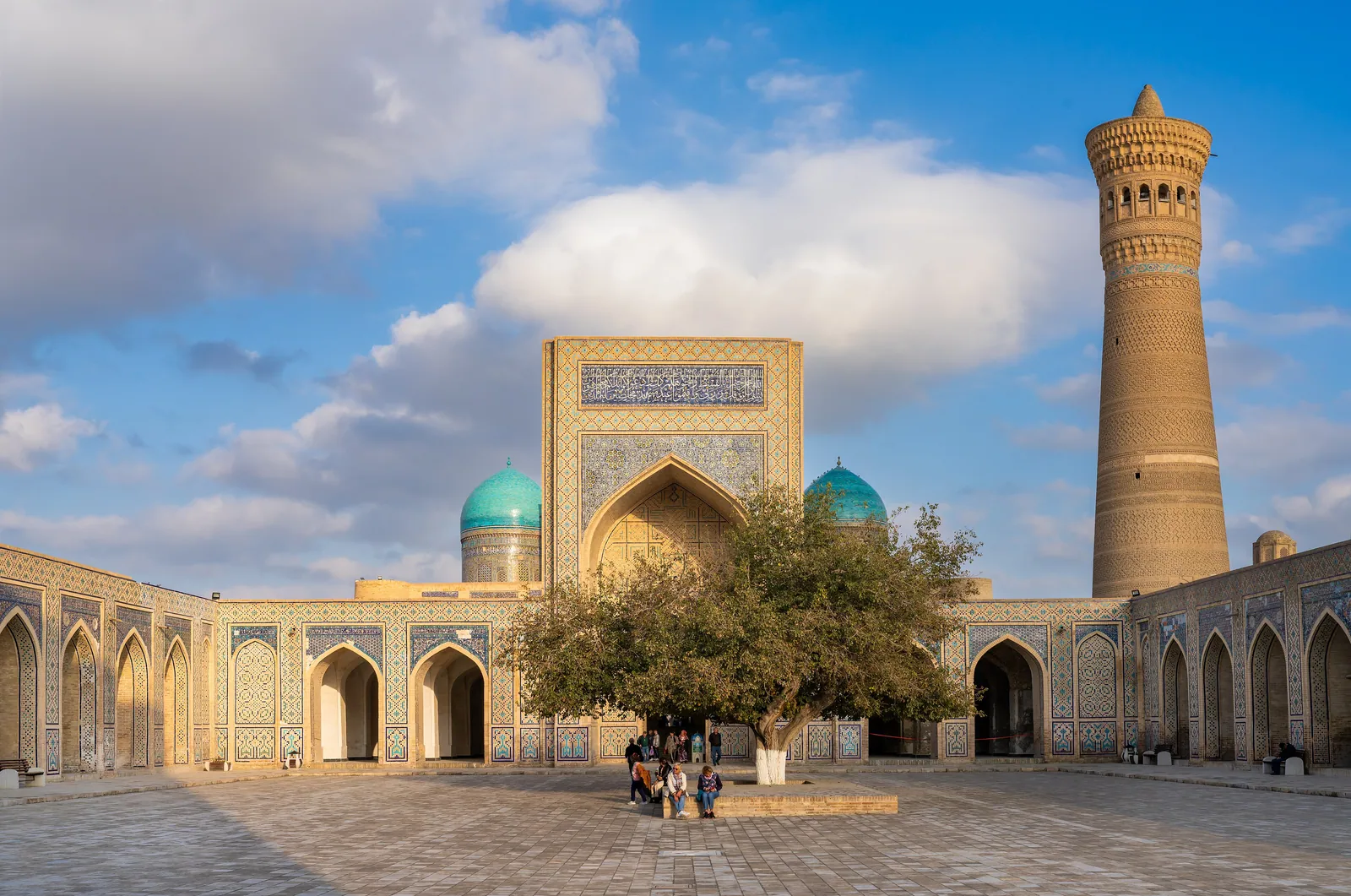
The Caravanserai: The Inn That Made the Silk Road Work
A fortified inn spaced roughly a day's march apart across thousands of kilometres of desert and mountain — the caravanserai was the infrastructure of the Silk Road, and some of the finest still stand.
Long-distance trade does not happen without infrastructure. The Silk Road's caravans — strings of Bactrian camels loaded with silk, paper, spices and glass, moving between China and the Mediterranean — could not have operated without a network of overnight stopping points spaced across the entire length of the route. Those stopping points were the caravanserais: large, fortified inns, built at intervals of roughly a day's march, where merchants, animals and goods could rest, water and feed under one defended roof.
Without the caravanserai, the Silk Road as a sustained commercial enterprise would have been impossible. The distances between oasis cities were too great, the deserts too hostile, the dangers of camping in the open too serious for the scale of trade that actually developed. When empires or prosperous cities built and maintained caravanserais along a route, commerce followed. When the maintenance lapsed, trade rerouted. The buildings are not decorative features of the Silk Road; they are the mechanism by which it operated.
What a caravanserai was, and how it worked
The form of the caravanserai was broadly consistent across the Islamic world, from Morocco to Central Asia, because the problem it solved was always the same. A large central courtyard, open to the sky, was surrounded by a single story of cells on two levels: the upper level for human accommodation, the lower for animals and goods. A single, heavy gate in the outer wall controlled entry and could be secured against bandits. Inside, there were often separate areas for water, for cooking, and for the most basic commercial activity — buying provisions, exchanging news, settling accounts.
The scale varied. Modest caravanserais accommodated a few dozen travellers and their animals; major ones on busy routes could house several hundred, with separate wings for different nationalities or trading communities, mosques or prayer rooms, and sometimes libraries or baths. Maintenance was typically the responsibility of a local ruler or wealthy patron — building a caravanserai was considered an act of piety and good governance, ensuring the road remained viable and the taxes on passing trade kept flowing.
The caravanserai and the pace of travel
A loaded Bactrian camel covers between 25 and 40 kilometres in a day, depending on terrain and load. The standard spacing between caravanserais was calibrated to this pace: a day's march apart, close enough that a caravan starting at dawn could reliably reach the next rest point before dark. This systematic spacing was not accidental — it required planning by whoever controlled the road — and its effect was to transform what would otherwise have been a series of dangerous gambles into something approaching a reliable schedule.
Time at a caravanserai was not merely rest. It was also commerce. Merchants arriving from opposite directions exchanged goods, news and prices; the accumulated intelligence of a night's conversation at a caravanserai was the closest equivalent to a market report that long-distance traders possessed. Languages mixed in the courtyard; so did religious practices, medical knowledge and, less happily, epidemic diseases. The caravanserai was not only infrastructure; it was a junction of cultures, performing at the granular level the same function that Samarkand or Bukhara performed at the city scale.
The Sultan Han of Anatolia
Anatolia, the western arm of the Silk Road, is dense with surviving caravanserais, the legacy of the Seljuk Turkish sultans who governed the region from the 11th to the 13th centuries and systematically built khans at intervals along the major routes. The Sultan Han near Aksaray, built in 1229 by the Seljuk sultan Kayqubad I, is one of the largest and best preserved in existence — a vast stone building whose interior courtyard could accommodate hundreds of animals, and whose elaborately carved portal rivals the great mosques of the period in ambition.
The Seljuk caravanserais were state infrastructure at its most deliberate. They were free to use — no merchant was charged to rest here — funded instead by endowments that generated income from surrounding land. The khan network across Anatolia represented an investment in trade facilitation comparable to any modern road-building programme, and its legacy is the extraordinary density of medieval monuments that still lines the Anatolian highway routes.
The caravanserais of Uzbekistan
The trading domes of Bukhara — the Taki-Zargaron, Taki-Telpak-Furushon and Taki-Sarrafon — are among the most distinctive surviving examples of urban Silk Road commercial architecture: vaulted brick crossroads covered by domes that kept merchants and their goods in shade. They are caravanserais in miniature, adapted for urban use. But the region also preserves rural examples, including the Rabat-i-Malik caravanserai between Samarkand and Bukhara, of which only the entrance portal survives — a structure of such architectural ambition, standing alone in the steppe, that it gives a clear idea of the scale of investment the Karakhanid rulers made in the route.
Within Bukhara's old city, the Toqi caravanserais also served as wholesale markets, where travelling merchants lodged and transacted business under the same roof. These integrated commercial-residential spaces were the working model for the bazaar districts that still characterise the historic centres of Uzbekistan's cities — a continuity of commercial form, if not always of personnel, that stretches unbroken from the Silk Road period into the present day.
The decline and the legacy
The caravanserai network declined for the same reasons the Silk Road itself declined: the shift of bulk trade to maritime routes from the 15th century onward made overland trade less economically central, and the incentive to build and maintain the infrastructure of a land route diminished. By the 18th and 19th centuries many caravanserais had fallen into disrepair, were repurposed as storehouses or stables, or had been partly demolished for building material.
What remains is extraordinary nonetheless. From Morocco to Iran, from Anatolia to Central Asia, hundreds of caravanserais survive in varying states of preservation — some restored as hotels or museums, many simply standing in the landscape as ruins that the flat desert around them refuses to hide. Travelling the Silk Road today, it is possible to sleep in a converted caravanserai in Cappadocia, eat in one in the covered bazaars of Bukhara, and stand in the portal of one abandoned in the Uzbek steppe and understand, from the silence around it, exactly how far the next stopping point was.
Quick answers
What was a caravanserai?
A caravanserai was a large, fortified roadside inn built at intervals along trade routes across the Islamic world and Central Asia. Its typical form was a central open courtyard surrounded by cells for travellers on the upper level and stalls for animals and goods on the lower. A single fortified gate provided security. Caravanserais were typically free to use, funded by endowments, and spaced roughly a day's march apart — a deliberate system that made long-distance overland trade practicable.
How many caravanserais still exist?
Hundreds survive across the former Silk Road world, from Morocco through Turkey, Iran, Central Asia and beyond. The concentration is particularly high in Anatolia, where the Seljuk sultans built a systematic state network in the 12th and 13th centuries, and in Uzbekistan, where urban trading domes in Bukhara and Samarkand preserve the commercial architecture of the Timurid period. Many are ruined; some have been restored as hotels or museums.
Can you stay in a caravanserai today?
Yes. A number of historic caravanserais have been converted into boutique hotels or guesthouses, particularly in Turkey and Iran. In Cappadocia several cave hotels occupy former caravanserai structures. In Uzbekistan the old trading domes of Bukhara still house shops, and the Khan Palace hotel in Khiva occupies a converted historic structure. The experience of sleeping in one connects directly with the function the building performed for centuries.
Who built caravanserais, and why?
Caravanserais were built by rulers, wealthy merchants and religious foundations across the Islamic world. For rulers, they were strategic investments: a working road network meant taxable trade and military mobility. For pious patrons, building a caravanserai was considered an act of merit — ensuring safe passage for travellers was a religious obligation. The buildings were typically operated as free stopping places funded by endowments from surrounding land or commercial properties, rather than by charges on travellers.
Let the reading become a route.
When an article sparks something, our planners are the next step. Tell us what you are dreaming of.