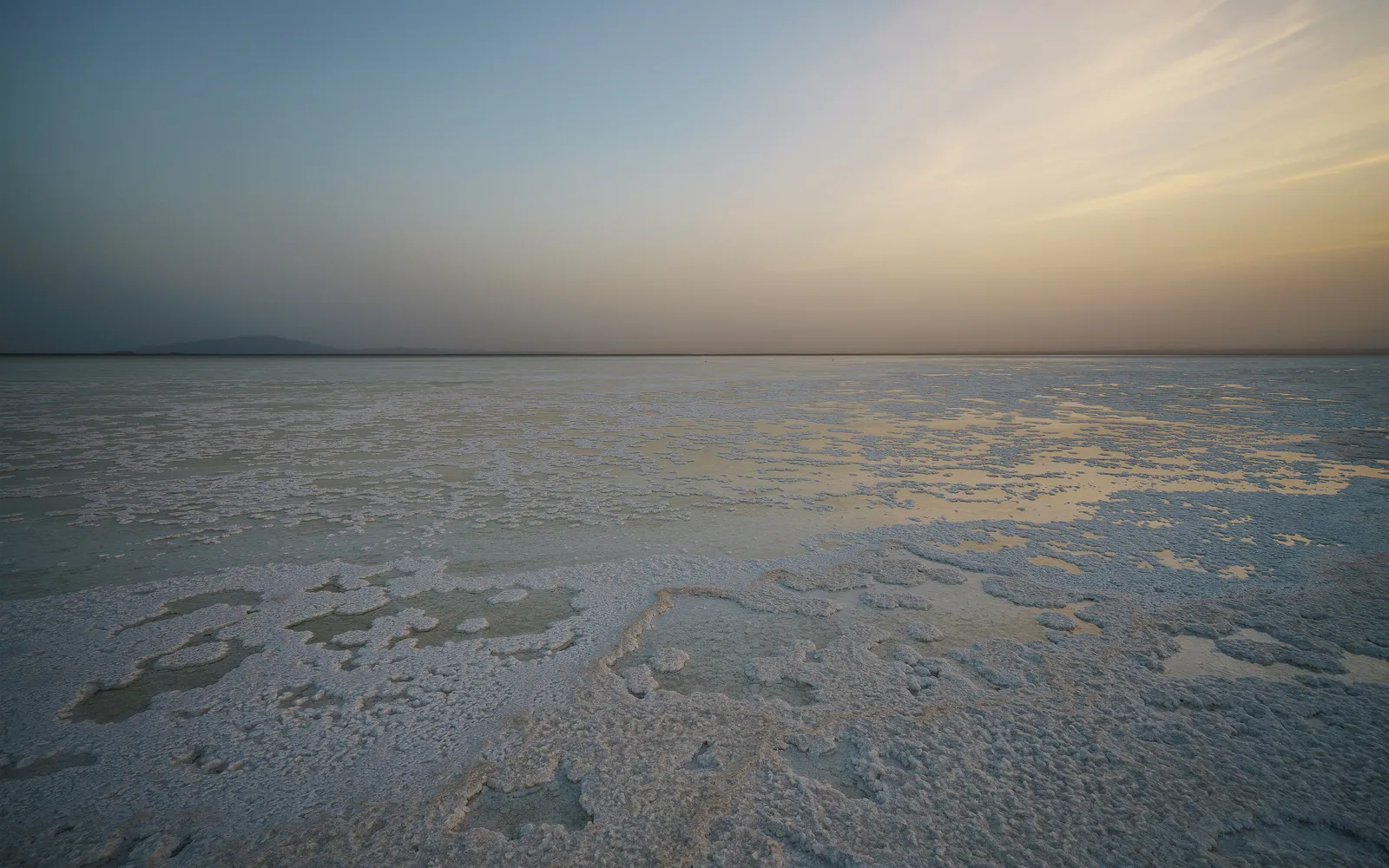
The Danakil Depression: Earth's Hottest Inhabited Landscape
The Danakil Depression in northeastern Ethiopia is one of the lowest, hottest and most geologically violent places on Earth — a landscape of lava lakes, sulphur fields and salt flats that sits at the junction of three tectonic plates.
The Danakil Depression lies in the Afar region of northeastern Ethiopia, at the northern end of the East African Rift. Parts of it sit more than 100 metres below sea level, in the same geological basin as the Red Sea and the Gulf of Aden — a triple junction where three tectonic plates are slowly pulling apart. The result is one of the most extreme landscapes on Earth: an active volcanic field, lava lakes, acid hot springs, sulphur vents and a vast salt flat, all in an environment where daytime temperatures regularly exceed 50 degrees Celsius.
Yet the Danakil is not uninhabited. The Afar people — pastoralists and, historically, salt merchants — have lived here for centuries, working the salt flats of the Danakil by hand and driving camel caravans loaded with blocks of crystalline halite into the Ethiopian highlands. That human story, set against one of the planet's most geologically raw landscapes, is what makes the Danakil genuinely extraordinary rather than merely extreme. It is not a place to visit lightly, but for the traveller prepared for the logistics, it is unlike anything else on Earth.
The geology of an opening ocean
The Danakil is a visible lesson in plate tectonics. The African, Arabian and Somalian plates meet in the Afar Triangle, and all three are moving apart — slowly, at rates measured in millimetres per year, but relentlessly. Where they pull away from each other, the crust thins, drops and fractures, creating the Afar Depression. The heat from below is close to the surface here, which is why the region is so volcanically and hydrothermally active.
Scientists regard the Afar Triangle as one of the few places on Earth where the early stages of ocean formation can be observed above sea level. Given enough geological time — tens of millions of years — the Red Sea and Gulf of Aden will widen further, eventually flooding the Afar and splitting the African continent. The Danakil, in other words, is a future ocean floor, currently open to the sky.
Erta Ale and its lava lake
Erta Ale is a shield volcano rising from the floor of the Danakil Depression, and its summit caldera contains one of a handful of persistent lava lakes in the world — a pool of actively circulating molten rock that has been documented since at least the early twentieth century. The Afar name for it translates roughly as 'smoking mountain'.
Visiting Erta Ale requires an overnight hike from the base camp, arriving at the rim after dark when the lava's glow is most visible: the lake churning and spattering, crusts of cooling rock breaking apart and sinking, convection currents revealing the bright orange beneath. It is a sight that resists description. The Danakil is not the only place on Earth with a lava lake — Nyiragongo in the Democratic Republic of Congo is another — but reaching Erta Ale on foot, in the dark, across a volcanic field, is an experience of particular intensity.
Dallol: sulphur and acid
Dallol is a hydrothermal field near the lowest point of the Depression, and its colours are genuinely surreal: pools of water coloured by dissolved iron and sulphur — yellows, greens, reds and whites — rimmed by crystalline formations of salt and gypsum, all bubbling and steaming in the heat. Temperatures measured at Dallol have given it a claim to the highest average annual temperature ever recorded for an inhabited or formerly inhabited location on Earth.
The formations at Dallol are geologically fragile and chemically hostile — some of the pools have a pH close to zero. The acidic environment has been a subject of scientific interest in the context of extremophile research: organisms that can survive such conditions are relevant to questions about the origins of life and even the possibility of life on other planets. Walking at Dallol demands care and a guide; the crust can be thin and collapse into what lies beneath.
The Afar salt trade
Beneath much of the Danakil lies a vast deposit of halite — crystalline rock salt — laid down when an ancient sea evaporated millions of years ago. The Afar people have worked this salt for generations, quarrying it by hand from the surface of Lake Asale and Lake Karum, cutting it into uniform blocks with wooden tools and metal bars, then loading it onto camels and donkeys for the long journey into the highlands.
The salt caravans are a remarkable sight: lines of camels stretching across the white flats, each animal carrying a load of blocks wrapped in straw. The trade has ancient roots — salt was once as valuable as gold in the Ethiopian highlands, used as currency and as a dietary essential in a landlocked country. The salt blocks still reach highland markets today, though the quantities have declined as road transport has changed the economics of the trade. Watching the caravans form at dawn, in the cool before the Danakil heat sets in, is one of the quietest and most moving things the region offers.
Logistics and what to expect
The Danakil is a serious destination. Access is almost entirely through organised tours departing from Mekele in northern Ethiopia — the regional capital and the nearest significant city. The Ethiopian government has in the past required armed escort in parts of Afar owing to the proximity of politically sensitive borders, and it is essential to check the current security situation before planning any visit.
The heat is not a background detail but a physical reality: the window for visiting is roughly November to February, when temperatures are merely fierce rather than truly dangerous. Even then, hydration, sun protection and acclimatisation to the heat are serious concerns. The reward for accepting these conditions is access to a landscape so geologically raw and so visually overwhelming that travellers consistently describe it as one of the most extraordinary places they have ever seen — and one of the hardest to convey to those who have not been.
The Danakil in context
The Danakil is rarely the only stop on a journey through northern Ethiopia — most itineraries combine it with the historic circuit of Lalibela, Aksum and Gondar, treating the Depression as a geological counterpoint to the cultural highlands. A day or two in Mekele before and after allows acclimatisation and logistical preparation.
For the traveller who has already visited the more accessible parts of the continent — the Serengeti, the Nile corridor, the South African coast — the Danakil represents the end of the easily categorisable. It has no precedent in most travellers' experience; it changes what they think a landscape can be. That disorientation is, for the right person, precisely the point.
Quick answers
Is the Danakil Depression safe to visit?
The Danakil requires careful planning and up-to-date advice. The Ethiopian government has at times required armed escort in parts of the Afar region due to proximity to sensitive borders with Eritrea and Djibouti. The physical environment is genuinely hostile — extreme heat, acidic geothermal fields, unstable volcanic terrain. Visiting through a reputable, licensed Ethiopian tour operator is essential. Always check current travel advisories from your government before planning.
When is the best time to visit the Danakil?
November to February is the recommended window, when temperatures are at their lowest — still very hot by any normal standard, but manageable with proper preparation. The summer months from June to September are considered too dangerous for most visitors owing to extreme heat. Even in the cooler season, all visits begin before dawn to work in the morning hours and retreat to shade during midday.
What is a lava lake and how rare are they?
A lava lake is a pool of persistently molten lava in a volcanic crater or pit, kept liquid by the ongoing heat from below. They are extremely rare: only a handful of persistent lava lakes exist worldwide, including Erta Ale in Ethiopia, Nyiragongo in the Democratic Republic of Congo, and Halema'uma'u in Hawaii. Erta Ale's lake has been documented continuously for over a century.
How do I get to the Danakil Depression?
The standard access point is Mekele, the capital of the Tigray region of northern Ethiopia, which has an airport connected to Addis Ababa. From Mekele, multi-day tours (typically two to four days) access the main sites by 4x4 vehicle, with the approach to Erta Ale's summit done on foot overnight. No independent access is currently possible; a licensed local guide and, where required, an armed escort are mandatory.
Let the reading become a route.
When an article sparks something, our planners are the next step. Tell us what you are dreaming of.