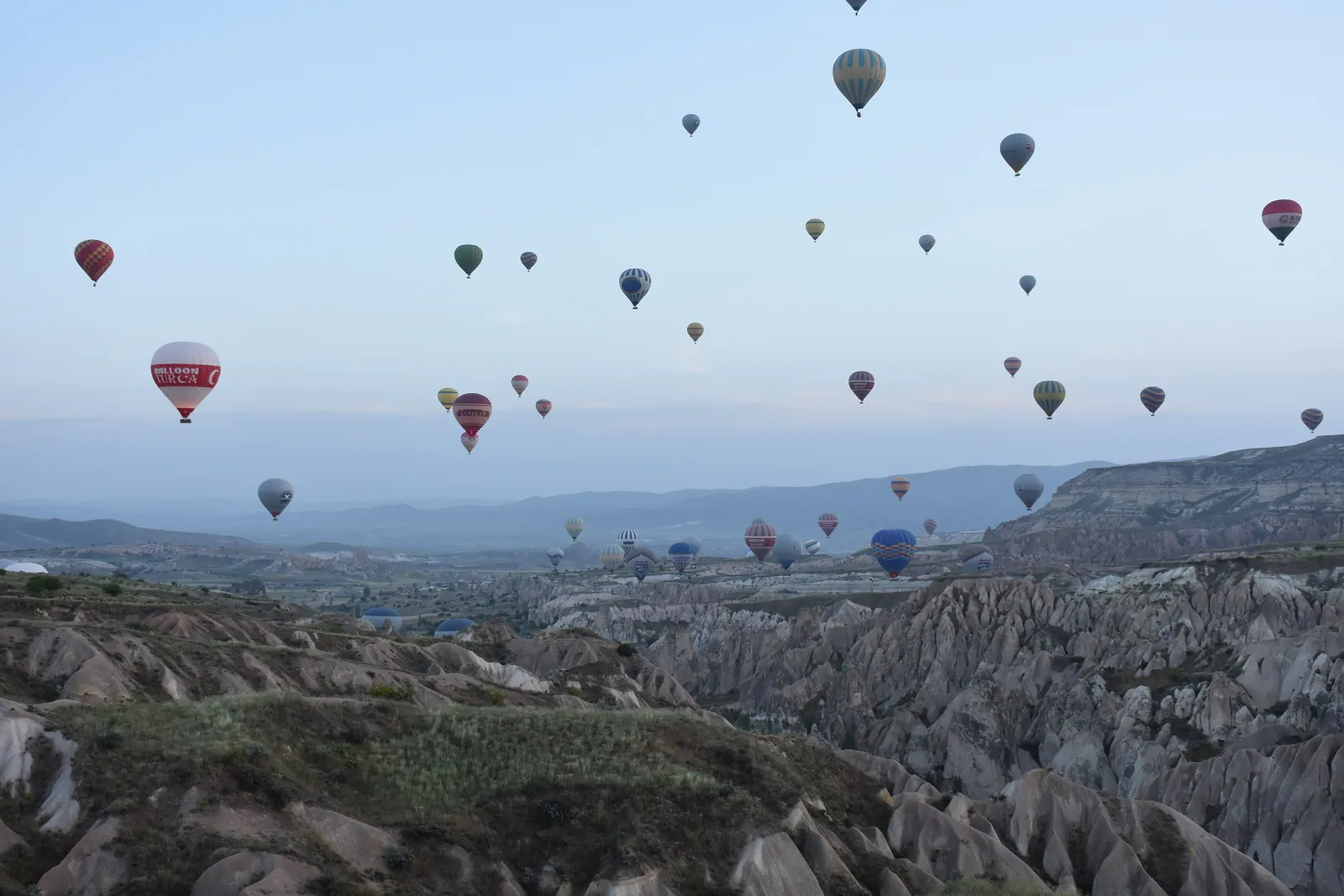
The Dawn Balloons of Cappadocia
On a still morning, hundreds of hot-air balloons rise over the valleys of Cappadocia at first light. Here is why they fly here, what the experience is really like, and how to do it well.
Cappadocia, in central Turkey, has become one of the world's great ballooning destinations because of a rare combination: a surreal eroded landscape worth seeing from above, and unusually stable, light winds at dawn for much of the year. On a good morning, well over a hundred balloons lift off together as the sun comes up over the valleys.
A flight here is not a thrill ride. It is a slow, quiet drift — typically around an hour — that carries you low over fairy chimneys and rock-cut villages, then high enough to take in the whole strange terrain at once. Done with a good operator and a clear-headed plan, it is the single most memorable hour many travellers spend in Turkey.
Why the balloons fly here
Cappadocia's landscape was made by volcanoes and erosion. Ancient eruptions laid down thick beds of soft volcanic ash that hardened into a rock called tuff; millennia of wind and water then carved it into ridges, ravines and the tapering pillars known as fairy chimneys, often capped by a harder boulder. From the ground the effect is otherworldly; from the air it is coherent, and the scale finally makes sense.
The flying conditions are the other half of the story. Cappadocia sits on a high, open plateau where dawn winds are often gentle and predictable, allowing balloons to drift slowly and land safely. Pilots use the way wind speed and direction change with altitude to steer — rising or descending to catch a different current — which is how a balloon can be made to dip into a valley and then climb out of it.
What a flight is actually like
You will be collected in the dark, well before sunrise, and taken to the launch field where the crews are already inflating the envelopes with great roaring blasts of flame. Baskets carry anywhere from a handful of passengers to twenty or more; you stand for the duration, and the sides come up to roughly chest height.
Lift-off is so smooth that it is easy to miss the moment the ground lets go. There is no rushing wind, because the balloon moves with the air, and the quiet is broken only by the periodic burn of the gas. For an hour or so you drift — sometimes skimming close enough to brush the rock, sometimes climbing to perhaps a thousand metres above the valley floor — while the rising sun turns the tuff gold and pink. Landing is back onto a chase vehicle's trailer or an open field, and many operators mark the end with a small sparkling-wine toast.
Choosing a flight, and choosing well
Ballooning in Cappadocia is regulated by Turkey's civil aviation authority, which licenses operators and pilots and caps the number of balloons aloft each day. Flights only go ahead when conditions are judged safe, so cancellations for weather do happen — most often in winter and on windy days — and a flexible itinerary matters.
When you book, favour an established, properly licensed company over the cheapest quote, ask about basket size if you would prefer a smaller group, and understand the cancellation and refund terms before you pay. A reputable operator will scrub a flight rather than fly in marginal weather, and that caution is exactly what you want.
Practical notes for the morning
Dress in layers: pre-dawn on the plateau is cold even in summer, and the morning warms quickly. Closed, flat shoes are sensible for the landing. The burner above your head radiates real heat, so a hat is welcome. There is no need for anything elaborate — the flight does all the work.
Choose a window seat in the basket if you can, but know that the balloon turns slowly as it drifts, so every passenger gets the view in time. And keep your camera on a strap or in a zipped pocket; the one thing you cannot retrieve over a Cappadocian valley is a dropped phone.
If the weather grounds you
Even on The Silk Road Reborn, where we build in spare time precisely so a cancelled flight can be re-attempted, the wind sometimes wins. It is worth deciding in advance that this is acceptable, because the same valleys that the balloons cross are wonderful at ground level.
The viewpoints above Göreme and the rim walks around the Red and Rose Valleys give you the balloons themselves as a spectacle — a hundred bright shapes rising against the dawn — and the hiking trails through the chimneys are a different, slower way to know the landscape. The flight is a gift, not a guarantee, and Cappadocia repays the patient traveller either way.
Quick answers
Is hot-air ballooning over Cappadocia safe?
Ballooning in Cappadocia is overseen by Turkey's Directorate General of Civil Aviation, which licenses operators and pilots and limits how many balloons may fly each day. As with any aviation, it is not risk-free, but flights are only launched in suitable conditions and reputable operators cancel readily when winds are marginal. Choosing a licensed, well-established company is the most important decision you make.
What time of year is best for ballooning in Cappadocia?
Balloons fly year-round, but the most reliable conditions are generally in late spring and early autumn, when winds are calm and skies often clear. Summer flights are common too. Winter brings beautiful snow-dusted scenery but more frequent weather cancellations. Whenever you go, allow a spare morning in your itinerary so a scrubbed flight can be re-attempted.
What should I wear and bring for a dawn flight?
Dress in warm layers — the pre-dawn plateau is cold in every season — with a hat and closed, flat shoes for the landing. Bring a camera secured on a strap or in a zipped pocket. You do not need gloves or specialist gear; the basket and the burner are straightforward, and the crew briefs you on everything before lift-off.
Let the reading become a route.
When an article sparks something, our planners are the next step. Tell us what you are dreaming of.