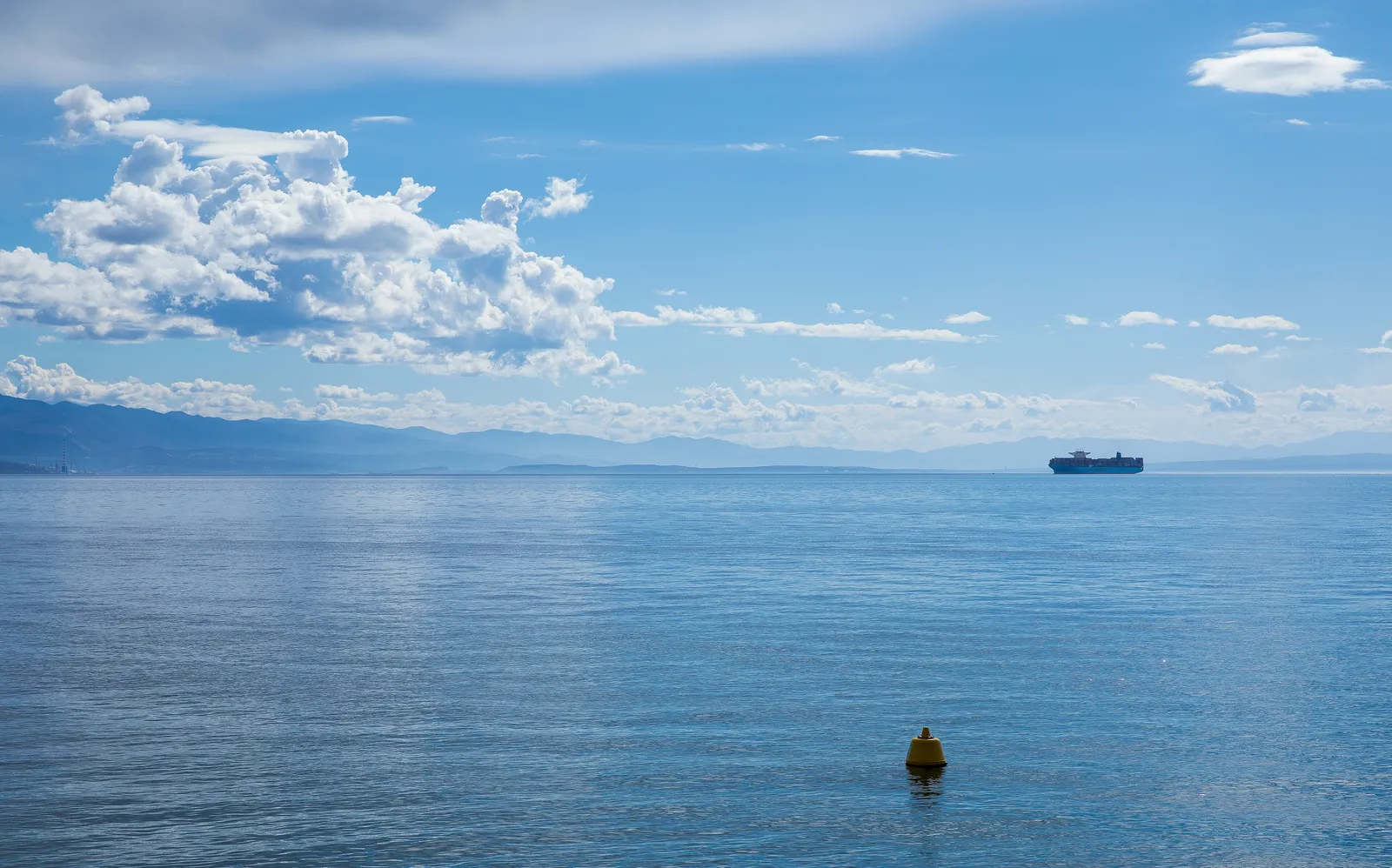
The Freighter Passage: The Slowest Way Across the Sea
Every day, thousands of container ships cross the world's oceans carrying the goods of global trade. A small number of them carry passengers — and for the traveller willing to spend two or three weeks at sea with no entertainment but the horizon, it remains one of the most profound journeys available.
The cargo ship is not a cruise ship. There is no entertainment programme, no casino, no shuffleboard deck, no shore excursions. There are perhaps six to twelve passenger cabins, a small common room, a dining table where you eat with the officers, and the sea — in every direction, for days and weeks at a time. The average container ship crosses the Atlantic in eight to twelve days. The Pacific takes two to three weeks. For some travellers, this is the definition of intolerable tedium. For others, it is the most complete form of slow travel the modern world still makes available.
Passenger-carrying freighters have existed for as long as commercial shipping has existed, and in the era before mass air travel they were the standard means of crossing the world's oceans. Writers and travellers who crossed the Atlantic or Pacific by cargo ship in the mid-twentieth century left accounts of a particular kind of offshore life: the unchanging routine of meals and watches, the intimacy of a small community at sea, the way three weeks on the open ocean changes a person's relationship with scale and solitude. That experience is still available, with minimal modification, on a handful of shipping lines that accept passengers today. The ship is larger now, the containers stacked many stories high, but the ocean is the same ocean.
How freighter travel works
A handful of shipping companies — among them Cargo Ship Voyages, Freighter Expeditions, and Maris Freighter Cruises — act as booking agents for passenger berths on working cargo ships. The ships are operated by major container lines and carry up to twelve passengers, which is the regulatory maximum before a vessel is required to carry a medical officer. The cabins are officer-grade rather than passenger-luxury — generally a private bathroom, a desk, comfortable if not extravagant furnishings. Meals are taken in the officers' mess, usually at a fixed table with the captain and senior officers, and the food quality is considerably better than the ship's functional reputation might suggest.
Passengers typically have access to a small lounge or library, sometimes a deck area, and the bridge at the captain's discretion — which, for a traveller interested in navigation, weather and the mechanics of ocean shipping, can be one of the most extraordinary privileges the journey offers. The schedule is that of the cargo: ports are visited when the manifest requires, stays are rarely more than a day, and the ship departs when the cargo is loaded, regardless of whether passengers are back aboard. Freighter travel demands the same flexibility as any expedition travel — the schedule exists, but it is not yours to manage.
What the open ocean does to a traveller
The first two or three days on the open ocean are almost always a process of adjustment — to the motion of the ship, to the absence of any horizon except water, to the removal of the normal architecture of a day. There is no city outside the window, no agenda, no arrival that is imminent. The day organises itself around meals, around walking the deck, around whatever reading or writing the traveller has thought to bring. Most experienced freighter passengers describe the adjustment period as the journey's difficult gift: the point at which the habits of ordinary life — the checking of messages, the production of activity, the management of time — begin to release, because there is nothing to sustain them.
What comes after this release is the thing that freighter travellers consistently describe and rarely adequately explain. A quality of spaciousness in the day. A return of the ability to think in extended sequences rather than fragments. The discovery that the sea, watched for hours across consecutive days, is never the same twice: the colour, the texture, the life on and just under the surface — the occasional whale or dolphin, the seabirds that appear hundreds of miles from any coast — is an inexhaustible subject. The novelist Patrick White crossed the Pacific by freighter several times and wrote of the ocean as a place where the mind was restored to something like its full capacity.
The community of the ship
The community of a working cargo ship is small, hierarchical and professional. The officers are there to run the ship; the passengers are, by the standards of their working day, a minor consideration. This is not unfriendly — most officers enjoy the company of passengers and are forthcoming about their work, their route, their experience of the sea — but it is not a cruise-ship relationship, where every interaction is oriented toward the guest's satisfaction. The freighter passenger is a guest in someone else's working environment, and the adjustment to that role is itself instructive.
The six to twelve passengers who share the voyage form their own sub-community. They are typically self-selecting in interesting ways: there are writers on long projects who need uninterrupted time, retired travellers doing the journeys they deferred for decades, academics doing research between institutions, people who have simply decided to stop flying and mean it. The conversation, over three weeks of shared meals and shared deck space, tends to go deep in the way that conversations go deep when people have time and nowhere else to be. Many freighter travellers describe the fellow passengers they have encountered as among the most interesting they have met anywhere.
The routes that are still possible
Several classic ocean passages remain bookable on working cargo ships. The North Atlantic routes — between European ports and the eastern seaboard of North America or the Caribbean — are among the most accessible, with crossing times of eight to twelve days and regular departures from ports including Hamburg, Antwerp, Le Havre and Tilbury. The routes to Australia or New Zealand, from Europe or North America, are the longest: the passage from Europe around the Cape of Good Hope and across the Indian Ocean takes four to six weeks, and is one of the great ocean journeys still available to a paying passenger.
The Panama Canal passage is available on certain routes between the Atlantic and Pacific and remains one of the engineering spectacles of the world, experienced very differently from a container ship deck than from a cruise vessel — the canal locks bring the ship close to the walls in a way that makes the scale immediately legible. Routes between European and South American ports, and between Asian ports, are also bookable but require flexibility about departure dates, as cargo ship schedules are determined by commercial needs and can change. A dedicated booking agent is essential for managing the logistics.
Practical matters: cost, booking and what to bring
Freighter passages are not cheap by the standards of the distance covered: rates typically run to around one hundred US dollars per day per person, putting a two-week Atlantic crossing at roughly one to one-and-a-half thousand dollars per person. This is significantly more than a budget airline fare and somewhat more than a mid-range cruise for equivalent distance — the cost reflects the genuine scarcity of berths and the officer-grade accommodation. Some passages, particularly on less-frequented routes, can be arranged at lower rates, and one-way passages are generally available as well as round trips.
The practical preparation for a freighter passage is simpler than it sounds. You need reading material for several weeks — physical books, since digital dependency on an ocean without wifi is its own experiment. You need entertainment that does not require the internet: a writing project, a language study, a musical instrument if you can bring one. You need sea-sickness medication for the adjustment period, particularly on Atlantic crossings in autumn and winter when the North Atlantic swell is significant. And you need the particular mental preparation of knowing that for the duration of the crossing, you are genuinely somewhere else — not passing over the ocean but passing through it.
What freighter travel is for
Most forms of slow travel can be explained in terms of the experience they produce: the bicycle tour produces a physical relationship with the landscape; the pilgrimage produces interior work; the overnight train produces an intimacy with the geography of a continent. The freighter passage produces something harder to name. It is perhaps closest to the experience of removal: the deliberate removal of oneself from the world of ordinary obligations and stimulations, the placement of an ocean between the life one was living and the life one is about to begin. This is what the great ocean crossing always was, in the era when there was no alternative — the weeks at sea were the natural decompression between one world and another.
In an era when any place on earth can be reached in less than a day, the freighter passage is a choice to restore the ocean to its proper dimensions. The Pacific is large. The Atlantic is wide. Sitting on the deck of a container ship three days out of Antwerp, watching the sea move in its grey Atlantic way, with no coast in sight and no coast imminent, one understands this in a way that no flight data or statistic can provide. The slow traveller's deepest conviction — that what you gain by arriving carefully is worth the time spent arriving — finds no purer expression than on the open water.
Quick answers
How do I book a freighter passage?
The most reliable method is to use a specialist booking agent — companies such as Cargo Ship Voyages (UK), Freighter Expeditions (Australia) or Maris Freighter Cruises (USA) maintain current availability across multiple shipping lines and can match passengers to routes. Direct booking with shipping lines is possible but requires navigating commercial operations not designed for individual passengers. Booking well in advance — three to six months for popular routes — is advisable, as the number of passenger berths is very limited.
What should I expect in terms of comfort?
Officer-grade accommodation: a private cabin with a double or single bed, private bathroom, desk and often a small fridge. Not luxurious, but comfortable and entirely functional. Meals in the officers' mess are generally three times daily, cooked by the ship's cook, and are often considerably better than travellers expect — some routes are noted for their food. There is no air conditioning guarantee on older vessels; ask your agent about the specific ship on your route.
Is there wifi on cargo ships?
Sometimes, and it is generally slow and metered. Some ships offer a small wifi allocation per day; others have no passenger internet at all. This is not an accident of infrastructure — it is part of what the passage offers. Experienced freighter travellers recommend treating limited or no connectivity as a feature rather than a deficiency and preparing accordingly with offline entertainment and projects.
Who is freighter travel suited to?
People who are genuinely comfortable with sustained solitude, who have a project or discipline that benefits from uninterrupted time, and who find the ocean intrinsically compelling rather than merely an obstacle to traverse. It is not suited to travellers who need constant social stimulation, regular internet access for professional reasons, or a structured programme of activities. Most freighter passengers are over forty and many are retired, but the common denominator is less age than temperament: a particular kind of patience, and a particular appetite for the expansive and the unhurried.

Let the reading become a route.
When an article sparks something, our planners are the next step. Tell us what you are dreaming of.