The Galápagos: Darwin's Living Laboratory, Still at Work
The Galápagos Islands gave Darwin the evidence he needed to frame a theory of life. The animals that convinced him are still there, still evolving, and still utterly unafraid of the humans who come to watch them.
In September 1835, HMS Beagle anchored off the Galápagos Islands and a young naturalist named Charles Darwin stepped ashore. He spent five weeks across several islands, collecting specimens and making notes, and left without yet knowing what he had seen. It was only years later, back in London, that ornithologist John Gould told him that the birds he had collected from different islands — which Darwin had casually assumed were various wrens and blackbirds — were in fact thirteen closely related finch species, each adapted to a different food source. That realization became one of the foundation stones of evolutionary theory.
The Galápagos today receive far more visitors than Darwin did, but the essential experience remains unchanged. The wildlife is extraordinarily tame — not because the animals have been habituated to people over generations of tourism, but because large predators never reached these remote Pacific islands, and a creature that evolved with no mammalian enemies has never learned to fear us. Walking a trail in the Galápagos is to move through a world where the animals simply do not run away, and the encounter that results is one of the most intimate in all of wildlife travel.
Why these islands produced such extraordinary evolution
The Galápagos are a volcanic archipelago that rose from the ocean floor entirely independently of the South American mainland, located in the Pacific roughly 1,000 kilometres west of Ecuador. They are geologically young — the oldest islands are around 4 million years old, the newest still forming — and they were colonised not by animals that crossed from a continent but by the few species that made the journey across open ocean by chance: drifting, flying or swimming.
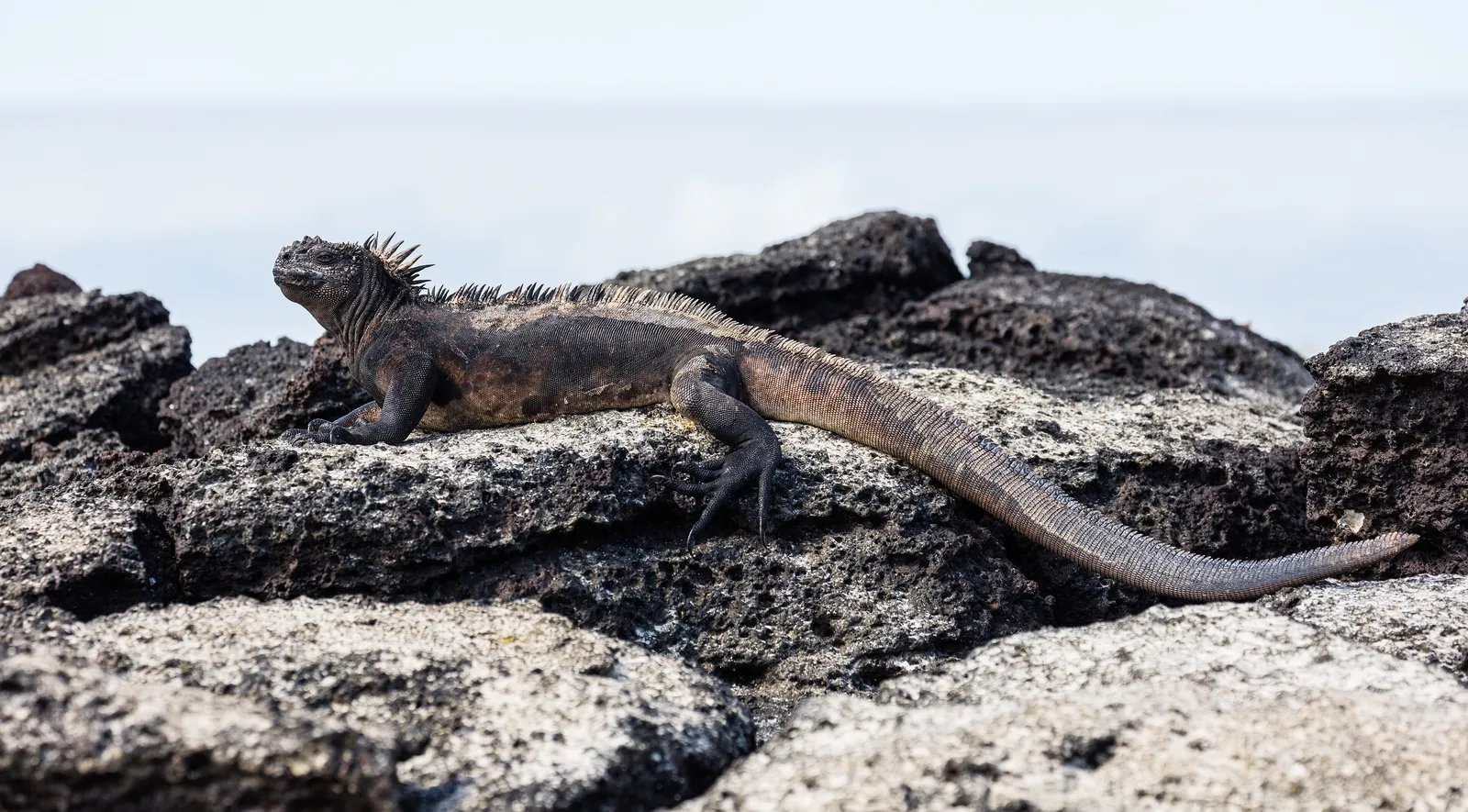
Each island presented a slightly different environment — different altitude, different vegetation, different rainfall, different food sources — and with few competitors, the original colonists diversified to fill available niches. This is the core of what Darwin eventually understood: the same ancestral finch that arrived on the archipelago gave rise to thirteen species because on different islands with different food, slightly different beak shapes reproduced more successfully, and over generations those differences compounded into distinct species. The same logic produced the Galápagos tortoise, in multiple island varieties, and the marine iguana — a lizard that evolved the unique ability among all lizards to dive and graze on underwater algae.
The iconic animals: who you will meet and where
Galápagos giant tortoises are the archipelago's most famous residents. They can live for over 150 years, weigh up to 400 kilograms, and move through their highland meadows with a patience that seems geological. Each major island once had its own tortoise species or subspecies, shaped by the local food; the dome-shelled tortoises of lush highland islands have short necks for grazing grass, while the saddleback varieties of drier islands have longer necks for reaching cactus pads. The tortoise population collapsed through hunting by whalers and sailors in the eighteenth and nineteenth centuries, and through predation by introduced rats and pigs; intensive conservation work, including captive breeding programs, has brought several populations back from near-extinction.
Marine iguanas are unique to the Galápagos and unlike any other lizard on Earth. They are the only lizard that regularly enters the sea to feed, diving to depths of up to 30 metres to graze on subtidal algae and holding their breath for over an hour during cold-water dives. On shore they look prehistoric — dark, spiny, encrusted, piled on each other on black lava in the sun — and the sound of a beach full of them sneezing salt crystals from their nasal glands is one of the stranger wildlife soundscapes available.
The birds: Darwin's finches and everything else
Darwin's finches are the conceptual center of the Galápagos story, but they are small brown birds and not every traveller finds them riveting. The archipelago's more immediately spectacular birds are easier to appreciate. Blue-footed boobies perform an unmistakeable courtship display — lifting their electric-blue feet one at a time in a high-stepping walk, as if showing them off — on the rocky shores of many islands. Frigatebirds inflate a red throat pouch the size of a football to attract females. Flightless cormorants hold their vestigial wings out to dry in a posture that speaks directly to the evolutionary logic of an island with no predators and abundant shallow-water fish.
The waved albatross — the largest bird in the Galápagos — breeds exclusively on Española Island from roughly April to December, making it one of the most range-restricted breeding birds on Earth. Pairs bond for life and perform an elaborate bill-clacking, dance-walking courtship display that is extraordinary to watch at close range. Galápagos penguins, the only penguins north of the equator and the rarest penguin species, huddle in the cold Cromwell Current upwellings around Fernandina and Isabela.
Visiting well: rules, routes and the national park
Around 97 percent of the Galápagos land area is national park, and it is among the most strictly managed wildlife destinations on Earth. All visitors must be accompanied by a licensed naturalist guide; access to most sites is via organised tours on live-aboard boats or day trips from the inhabited islands of Santa Cruz, San Cristóbal, Isabela and Floreana. The number of visitors per landing site is capped, and visitor trails on islands are clearly marked and narrow; straying off them is prohibited.
The regulations exist not as inconvenience but as necessity. Introduced species — rats, cats, goats, pigs, and the black rat that stowed away on early ships — have done devastating damage to island ecosystems, and preventing further introductions is an ongoing priority. Visitors are required to step through disinfectant mats and have their bags inspected. These are not formalities: the Galápagos's uniqueness is fragile, and everything that has made it extraordinary over 4 million years can be undone in a few decades of carelessness.
Conservation: the work of keeping the laboratory intact
The Charles Darwin Research Station on Santa Cruz, operating since 1964, coordinates the science that guides Galápagos conservation. Its tortoise breeding program has repatriated thousands of tortoises to islands where they had been exterminated; the program for Española Island, where the tortoise population fell to just 14 individuals, has restored the population to over 2,000. Similar work continues for land iguanas and the various finch and mockingbird populations.
The ocean around the Galápagos presents a different set of challenges. The Galápagos Marine Reserve, established in 1998 and now one of the largest marine protected areas in the world, covers about 133,000 square kilometres and protects the extraordinary marine biodiversity of the archipelago. Illegal fishing — particularly for shark fins — remains a pressure, as does the impact of climate change on the cold-water upwellings that feed the unique cold-adapted species of the islands. The Galápagos are not pristine, but they are among the most actively defended wild places on Earth, and the story of their conservation is inseparable from the story of the living creatures that made them famous.
Quick answers
Can I visit the Galápagos independently, or do I need a tour?
You must be accompanied by a licensed naturalist guide to visit most sites within the national park. Most travellers see the archipelago either on a live-aboard cruise, which provides access to more remote islands, or on day trips from the main inhabited islands combined with staying in island accommodation. The day-trip model is less expensive but limits you to the sites reachable from Santa Cruz or San Cristóbal. Live-aboards allow access to the outer and less-visited islands.
Why are the Galápagos animals so tame?
The islands were colonised by animals that evolved with no mammalian predators — there were no cats, no foxes, no weasels, nothing that hunted terrestrial animals before humans arrived. Without a reason to fear large moving objects, the animals never developed the flight response that makes wildlife in most of the world skittish. This tameness is not habituation to tourists; it is evolutionary innocence, and it means the animals' tolerance of people can be withdrawn if they learn to associate humans with threats — which is why the rules about maintaining distance are taken seriously.
What is the best time of year to visit the Galápagos?
The Galápagos are rewarding year-round, but the two seasons differ in character. The warm and wet season, roughly December to May, brings calmer seas, greener vegetation, and the courtship and nesting of several species including the waved albatross. The cool and dry season, June to November, brings stronger currents — better for diving and seeing penguins and marine iguanas in the water — and the arrival of the waved albatross on Española. Both seasons have advantages; the choice depends on which wildlife experiences matter most.
Is it true the Galápagos are still volcanically active?
Yes. The western islands — particularly Fernandina and Isabela — are among the world's most volcanically active, sitting over the Galápagos hotspot. Eruptions are relatively frequent; Fernandina erupted most recently in 2024. The lava landscapes visible throughout the western islands are geologically very young, in some cases just decades old, and the flightless cormorant and Galápagos penguin are found in these same volcanically active areas where the Cromwell Current brings cold, nutrient-rich water upward.

Let the reading become a route.
When an article sparks something, our planners are the next step. Tell us what you are dreaming of.