The Japanese Tea Ceremony: Silence, Wabi and the Art of Being Present
The Japanese tea ceremony — chanoyu — is simultaneously a performing art, a spiritual practice and the world's most refined act of hospitality. It is not about the tea; it is about the moment.
In the heart of Kyoto, in a garden enclosure protected by earthen walls and bamboo, a host kneeling on tatami folds a silk cloth in seven exact movements before cleaning a ceramic bowl that is already clean. The visitor seated before her is silent. There is no music, no conversation, no telephone. The only sound is the water heating in the iron kettle with the murmur that tea masters compare to wind through pine trees. Incense scents the air. After several minutes, the tea — matcha, brilliant green and bitter — arrives in the bowl and the visitor holds it in both hands, turns it three times clockwise before drinking, and finishes the last mouthfuls with the soft sound that indicates the bowl is empty. The ceremony has lasted forty minutes. The world outside is where it was.
Chanoyu — the Japanese tea ceremony — is one of the most sophisticated cultural forms that exists anywhere in the world. It is not simply the preparation and consumption of powdered green tea: it is a complete aesthetic system that integrates architecture, garden design, ceramics, calligraphy, flower arranging, dress and etiquette into an act of hospitality that has taken centuries to develop and that has, in its finest expressions, the precision and depth of a work of art. To understand chanoyu is to understand something essential about Japanese cultural character.
History: from Chinese tea powder to the way of tea
Matcha arrived in Japan from China in the Heian period (794–1185 CE), brought by Buddhist monks who recognised in tea a support for meditation: its caffeine sustained attention through long hours of zazen. It was in the twelfth and thirteenth centuries, under Zen influence, that tea consumption began to acquire the ritualised character we recognise today. The master Eisai, who brought tea seeds back from China in the twelfth century following his studies there, wrote the first Japanese treatise on tea, describing its medicinal properties.
The canonical form of chanoyu was codified by Sen no Rikyū in the sixteenth century under the patronage of the warlord Oda Nobunaga and then Toyotomi Hideyoshi. Rikyū developed the central aesthetic principle of chanoyu: wabi, which translates approximately as the beauty of the incomplete, the imperfect and the transient. He chose rustic materials over the ostentatious: asymmetrical, thick-walled ceramic bowls over Chinese porcelain; small, austere tea rooms over palatial halls; wildflowers in place of elaborate ornament. He died by order of Hideyoshi in 1591, for reasons that remain historically debated, but his legacy defined Japanese aesthetics for the centuries that followed.
The four principles: wa, kei, sei, jaku
Rikyū summarised the spirit of chanoyu in four words: wa (harmony), kei (respect), sei (purity) and jaku (tranquility). These four principles are not merely abstract philosophy; they are a code of conduct in the tea room. Harmony is expressed in the coordination of all elements of the space — the bowl with the season, the kakemono (hanging scroll) with the occasion, the flowers of the tokonoma with the type of gathering. Respect manifests in the slow, deliberate gestures of the host and in the full attention of the visitor. Purity is both literal and metaphorical: the ritual cleaning of all utensils is part of the performance.
Jaku — tranquility — is perhaps the most difficult principle to achieve and the most essential. It is the stillness generated in the room when all its elements are in their right place: the sound of the water, the empty space of the tatami, the slow movement of the host. Tea masters speak of jaku not as the absence of noise but as a positive presence, a quality of space that is actively created through the correct practice of all the other principles. In Western terms it is what meditation teachers call full presence: the only moment that exists is this moment.
The styles and schools: Ura Senke, Omote Senke and the lineage of Rikyū
Sen no Rikyū's legacy is perpetuated in three main schools founded by his descendants, collectively known as Sansenke. The most internationally influential is Ura Senke — headquartered in Kyoto with branches in dozens of countries — which is the most accessible to foreigners and has most actively promoted chanoyu outside Japan. Omote Senke has a somewhat more austere and quiet style. Mushanokōji Senke is the least known outside Japan but preserves some of the oldest forms.
The differences between the schools are not only philosophical but gestural and technical. The way the fukusa (silk cloth) is folded, the angle at which hot water is poured, the number of times the bowl is turned before drinking: all of this varies between schools, and each student learns their school's method with the same precision that a musician learns to read a score. There is also the iemoto system — the system of family headship — in which doctrinal authority is transmitted from generation to generation within the founding family, making chanoyu one of the most continuously transmitted cultural traditions of any discipline.
The tea room, the garden and the architecture of intimacy
The traditional tea room — the chashitsu — is one of the world's most architecturally sophisticated and deliberately modest spaces. Rikyū designed some rooms of as little as two tatami (roughly three square metres), with low ceilings, earthen and paper walls, and the niwa-guchi entrance so low that it forces anyone entering to bow, symbolically equalising the samurai with the peasant. The room contains only what is essential: the tokonoma (the alcove of honour) with the kakemono and flowers; the temae-za (the space where the host prepares the tea); and the tatami where the visitors sit.
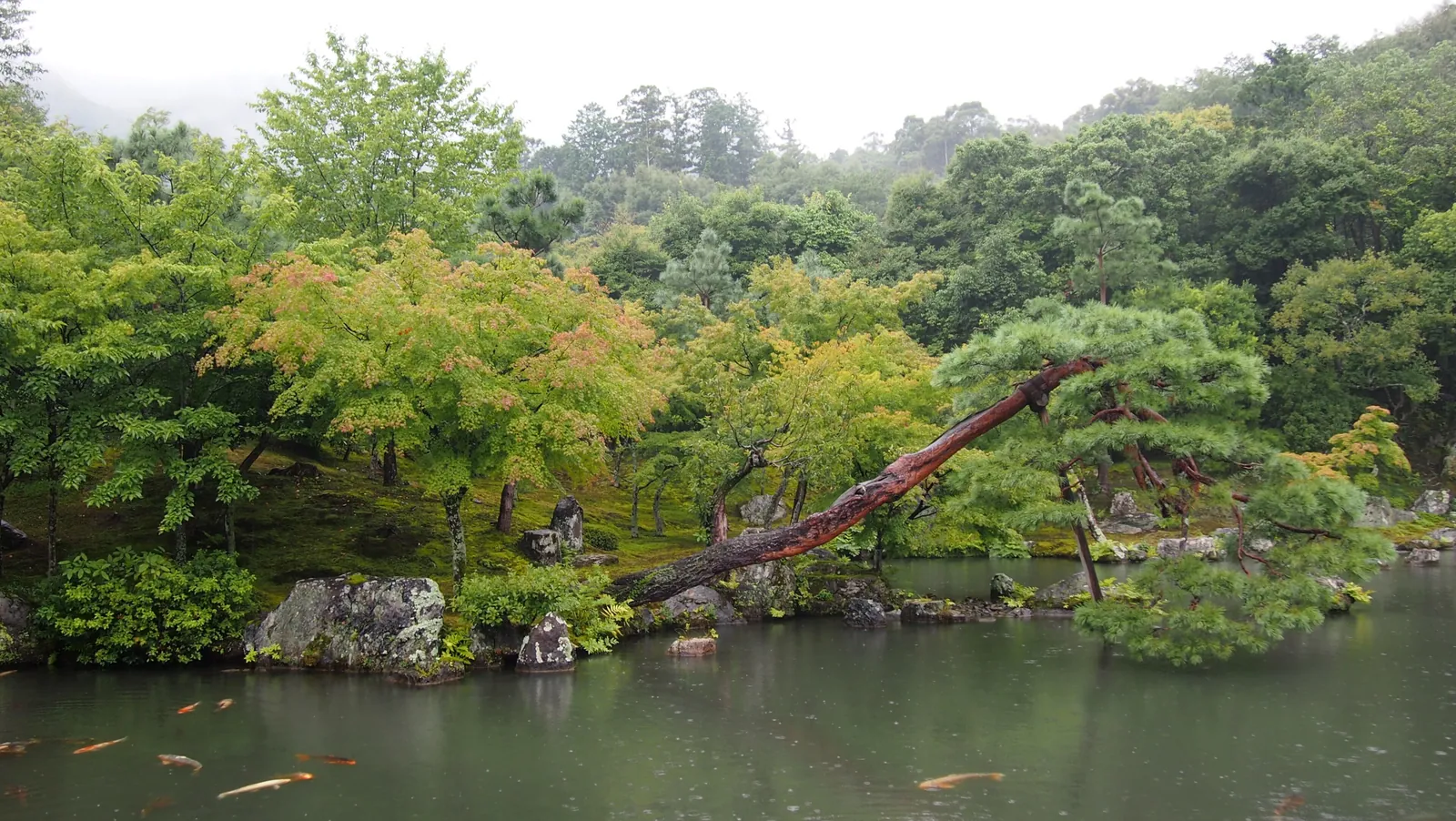
The approach garden — the roji — that leads to the tea room is an inseparable part of the ceremony. Designed to prepare the visitor's spirit before entering, the roji is a path of stepping stones and moss, stone water basins for handwashing, and vegetation that filters the light in calculated ways. Walking the roji is, according to the masters, the beginning of chanoyu: the transition from the ordinary world into the space of the room. The gardens of the Ura Senke in Kyoto, those of Kodaiji and those of the Imperial Villa Katsura are all examples of this poetics of transition.
The matcha: the tea, the sweets and the season
The tea prepared in chanoyu is matcha: green tea leaves (Camellia sinensis) shade-grown for the final weeks before harvest — the shade concentrates chlorophyll and L-theanine, producing the brilliant green colour and the umami flavour — then dried and stone-ground into a very fine powder. There are two types: usucha (thin tea, whisked with hot water into a froth) and koicha (thick tea, almost a paste, more intense in flavour). Koicha is prepared with the highest-quality matcha and is drunk in formal ceremonies.
The wagashi — Japanese confectionery served with the tea — are an inseparable part of the experience. They are served before the tea to prepare the palate: their sweetness contrasts with the bitterness of the matcha in the way one musical chord contrasts with the next. Wagashi follow the seasons strictly: in spring they are cherry-blossom shapes made from white bean paste; in autumn, maple-leaf shapes from yokan (adzuki jelly). The surest indicator of the quality of a tea ceremony is the quality and seasonal pertinence of its wagashi.
How to participate: where to experience chanoyu in Japan
Kyoto is the centre of chanoyu and has more opportunities to take part in a tea ceremony than any other city in the world. Visitor experiences are available in the gardens of Kodaiji, in the Ura Senke precinct, at the Urasenke Konnichian and at dozens of tea houses in Gion, Arashiyama and the Nishiki neighbourhood. The difference between a tourist experience and a genuine one is often the attention to context: the room, the garden, the host who has studied the discipline rather than simply demonstrating it.
In our Japan journeys, an afternoon with a chanoyu master — not a twenty-minute demonstration but a complete ceremony with time for silence — is one of those moments our travellers mention months later. Chanoyu is not a relic of the past: it is a living practice that millions of Japanese study as a personal discipline. For the attentive visitor, it offers something few traditions offer: the concentrated, deliberate and completely present experience of a single moment of beauty.
Quick answers
How long does a tea ceremony last and what protocol should I know?
A complete formal ceremony (chaji) can last four hours and includes a kaiseki meal, sweets, koicha and usucha. Experiences available to visitors are generally abbreviated versions of thirty to sixty minutes, focused on the preparation and drinking of usucha. The essential protocol is simple: enter quietly, sit where directed, receive the bowl with both hands, turn it three times clockwise before drinking and return it also with both hands. The host or guide will explain the rest.
Do you have to sit on the floor? Is it uncomfortable?
Yes, the traditional position is seiza — kneeling on the heels on the tatami — which is uncomfortable for those unaccustomed to it beyond fifteen or twenty minutes. In experiences designed for foreign visitors it is common to offer cushions or to permit cross-legged seating. Some places with greater accessibility have low chairs. If you have knee or back problems, enquire in advance.
What is matcha and how does it differ from regular green tea?
Matcha is green tea that has been stone-ground into a very fine powder and is whisked directly with hot water rather than steeped and removed like leaf green tea. The plant is the same (Camellia sinensis), but shade cultivation concentrates chlorophyll, L-theanine and other molecules that produce the umami flavour, the brilliant green colour and a calm-alertness effect distinct from coffee. Quality varies enormously: ceremonial-grade matcha (from the first harvest, shade-grown, slowly ground) is very different from the low-grade powder used in smoothies and ice cream.
Can chanoyu be studied outside Japan?
Yes. Ura Senke has accredited associations and teachers in dozens of countries, including several in Latin America and Spain. Formal study of chanoyu is a discipline of years or decades: serious practitioners study for a lifetime. For the curious traveller, a ceremony experience in Japan with a competent master is more valuable than an introductory workshop outside context; but local schools offer a genuine path of learning for those who wish to go deeper.
What are wagashi and where are the best in Kyoto?
Wagashi are traditional Japanese confectioneries served in tea ceremonies. The finest are creations of adzuki, white bean paste and pounded rice moulded into shapes representing the season. The best wagashi pastry shops in Kyoto include Toraya (with more than five centuries of history), Kagizen Yoshifusa in Gion and Nakamura Tokichi in Uji — the city of the world's best matcha, thirty minutes from Kyoto. Wagashi are also sold at the Nishiki market and at the tea rooms of major temples.

Let the reading become a route.
When an article sparks something, our planners are the next step. Tell us what you are dreaming of.