The Marquesas: The Most Dramatic Islands in the Pacific
Remote, volcanic and barely touched by mass tourism, the Marquesas Islands are the wildest corner of French Polynesia — towering black basalt, living tattoo culture and valleys that were colonised by people who had sailed from the other side of the ocean.
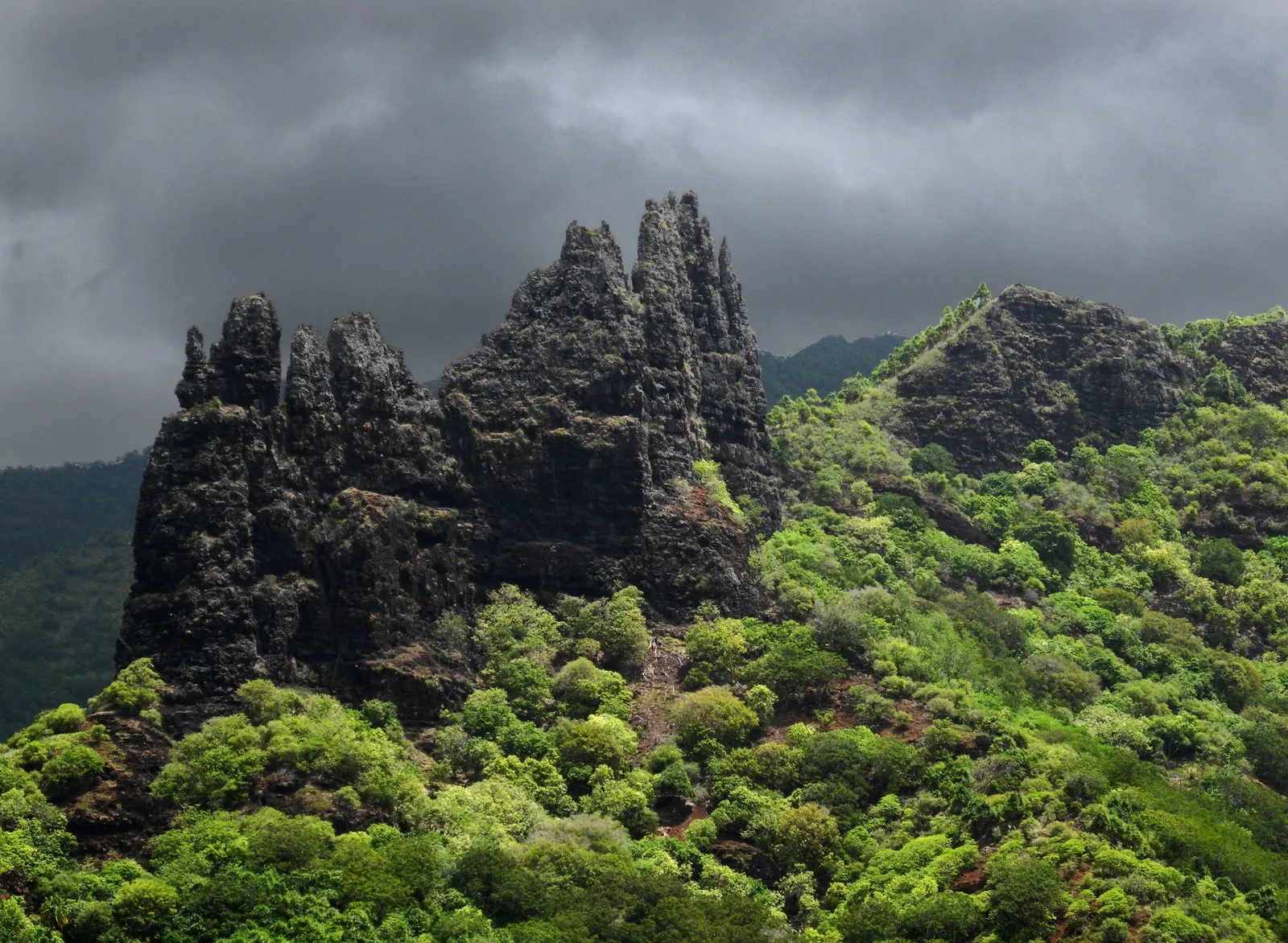
Fly north-east from Tahiti for three and a half hours and the Marquesas appear below: a chain of dark, jagged islands rising from the deepest blue of the open Pacific, trailing no coral reef, no sheltering lagoon, no gradual approach. They thrust out of the sea as cliffs and spires, waterfalls streaming down their flanks into a swell that arrives unbroken from thousands of kilometres away. There are no atolls here, no sugar-sand beaches ringed by turquoise shallows. The Marquesas are not that kind of Pacific.
They are the Pacific at its most vertical, most ancient and most itself. The twelve islands of the group — six of which are inhabited — hold some of the most dramatic landscapes in the entire ocean, a living Marquesan culture of extraordinary depth, and a place in navigation history that belongs to the very last act of Polynesian expansion. Understanding the Marquesas means stepping out of the postcard and into something genuinely wilder — and genuinely worth the distance.
The landscape: what volcanism without a reef looks like
Most of French Polynesia's islands sit within or behind coral reefs that soften the ocean's energy and create the lagoons the region is famous for. The Marquesas are different: they are geologically young enough that the fringing reefs never fully developed, which means the ocean delivers its full force directly to the coastline. The result is a landscape of headlands, sea caves, dark basalt walls and pounding surf, combined with interior valleys so deep and mist-hung that they feel separated from the coast by an entirely different climate.
The interior of islands like Nuku Hiva and Hiva Oa is astonishingly lush — valleys dense with wild horses, tropical forest and waterfalls that drop hundreds of metres in a single fall. The contrast between the violent coast and the fertile, almost temperate interior is disorienting and magnificent. The highest point, Mount Temetiu on Hiva Oa, rises over 1,200 metres above the sea. The whole archipelago sits in tropical isolation, roughly 1,500 kilometres north-east of Tahiti, far closer to the Equator and to the Americas than to anywhere else in the French Pacific.
The culture: tattoo, tiki and living tradition
Marquesan culture is among the most distinctive in Polynesia. The word 'tattoo' itself entered the English language from Polynesia — missionaries who visited the Marquesas in the eighteenth century were the first Europeans to encounter the practice systematically — and in the Marquesas the art has never died. Marquesan tattoo, characterised by bold geometric patterns covering large areas of the body, is a living tradition with its own grammar of symbols, and contemporary Marquesan tattoo artists are sought internationally.
The islands are also known for their tiki — large stone carvings of human or semi-human figures — and their me'ae, sacred stone ceremonial platforms comparable to the ahu of Rapa Nui. The most important archaeological site in the Marquesas is Iipona on Hiva Oa, containing the largest tiki in French Polynesia. The culture is not museum culture; the Marquesan people are actively engaged in the revitalisation of language, dance, tattooing and navigation, and the annual Marquesas Arts Festival, held roughly every four years, draws performers from across Polynesia.
Nuku Hiva: the main island and its valleys
Nuku Hiva is the largest island and the administrative centre, home to the main town of Taiohae and the deepest natural harbour in French Polynesia. It is the usual arrival point for travellers coming by either inter-island flight from Tahiti or aboard a cruise ship or the supply vessel Aranui. The bay at Taiohae, backed by green mountains and studded with anchored yachts, is one of the most beautiful anchorages in the Pacific.
The island's other great anchor is the Taipivai Valley, which Herman Melville explored and wrote about in his 1846 book Typee, one of the first extended accounts of Marquesan life by a Western writer. The valley is still remote, accessible by four-wheel drive and on foot, and its interior contains archaeological sites scattered among breadfruit trees and stream-cut rock. On Nuku Hiva's wild north coast, the Hakaui Valley holds the Vaipo waterfall, one of the tallest in the world, dropping nearly 350 metres into a gorge accessible only by boat and then on foot.
Hiva Oa: Gauguin, Jacques Brel and the monumental past
Hiva Oa is the cultural heart of the southern Marquesas and the island where Paul Gauguin spent the last two years of his life, dying there in 1903. His grave, alongside that of the Belgian singer-songwriter Jacques Brel — who also chose to live and die on the island — is in the Calvary cemetery above the town of Atuona. Both men were drawn by the same qualities: radical distance, living culture, light that is specific to this latitude.
The Atuona museum holds reproductions of Gauguin's works and interprets the island's history. More significant, historically, is the me'ae of Iipona in the Puama'u Valley, where six tiki stand on a restored platform in varying states of preservation — the largest, Taka'i'i, is nearly 2.4 metres tall and is the biggest tiki in all of French Polynesia. These are not carvings for display; they were objects of profound spiritual significance in a society that was devastated by introduced disease after European contact, and approaching them requires the context and respect the landscape demands.
Getting there and the supply ship Aranui
The Marquesas are genuinely remote, and that remoteness is intrinsic to their character. Flights from Tahiti's Faa'a Airport serve Nuku Hiva and Hiva Oa directly, and inter-island aircraft connect the smaller inhabited islands. But the most distinctive way to arrive — and the way that best reflects the Marquesas' own history as a place that depends on the sea — is aboard the Aranui, a combination cargo and passenger ship that has served these islands for decades.
The Aranui makes a roughly two-week voyage from Papeete, stopping at each inhabited island to unload supplies and take on passengers and freight. For travellers, the ship functions as a moving expedition base: you visit each island on a day excursion and return to the vessel each night. The communities that come down to the dock when the Aranui arrives — the only connection to the wider world for the more remote valleys — is a reminder that the Marquesas are not merely a destination but a place that people call home at the far end of the world's largest ocean.
Quick answers
How do you get to the Marquesas Islands?
Air Tahiti operates regular flights from Papeete to Nuku Hiva and Hiva Oa, with smaller inter-island flights connecting the other inhabited islands. The voyage can also be made aboard the Aranui, a cargo-passenger vessel that makes a roughly two-week circuit of the islands from Papeete, combining freight delivery with passenger excursions at each island. It is one of the great slow-travel itineraries remaining in the Pacific.
What is the best island to visit in the Marquesas?
Nuku Hiva and Hiva Oa are the most visited and have the most facilities, but they are strikingly different in character. Nuku Hiva is the largest, with dramatic valleys, the best harbour and the most hiking options. Hiva Oa is the cultural centre, with the Gauguin connection, the best archaeological site at Iipona, and a quieter, more intimate scale. Travellers with time for only one often find Hiva Oa the more memorable.
What is the Marquesas Arts Festival?
The Marquesas Arts Festival is a major cultural gathering held roughly every four years on one of the Marquesas islands, rotating between them. It brings together performers from across the Marquesas and wider Polynesia for several days of traditional dance, music, tattooing, canoe building and other cultural demonstrations. It is one of the most significant celebrations of living Polynesian culture in the Pacific and draws travellers who specifically time their visit to coincide with it.
Why don't the Marquesas have coral reefs?
The Marquesas Islands are geologically young and sit on a section of the Pacific Plate moving relatively quickly over a hot spot, which means the islands have not had time for extensive fringing reefs to develop around them. The lack of a reef means the open ocean swells reach the coastline directly, producing the dramatic cliff scenery and heavy surf the islands are known for, rather than the calm lagoons of older Pacific island groups.
Let the reading become a route.
When an article sparks something, our planners are the next step. Tell us what you are dreaming of.