The Masai Mara: Kenya's Great Game Reserve and Its People
The Masai Mara is the Kenyan half of the greatest wildlife spectacle on Earth — and also the homeland of the Maasai, whose cattle culture, distinctive dress and complex relationship with the land add a human dimension that no safari here can ignore.
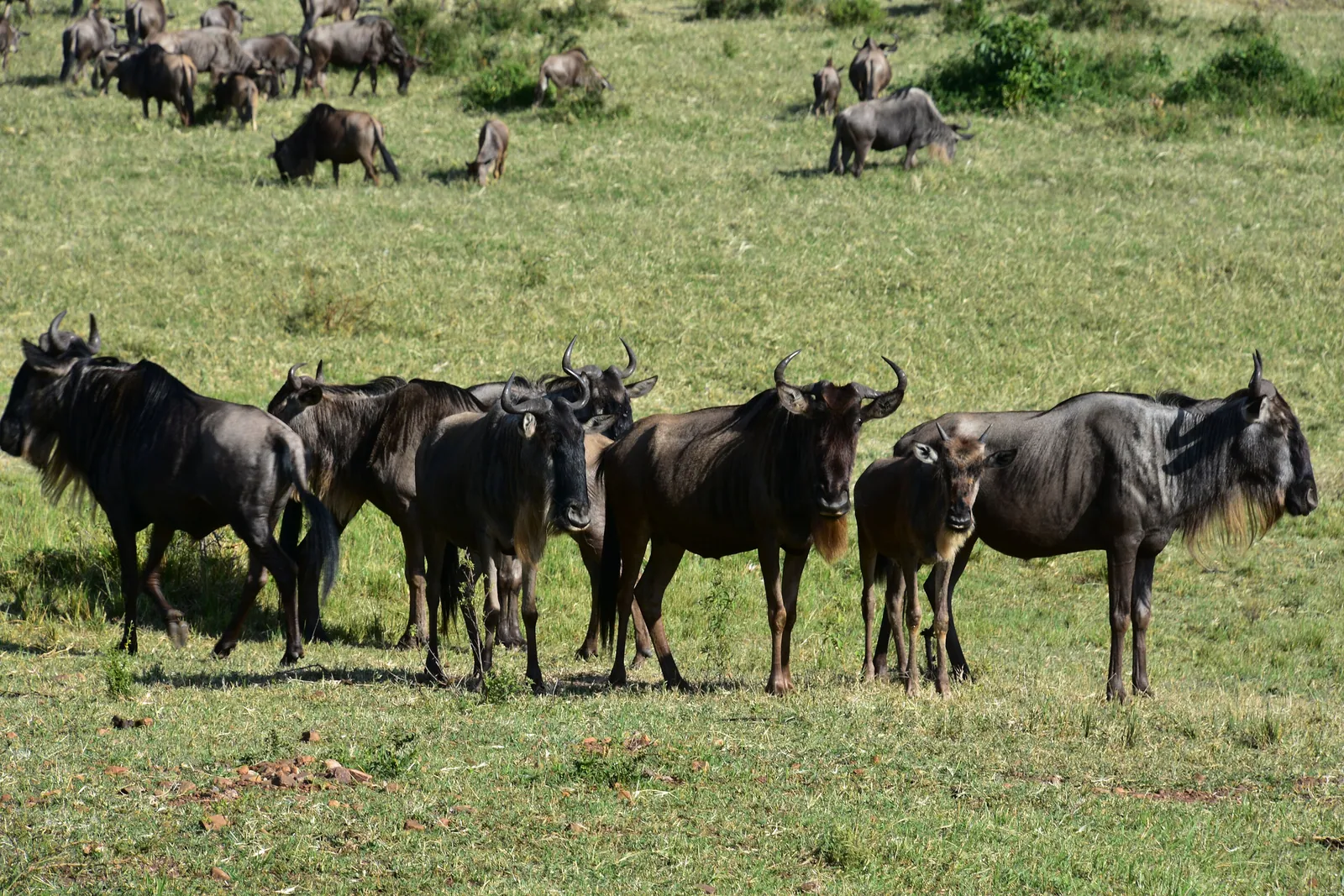
The Masai Mara National Reserve occupies the southwestern corner of Kenya, separated from Tanzania's Serengeti only by the Mara River and a fence that the great migration ignores entirely. The two ecosystems are biologically continuous: the same immense population of wildebeest, zebra and gazelle that calves on the Serengeti plains in February moves north into the Mara by July, and the river crossings that draw the world's wildlife photographers happen here, on the Kenya side, through August and October.
But the Mara is more than the northern annexe of a Tanzanian spectacle. It is a reserve that sits within a larger landscape of Maasai community land — the Mara ecosystem — where the semi-nomadic Maasai people have herded cattle for centuries, shaping the grasslands through burning and grazing in ways that directly influence where the game can live. The relationship between the Maasai, their cattle and the wild animals that share their landscape is one of the most interesting and contested dynamics in African conservation, and no honest account of a Mara journey can separate the wildlife from the people.
The reserve and its ecosystem
The Masai Mara National Reserve covers roughly 1,500 square kilometres of open savannah, woodland and riverine forest — less than a tenth of the size of the Serengeti National Park. Its fame rests on the density of its wildlife rather than its area. The Mara is one of the few places in Africa where all five of the Big Five — lion, leopard, elephant, buffalo and rhinoceros — can be realistically seen in a single visit, and its lion and cheetah populations are among the most studied in the world.
Around the reserve lie the privately owned Mara conservancies — Olare Motorogi, Naboisho, Ol Kinyei and others — that together form the broader Mara ecosystem. These conservancies operate on a different model: fewer vehicles per area, higher-end camps, and community partnerships with Maasai landowners who receive payments for tolerating wildlife on their land. The conservancies can be excellent for game: no visitor vehicle limits and a genuine possibility of night drives and walking safaris unavailable inside the official reserve.
The river crossings explained
The wildebeest crossings of the Mara River are among the most watched wildlife events in the world, and they are also among the least predictable. A crossing happens when one or more wildebeest work up the courage to enter the water — courage because the Mara River holds resident Nile crocodiles, among the largest in Africa, that wait at the crossing points. But wildebeest work by collective nervous energy, and crossing attempts can be aborted, reversed and restarted over the course of hours.
The crossing season runs broadly from late July to October, peaking in August and September. But there is no calendar — crossings can happen at intervals of hours or not at all for several days. Guides with years of experience reading the herds can significantly improve the odds, but the honest answer is that you choose a window, position yourself, and watch what happens. The experience of watching a crossing — thousands of animals plunging into water, crocodiles striking, the river churning — cannot be replicated in any other way, which is why it draws return visitors year after year.
The Maasai: cattle, land and conservation
The Maasai are a semi-nomadic pastoralist people of East Africa, today numbering perhaps 1.5 million in Kenya and Tanzania. Their culture is organised around cattle: wealth is measured in cattle, social relationships are maintained through the exchange of cattle, and the herds are moved between pastures following seasonal rains in a pattern designed to prevent overgrazing. Red ochre body paint, distinctive beaded jewellery, the shaved heads of Maasai women and the braided ochre-coloured hair of young men — the moran or warriors — make the Maasai among the most visually recognisable peoples on Earth.
The relationship between Maasai land use and wildlife conservation is long and unresolved. The Maasai were historically displaced from much of their traditional range to create national parks and game reserves — the Masai Mara itself was partly carved from Maasai grazing land. The community conservancy model, which has grown significantly over the past two decades, attempts a different approach: Maasai landowners retain ownership of their land and receive payments from tourism, in exchange for limiting cattle grazing and tolerating wildlife. The outcomes vary, but the model represents a genuine shift from the exclusion that characterised earlier conservation approaches.
Visiting a Maasai community
Most camps in and around the Mara offer visits to nearby Maasai villages, and these vary greatly in quality and authenticity. At one end are highly commercialised performances put on specifically for tourists — a welcome dance, a fire-lighting demonstration, a tour of a compound and a push toward a craft stall. At the other end are slower, more personal visits facilitated by individual community members with a genuine investment in showing you their actual lives.
The difference is almost always visible in how the visit is arranged: the best are small-group, facilitated by a camp whose community relationships are long-standing, with a local guide who can translate real conversations and navigate the nuance of what you are and are not invited to witness. Even a well-arranged visit involves showing up as a tourist in someone else's home, and the honest approach is to be curious rather than voyeuristic, to buy crafts if you want them rather than under pressure, and to take photographs only when permission has been asked and genuinely given.
Timing and logistics
The Mara has two distinct seasons. The dry season, roughly June to October, is when the migration arrives from the south and the river crossings happen — this is peak season in every sense: the best wildlife viewing, the most visitors and the highest prices. July and August in particular are crowded; the more discerning approach is to target the early part of the migration (late June to July) or the tail (October), when visitor numbers are somewhat lower but herds are present.
The wet season, from November to May, brings two rain periods — the short rains of November-December and the long rains of March-May. This is the season for the calving grounds on the Tanzanian side of the ecosystem, and the Mara itself is greener, less visited and often cheaper. The big cats are resident year-round; it is only the migration that is seasonal. For a traveller whose priority is cats — lions, cheetahs and leopards — the dry months without the migration crowds can offer a quieter and in some ways better experience than the high-season scramble for crossing-watching vehicles.
Quick answers
What is the difference between the Masai Mara and the Serengeti?
The Masai Mara and the Serengeti are biologically the same ecosystem, separated only by the Kenya-Tanzania border and the Mara River. The Serengeti is much larger; the Mara is where the wildebeest migration arrives in the northern dry season, producing the famous river crossings. In practice, the Mara tends to be somewhat more expensive and more visited than equivalent areas of the Serengeti, and has different logistical entry points. The private Mara conservancies offer a less crowded, often higher-quality experience than the main reserve.
When do the wildebeest river crossings happen at the Mara?
The crossing season runs broadly from late July to October, with August and September typically the most active. However, crossings are entirely unpredictable: they can happen multiple times a day or not at all for several days. No operator can guarantee a crossing, and the standard advice is to spend several days in the area during the window, position yourself at likely crossing points with a knowledgeable guide, and accept that waiting is part of the experience.
Are the Maasai community visits worth doing?
The quality varies enormously. Highly commercialised visits designed purely for tourists can feel hollow on both sides. Better visits are arranged through camps with genuine, long-standing community partnerships, are small-group and guided by someone who can translate real conversation. A well-arranged visit gives real context for everything you observe in the landscape — the cattle management, the burning patterns, the relationship between people and wildlife — that no game drive alone can provide.
What permits or fees are required to enter the Masai Mara?
The Masai Mara National Reserve charges a daily conservation fee per visitor, paid in foreign currency. Rates differ for residents and non-residents of Kenya. The fee covers entry to the main reserve only; the private conservancies have their own fee structures, typically included in camp rates. Fees are subject to change, so check current rates with your camp or operator before travel.
Let the reading become a route.
When an article sparks something, our planners are the next step. Tell us what you are dreaming of.