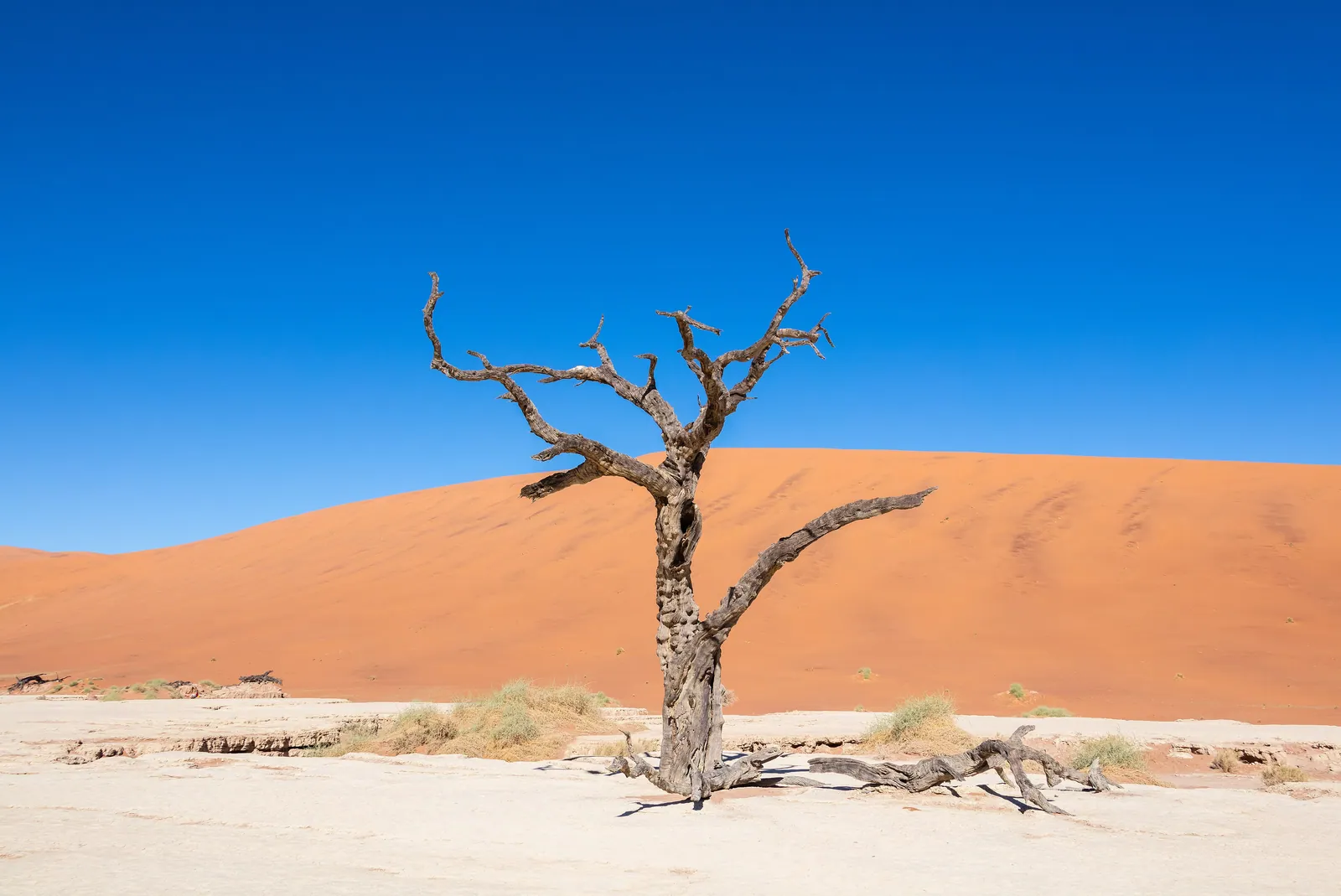
The Namib: Understanding the Oldest Desert on Earth
The Namib has been arid for tens of millions of years, kept dry by a cold ocean current and watered, strangely, by fog. Here is how the world's oldest desert works, and why that age shapes everything in it.
The Namib is widely considered the oldest desert on Earth — arid or semi-arid for at least 55 million years, and possibly far longer. That is not a marketing phrase but a geological fact with consequences: a landscape that has been dry for so long has had time to evolve specialists found nowhere else, and to build dunes and gravel plains of remarkable permanence.
What keeps the Namib dry is the sea beside it. The cold Benguela Current flows north along the coast, chilling the air above it so that little moisture rises and falls as rain. That same cold water, however, generates dense coastal fog that rolls inland most mornings — and that fog, not rain, is the desert's true water supply. Understanding the Namib means understanding this paradox: a desert kept alive by the ocean that keeps it dry.
How a desert measures its age
The Namib stretches roughly 2,000 kilometres down the Atlantic coast of Africa, across Angola, Namibia and into South Africa, and it occupies a narrow strip between the sea and the inland escarpment. Geologists date its aridity by the rock and sediment record, and the evidence points to a desert that has been dry, with only minor fluctuations, since the age of the early mammals.
Age matters because it is rare. Most of the world's deserts are young — products of climate shifts within the last few million years, or even few thousand. A desert that has been arid for tens of millions of years is an evolutionary laboratory: enough time for plants and animals to become finely, sometimes bizarrely, adapted to extreme dryness, and to do so in isolation.
The fog that feeds it
Rainfall across much of the Namib is negligible — often under 20 millimetres a year on the coast, and unreliable even inland. Yet life persists, and it does so on fog. When the cold Benguela air meets the warmer land, thick banks of fog form and drift inland, sometimes for tens of kilometres, on most mornings of the year.
For the desert's creatures this fog is everything. The famous fog-basking beetle of the Namib tilts its body into the breeze so condensed droplets run down to its mouth; lichens, plants and reptiles all draw on the same source. A traveller who wakes early on the coast and sees the fog roll in is watching the desert drink.
Welwitschia: a plant that outlives empires
No organism captures the Namib's strangeness like Welwitschia mirabilis. It is a plant unlike any other — a low, sprawling tangle that produces only two true leaves in its entire life, leaves that grow continuously and fray into ribbons over centuries. Many living specimens are estimated at 500 to 1,000 years old, and some considerably more.
Welwitschia survives by drawing on fog and on deep groundwater, and by simply being patient on a timescale that dwarfs human history. It is a living relic, a botanical link to a far older world, and a fitting emblem for a desert whose defining quality is endurance across deep time.
Gravel plains, dunes and a coast of bones
The Namib is not one landscape but several. There is the great sand sea of the south, with the towering dunes around Sossusvlei; there are vast gravel plains, scoured flat and dotted with isolated mountains; and there is the Skeleton Coast in the north, where the cold sea, treacherous surf and shifting fog have wrecked ships for centuries and left their hulls slowly disappearing into the sand.
Each of these owes its character to the desert's age and aridity. The dunes are stable because the climate has been stable; the gravel plains are swept clean because so little grows to bind them; the Skeleton Coast is a graveyard because the same cold current and fog that water the desert also blinded generations of sailors.
The Namib on a grand journey
For travellers crossing southern Africa, the Namib offers a profound contrast to the green and the crowded. It is quiet, vast and slow, and it asks to be experienced unhurried — a few days at least, moving between the dune sea, the plains and the coast, letting the scale settle.
On The Great Rift journey the Namib is the desert chapter of a continent-spanning route, a place to pause before the louder spectacle of Victoria Falls or the gardens of the Cape. Its lesson is one of time: this is the oldest desert on Earth, and it teaches a traveller to look at landscape as something with a history measured in epochs.
Quick answers
Why is the Namib called the oldest desert on Earth?
Geological evidence indicates the Namib has been arid or semi-arid for at least 55 million years, with only minor fluctuations. Most of the world's other deserts are far younger, having formed within the last few million years. This extreme age has allowed unique, highly specialised plants and animals to evolve there in isolation.
If it almost never rains, how does anything survive in the Namib?
Fog. The cold Benguela ocean current chills the coastal air, generating thick fog banks that drift inland most mornings. Beetles, lichens, reptiles and plants all draw water from this fog rather than from rain. It is the desert's primary and most reliable water source.
What is the Welwitschia plant?
Welwitschia mirabilis is a plant endemic to the Namib that produces just two leaves over its whole lifetime, growing continuously for centuries. Many specimens are 500 to 1,000 years old or more. It survives on fog and deep groundwater and is regarded as a living fossil, a link to a much older botanical world.
Let the reading become a route.
When an article sparks something, our planners are the next step. Tell us what you are dreaming of.