The Night Sky From the Edge of Space
Rise 35 kilometres in a stratospheric balloon and the sky changes character entirely — black by day, undimmed by air, fringed by the thin blue line of the atmosphere itself. What the view is really like.
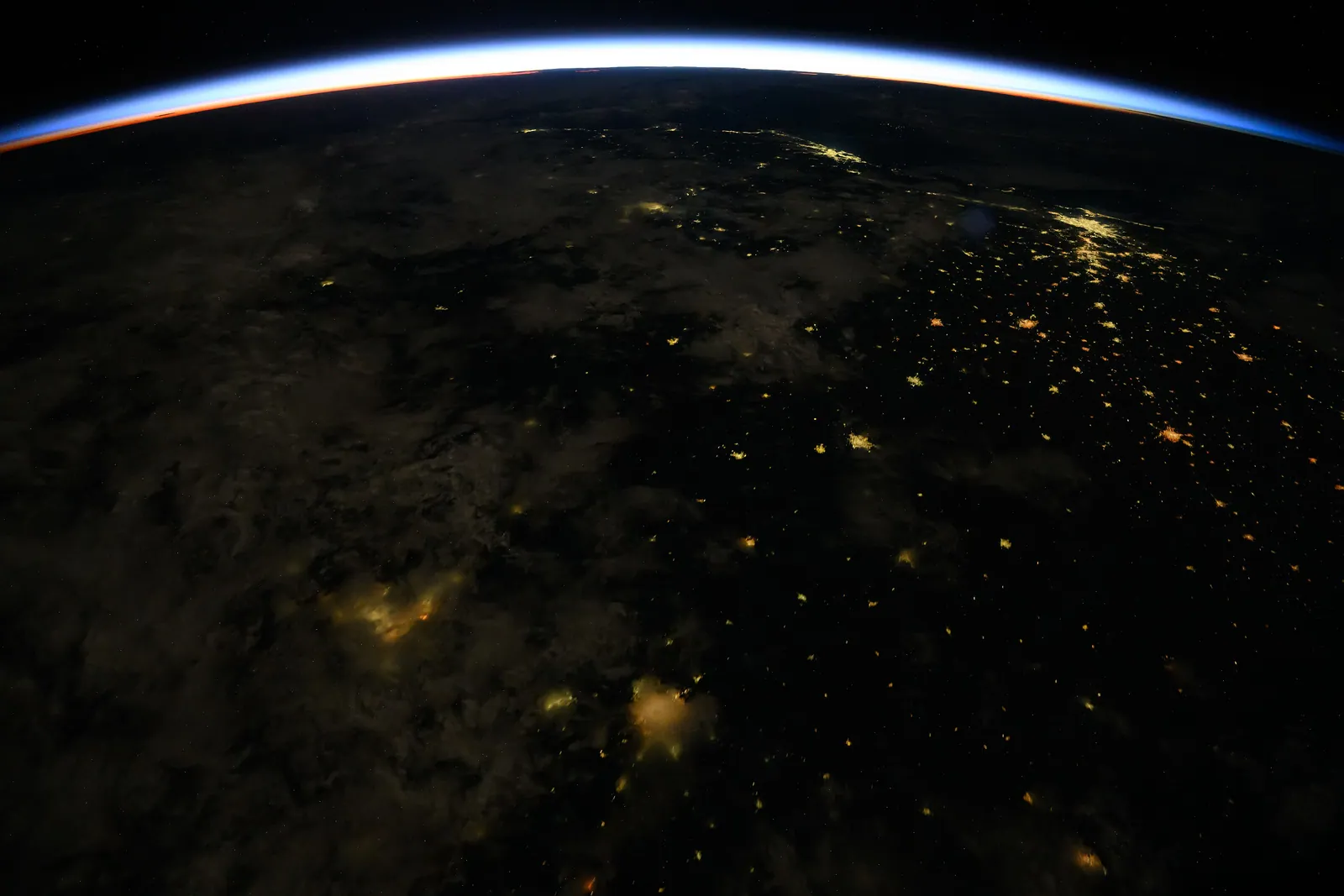
From the stratosphere, at around 35 kilometres up, the sky is no longer blue. You are above more than 99 percent of the atmosphere, and with so little air left overhead to scatter sunlight, the sky turns deep violet and then black even in full daylight — with the brighter stars and planets visible while the Sun is still up. The horizon below shows a distinct curve, fringed by the thin bright line of the atmosphere itself.
This is the destination of the final chapter of Beyond the Blue: a slow, crewed ascent by pressurised balloon to the threshold of space. It is not spaceflight — there is no rocket and no weightlessness — but it is the highest a traveller can go and still drift gently home the same afternoon. This article describes what the sky and the atmosphere actually look like from up there, and the physics behind the view.
Why the daytime sky turns black
The sky is blue because air molecules scatter sunlight, and they scatter short blue wavelengths most strongly — a process called Rayleigh scattering. That scattered blue light, arriving from every direction, is what we see as a bright sky. The effect depends entirely on there being air to do the scattering.
Climb into the stratosphere and most of that air is beneath you. With far fewer molecules overhead, very little sunlight is scattered, and the sky darkens through deep blue to violet to near-black. The Sun still blazes, and the ground is still lit, but the sky around the Sun is dark — the same sky astronauts describe, reached without leaving the atmosphere entirely.
Stars by day, and an undimmed night
Because the daytime sky is so dark from the stratosphere, the brighter stars and planets can be seen while the Sun is above the horizon — something impossible from the ground, where the scattered blue glow drowns them. The usual daytime and nighttime sky begin to merge into one.
At true night the advantage is sharper still. The air that remains above a stratospheric balloon is so thin that it dims and blurs starlight far less than even the best mountain-top site. Stars do not twinkle, because there is almost no turbulent air to make them shimmer. The night sky from the edge of space is about as clean as a view of the cosmos gets without a spacecraft.
Noctilucent clouds — the clouds at the edge of the air
The highest clouds on Earth form not in the stratosphere but above it, in the mesosphere, around 80 kilometres up. These are noctilucent, or 'night-shining', clouds — wispy, electric-blue filaments of ice crystals so high that they catch sunlight long after the ground below has fallen into night.
From the ground they are a rare summer-twilight sight at high latitudes. They are a reminder that the atmosphere has structure all the way up: layer upon layer of air, each thinner than the last, with phenomena of its own. A stratospheric ascent carries a traveller through several of those layers in a single quiet climb.
The curve of the Earth and the thin blue line
From 35 kilometres the curvature of the Earth is unmistakable — the horizon bends in a long, clean arc. Above that arc sits the feature that gives Beyond the Blue its name and its argument: the atmosphere itself, seen edge-on as a startlingly thin bright band, shading from white through blue into the black of space.
Seen from below, the sky feels limitless. Seen from the side, from the stratosphere, it is revealed as a fragile film — proportionally thinner, against the bulk of the planet, than the skin of an apple. It is the single image the whole journey has been climbing toward.
What the ascent is actually like
A stratospheric balloon flight is slow and gentle, not violent. A vast helium balloon lifts a sealed, pressurised capsule, and the cabin stays at a comfortable pressure and temperature throughout — there is no spacesuit, no decompression, no weightlessness. The climb takes around two hours, and the view changes steadily as the sky darkens and the horizon bends.
On Beyond the Blue, this is the closing stage of a thirty-day journey through the planet's extremes, and the itinerary builds in spare days because the flight depends entirely on calm weather. Full medical screening is required, as it is for the deep-sea dive. Operators developing these flights treat them as commercial aviation, with redundant safety systems and pilots — and we are careful never to claim more than that. You reach the edge of space; you watch the blue thin to a line; and you come home that same afternoon.
Quick answers
Why does the sky look black from a stratospheric balloon?
The blue of the daytime sky is sunlight scattered by air molecules. From the stratosphere, at around 35 kilometres, more than 99 percent of the atmosphere lies below you, so there is very little air left overhead to scatter light. With almost nothing to scatter the sunlight, the sky darkens to violet and then near-black, and the brighter stars become visible even in daytime.
Is a stratospheric balloon flight the same as going to space?
No. A balloon flight reaches the edge of space but not space itself — there is no rocket, no orbit and no weightlessness. A pressurised capsule rises gently under a helium balloon to roughly 35 kilometres, where the sky is black and the Earth's curve is visible, then descends the same day. It is the highest a traveller can go while still drifting home under a balloon and a parawing.
What are noctilucent clouds?
Noctilucent, or 'night-shining', clouds are the highest clouds on Earth — thin veils of ice crystals that form in the mesosphere around 80 kilometres up. Because they are so high, they remain sunlit after the ground has gone dark, glowing an electric blue in the deep twilight. From the ground they are a rare summer sight at high latitudes.
Let the reading become a route.
When an article sparks something, our planners are the next step. Tell us what you are dreaming of.