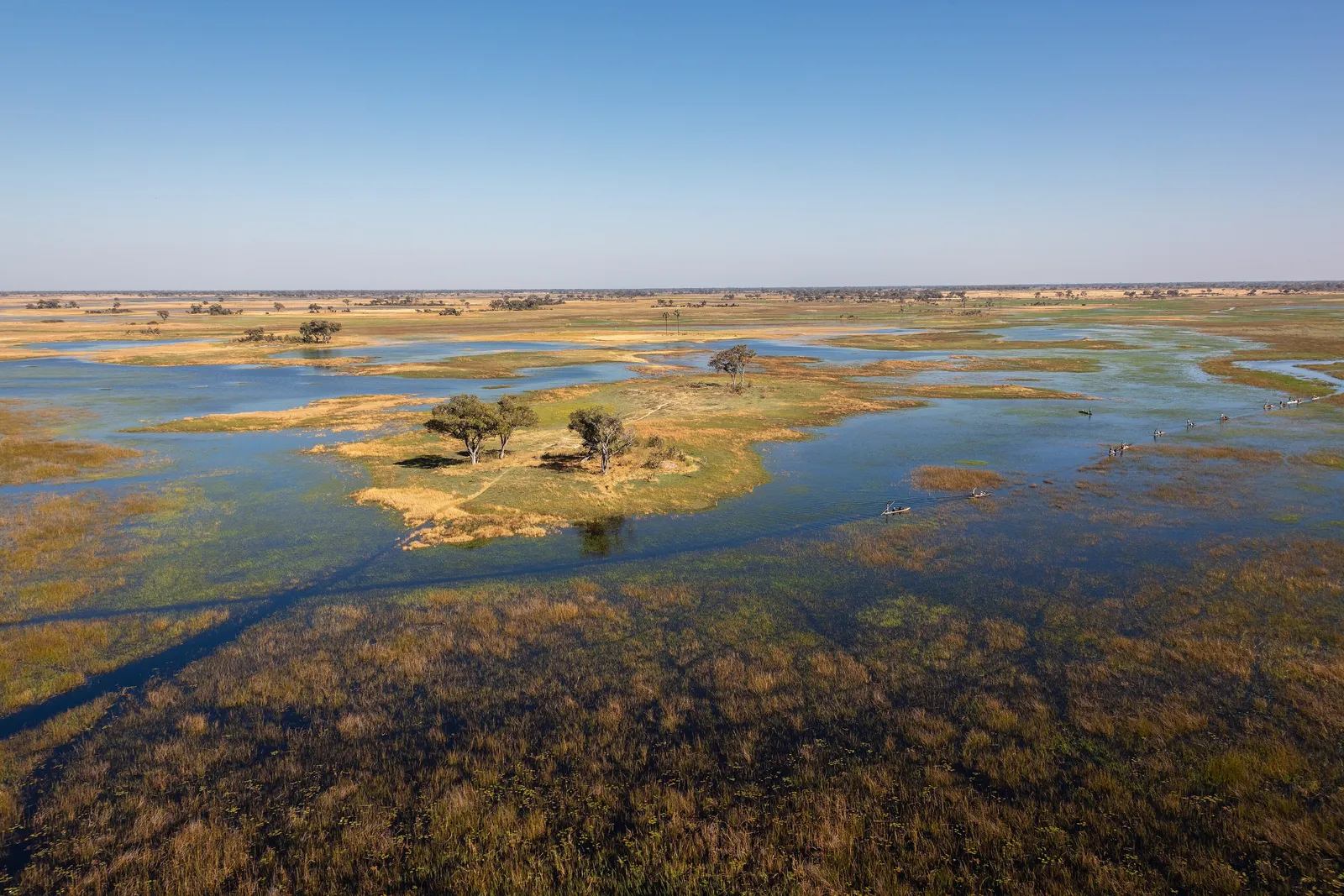
The Okavango Delta: Wildlife of the World's Greatest Inland Wetland
Each year a river from Angola floods into the Kalahari and vanishes — leaving behind a maze of channels, islands, and lagoons that sustains one of Africa's richest concentrations of large wildlife. Here is how the delta works, and what lives in it.
The Okavango River rises in the wet highlands of Angola, flows southeast for more than a thousand kilometres, crosses into Botswana — and then does something extraordinary. It does not reach the sea. Instead, it fans out across the sand of the Kalahari in a vast, shallow maze of channels, lagoons and reed beds, soaking down into the desert and evaporating in the dry air until nothing is left. The Okavango Delta is a river that disappears into itself, and in doing so creates one of the most improbable wildlife habitats on Earth.
The seasonal flood — peaking counterintuitively in the dry season, when it is most needed — turns three to six thousand square kilometres of Kalahari sandveld into a watery wilderness. Buffalo and elephant swim between islands. Hippos maintain channels. Sitatunga, a secretive antelope built for swamp, wade through papyrus. Leopards hunt from the fig trees above. And among the channels, in a dugout mokoro canoe pushed by a pole, a traveller moves through a world where the distinction between land and water has dissolved entirely.
How the flood works: a river that runs backward in time
The Okavango's seasonal rhythm seems backwards to anyone who has not studied it. Rainfall in the Angolan catchment peaks between November and March — the wet season in Angola — and the resultant flood wave travels slowly south and east, taking three to four months to reach the delta. By the time it arrives, Botswana's own rains have ended and the Kalahari is dry and hot. The flood peaks between roughly June and August, filling channels that were dust weeks before.
The mechanism is geological as well as hydrological. The delta sits at the southern end of the East African Rift system, and fault lines control the exact shape of the fan and the distribution of channels across it. The channels themselves shift over decades as sediment blocks one distributary and water finds another — so the delta is not a fixed map but a living structure, slowly rewriting itself. The islands within the delta, covered in palms and figs and mopane, are the raised edges of old termite mounds, the only solid ground in an otherwise flat landscape.
The large mammals: abundance on an unusual stage
The Okavango and its surrounding reserves — Moremi Game Reserve, the Chobe and Linyanti concessions, the private areas of the northern Tuli block — together form one of Africa's great wildlife strongholds. Botswana's deliberate policy of low-volume, high-value tourism has kept safari pressure comparatively light and wildlife densities high.
African elephants are present in extraordinary numbers — Botswana holds the largest elephant population in Africa, and Chobe, just northeast of the delta, has some of the continent's highest densities. Buffalo move through in large herds. African wild dogs, one of the continent's most endangered large predators, maintain healthy packs in the Okavango system. Leopard, lion, spotted hyena and cheetah all inhabit the area. The delta's watery margins add hippo, crocodile and the semi-aquatic sitatunga, a chocolate-brown antelope with splayed hooves built for moving through papyrus and floating grass mats.
Birds: a water world for an extraordinary avifauna
For birdwatchers, the Okavango is in a class of its own in Africa. More than 550 species have been recorded in the delta and its surroundings, reflecting the extraordinary diversity of habitats — open water, reedbeds, riparian forest, dry savanna and floodplain grassland — compressed into a small area. The delta's birds range from the massive Goliath heron and African fish eagle — whose cry is the signature sound of an African waterway — to tiny waxbills weaving nests in the reeds.
The Pel's fishing owl, a large tawny owl that hunts fish from overhanging branches, is one of the delta's most sought-after species and genuinely hard to find elsewhere. African skimmers skim the calm channels at dusk; malachite kingfishers flash electric blue from papyrus stems; and during the flood season, vast concentrations of waterbirds — herons, egrets, ibises, storks and darters — gather wherever fish are concentrated by the rising water. A morning on a mokoro, with a guide who knows the channels, can produce a hundred species before the heat of the day.
The mokoro and the experience of a water landscape
The traditional way to move through the delta is the mokoro — a shallow dugout canoe, traditionally hollowed from a sausage tree or ebony trunk, now more often made from fibreglass to ease pressure on trees. The poler stands at the stern and pushes against the silty bottom with a long pole, moving the canoe silently through channels wide enough only for one boat, past papyrus taller than a standing person and under overhanging sycamore figs heavy with fruit and hornbills.
The perspective from a mokoro is transforming. Sitting inches above the waterline, you lose all sense of distance and elevation and enter the reed beds as a participant rather than a viewer. A hippo nearby is genuinely impressive at this height; a family of painted reed frogs on a papyrus stem is a universe in miniature. The mokoro rewards the same quality as every good wildlife encounter — the willingness to stop moving and let the world come to you.
Conservation and the model that protects the delta
The Okavango Delta was inscribed as a UNESCO World Heritage Site in 2014, recognising its global ecological significance. Botswana's approach to wildlife management — strict limits on visitor numbers per concession, community-based natural resource management, and the economic empowerment of communities through safari employment — has created one of the most functional conservation economies in Africa.
The delta's continued existence depends on water reaching it from Angola. Any dam, large-scale irrigation or land-use change in the Okavango catchment could diminish the flood pulse, which is why the Okavango Delta is also formally protected as a Ramsar Wetland of International Importance, and why conservation organisations work across all three countries. Climate variability adds pressure: dry years produce a smaller flood, contracting the wetland. Protecting the delta means protecting a watershed that begins more than a thousand kilometres away.
Quick answers
When is the best time to visit the Okavango Delta?
The peak of the seasonal flood, from roughly June to August, is when the delta is at its most spectacular — channels are full, wildlife concentrates on islands, and the dry Botswana winter makes for comfortable days and cool nights. May and September are excellent shoulder months with fewer visitors. The summer (November to March) is hot, the delta is lower, and rainfall can make some areas inaccessible, though bird life peaks as migrants arrive.
Is a safari in the Okavango worth the expense?
The Okavango's lodges and camps are among the most expensive in Africa, reflecting Botswana's deliberate low-volume strategy. What you get is typically outstanding: small groups, highly experienced guides, exclusive concessions with minimal vehicle pressure, and wildlife densities that reward the investment. For those whose budget allows it, the quality of experience consistently matches the price. There are more affordable entry points through community campsites in the Moremi and Chobe areas.
What is a mokoro, and is it safe to use one near hippos and crocodiles?
A mokoro is a traditional dugout canoe used throughout the Okavango. It is paddled with a pole by a local guide who knows the channels and the behaviours of the animals in them. Crocodiles and hippos are present throughout the delta, and the guides who run mokoro excursions have a thorough understanding of how to read their behaviour and which channels to use. Serious incidents are rare; following your guide's instructions is the one requirement.
What wildlife is unique to the Okavango that I would not see elsewhere?
The sitatunga — a secretive, semi-aquatic antelope with a chocolate coat and splayed hooves — is rarely seen outside the delta and similar swamp habitats. The Pel's fishing owl is one of Africa's most sought-after birds and is genuinely easier to find in the Okavango than almost anywhere else. Red lechwe, another swamp-specialist antelope, are abundant and spectacular in large herds along the floodplains. And the sheer density of African wild dogs and their packs is exceptional by continental standards.
Let the reading become a route.
When an article sparks something, our planners are the next step. Tell us what you are dreaming of.