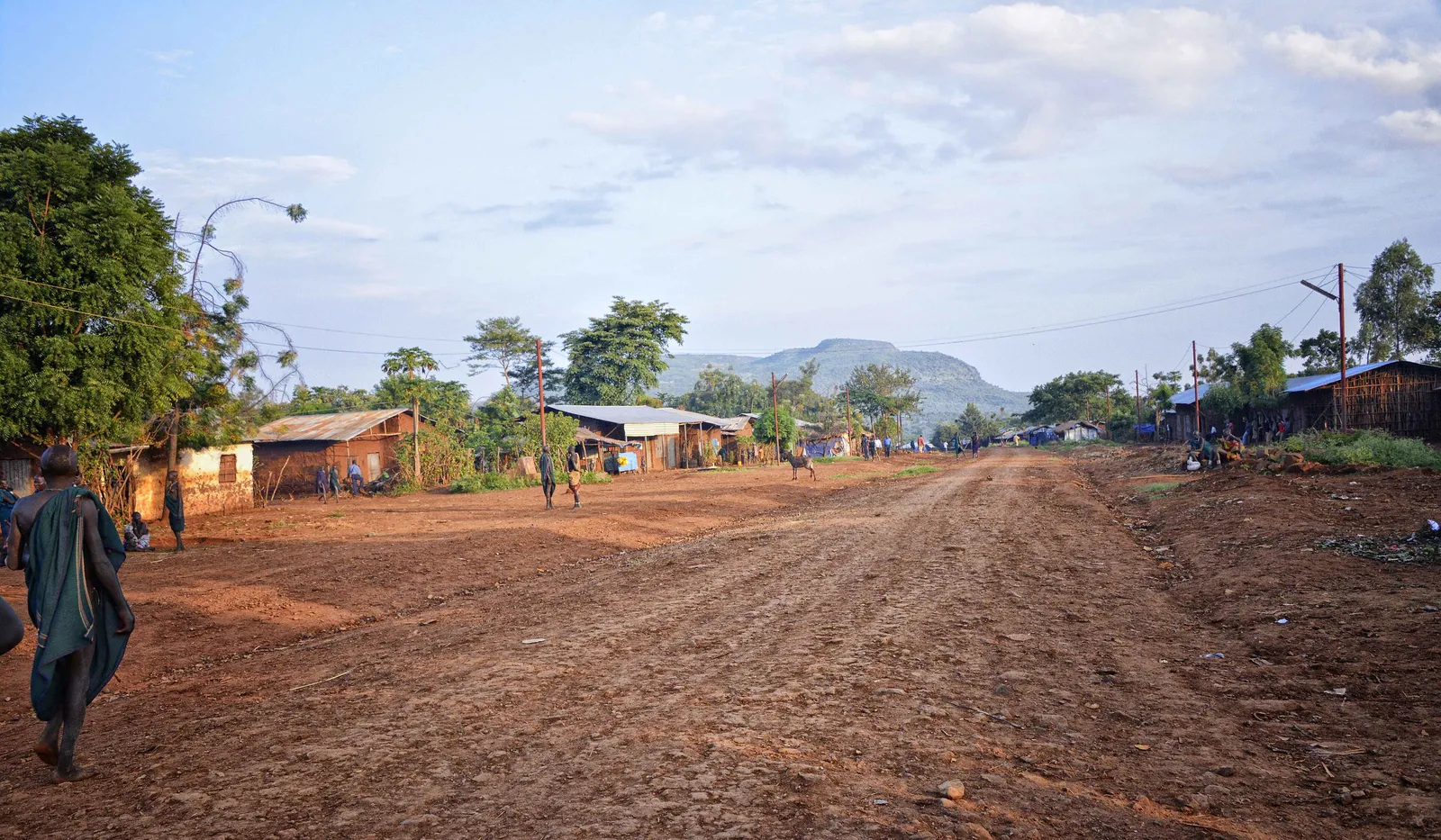
The Omo Valley: Ethiopia's Living Mosaic of Peoples
In the remote south of Ethiopia, the Omo River valley holds one of the greatest concentrations of distinct peoples anywhere on earth — each with its own language, cattle culture, body art and ceremonial life, and each living in ways that have changed slowly over centuries.
The Omo River rises in the Ethiopian highlands and runs south for roughly 760 kilometres before emptying into the shallow waters of Lake Turkana on the Kenya border — one of the few rivers in the world that does not reach the sea. Along its lower reaches, in the arid basin between the Ethiopian escarpment and the Kenyan frontier, the river has been the axis of human life for longer than almost anywhere else on earth. It was near here, at sites like Omo Kibish and Herto, that some of the oldest anatomically modern human fossils were found, pushing back the likely origins of Homo sapiens to well beyond 200,000 years ago.
The peoples of the lower Omo today are a different kind of testament to that deep time — not fossils but living communities, numbering among them the Mursi, Hamar, Karo, Dassanech, Bodi, Ari, Nyangatom, and a dozen others, each speaking a different language (several belonging to entirely separate language families) and organised around distinct systems of cattle ownership, age-grade initiation, ritual scarification, and seasonal movement. This is not a museum. The communities of the Omo hold their own councils, celebrate their own ceremonies, and exercise their own politics — and their willingness to receive visitors on their own terms is a compact that responsible travellers are obliged to respect.
A valley of language families
The lower Omo is linguistically staggering. Within a region smaller than Switzerland, you encounter speakers of Nilo-Saharan languages (Nyangatom, Mursi), Omotic languages among the oldest and most divergent on the continent (Hamar, Banna, Karo), and Afroasiatic Cushitic languages (Dassanech). The Ari, who occupy the highlands above the valley floor, speak an Omotic language and have maintained a complex hierarchical society with specialised craftspeople, blacksmiths, and a traditional governance structure. That such linguistic diversity survives in so small a geographic area is explained partly by the valley's isolation and partly by a settlement history in which successive peoples moved in without displacing those already there.
The cattle culture that underpins most of these societies has produced a shared aesthetic logic even across linguistic divides: cattle are currency, prestige, bride wealth, and ritual offering simultaneously. The Hamar practice of bull-jumping — a young man's passage from boy to adult requires him to run across the backs of a line of cattle without falling — reflects this with remarkable clarity. The Mursi are among the few peoples remaining in the world who continue the practice of lip plates: large clay or wooden discs inserted into a cut made in the lower lip as a young woman approaches marriageable age, their size a cultural marker of beauty and identity.
Body art and ceremony: reading the visual language
Across the lower Omo, the body is the primary artistic canvas. Hamar women wear ochre-coated hair in tightly wound coils, elaborate bead necklaces, and iron coils at their throat. Karo men paint their bodies with chalk, ochre, and charcoal to represent animals, celestial objects, and personal histories before ceremonies. Mursi men paint their faces for duelling or ceremony using the white mineral pigment that gives their tradition its graphic intensity. Dassanech men and women string elaborate aluminium and bead jewellery recycled, remarkably, from discarded watches and bottle caps — a visual vocabulary that includes the industrial world on its own terms.
The ceremonial calendar gives rhythm to the year. The Hamar bull-jumping ceremony, or Ukuli Bula, takes place at the end of the dry season and involves several days of preparation, ritual whipping of female relatives (an act they invite, demonstrating their bond with the initiate), and culminates in the young man's run across the cattle. Dimi, the Dassanech's most important celebration, is held when an elder's daughter reaches marriageable age and involves mass cattle slaughter, dancing, and days of communal eating. Visitors who attend these ceremonies with a knowledgeable local guide, contributing the small fee requested by the community, are participating in something that remains living and functional, not performed for tourism.
The Omo River and its ecology
The lower Omo has been, since long before any road reached it, defined by its annual flood. Each year, highland rains swell the river and inundate the riverbank flood plains from roughly July to October, depositing the silt that allows cultivation of sorghum, maize, and beans on the receding margin — a practice known as flood recession agriculture that has fed these communities for centuries. The flat bottomlands between the river and the escarpment are also dry-season pasture for enormous cattle herds, and the management of grazing rights between neighbouring peoples has historically been — and remains — a source of both conflict and negotiation.
The river and its tributaries shelter crocodiles, hippos, and a rich birdlife that includes Goliath herons, African fish eagles, and several species of kingfisher. The lake into which it drains, Turkana, is the largest desert lake in the world and holds Nile crocodiles in extraordinary concentrations at its northern end. The landscape of the lower Omo transitions from dense riparian woodland along the river to open acacia savanna and, toward the Kenya border, to near-desert — a visual compression of East African ecosystem types that can be experienced by vehicle in a single long day.
How to travel responsibly in the Omo Valley
The Omo Valley is not a straightforward destination. The road network is limited, conditions vary dramatically with season, and the relationship between communities and visitors requires active management. Travel should be arranged through an operator with established relationships with local guides and community leaders — not because the communities are fragile, but because the protocols around photography, ceremony attendance, and community payments are specific, and getting them wrong causes genuine harm. Photography fees paid directly to individuals are part of the local economy; understanding what is offered freely and what requires a fee is essential.
The most visited communities — principally the Mursi of Mago National Park and the Hamar near Turmi — have decades of experience with tourism and are sophisticated participants in the transaction. Less-visited peoples such as the Karo, who number only a few hundred and live on a dramatic rocky outcrop above the Omo, require more careful handling; their small population makes the economic impact of visitor fees proportionally large, but also makes disrespectful tourism more damaging. Our journeys pair travellers with local guides from the communities being visited wherever possible, and we contribute to community development funds rather than operating purely transactional photography stops.
The Omo Valley and the pressure of the modern world
The construction of the Gibe III dam on the Omo River, completed in 2016, has fundamentally changed the river's hydrology. By regulating flow and largely eliminating the annual flood pulse, the dam has dramatically reduced the flood recession agriculture that has sustained communities for centuries. The downstream effects on Lake Turkana's water level have been severe. Ethiopian government-sponsored agricultural concessions have displaced communities from their traditional land in the Omo basin, and the combination of dam-altered hydrology, land displacement, and new road access has brought rapid external pressure onto communities that were, until recently, among the most isolated in Africa.
None of this means that travel to the Omo Valley is inappropriate — on the contrary, responsible tourism that generates direct economic returns to communities is one of the few external forces that creates a genuine incentive to maintain cultural practices and resist further displacement. The travellers who go carefully, pay fairly, and leave as much money in the valley as possible are part of an argument, however small, for the value of what is there. The travellers who come purely for photographs of 'exotic' people without that broader awareness are part of a different and less constructive history.
Getting there and when to go
The Omo Valley is reached from Addis Ababa by a combination of domestic flights to Arba Minch (the principal hub town) and 4WD road travel into the valley itself — the roads between Jinka, Turmi, and Omorate range from reasonable dirt to heavily rutted tracks that require serious vehicles and experienced drivers. Jinka is the main access point for Mago National Park and the Mursi; Turmi is the gateway for the Hamar. The overland drive from Arba Minch to Turmi can be done in a long day in the dry season but may take two days in the rains.
The best season is the dry months from November to February and again from June to September. The short rains in March and April and the long rains from May make roads extremely difficult and some routes impassable. January to March is perhaps the most rewarding time — temperatures are moderate, the landscape is greener after the rains, and the cattle bull-jumping season falls from around September through November, so the timing overlaps the run-off period when the valley is most accessible. Altitude here is low — most of the valley floor sits below 600 metres — and heat in the dry season is intense: plan activities for early morning and late afternoon.
Quick answers
Is it ethical to visit and photograph the peoples of the Omo Valley?
Yes, if done correctly. The key elements are using a local guide with genuine community relationships, paying the photography fees and ceremony entrance fees that communities set for themselves, not photographing ceremonies or individuals who indicate they don't wish to be photographed, and contributing to community funds rather than purely transactional individual payments. Avoid operators who treat communities purely as spectacle. When done well, tourism creates direct economic incentive to maintain cultural practices that are otherwise under severe pressure from development and displacement.
Which peoples are most accessible to visit?
The Hamar (around Turmi and Dimeka) and the Mursi (in Mago National Park, accessed from Jinka) are the most visited and have the most developed visitor protocols. The Karo (on a rocky promontory above the Omo near Korcho) are fewer in number but deeply welcoming of respectful visitors. The Dassanech (near Omorate, at the Kenya border) offer a different cultural encounter with a more seminomadic lifestyle. Most itineraries in the valley include two to four community visits over three to four days.
Do Mursi women always wear lip plates?
The practice has become less universal among younger women, particularly those who have attended school. Traditionally, a cut is made in the lower lip of a girl before her first marriage negotiation, and a clay or wooden disc is progressively enlarged. Today, some women continue the practice, others do not; the choice is increasingly individual. Women may wear the plate for visitors who pay a photography fee, but they remove it at other times. It is important not to treat this as a spectacle or demand to see it — the practice belongs to the woman, not to the tourist.
How long should I spend in the Omo Valley?
A minimum of four to five days is needed to reach the valley from Arba Minch and visit two or three communities meaningfully. A week is better and allows for unhurried encounters, a boat trip on the Omo, and more remote visits. Most travellers incorporate the Omo Valley into a broader southern Ethiopia itinerary that also includes the highlands, Addis Ababa, and possibly Lalibela or the Simien Mountains.

Let the reading become a route.
When an article sparks something, our planners are the next step. Tell us what you are dreaming of.