The Pantanal and the Jaguar: South America's Wildest Wetland
The Pantanal is the largest tropical wetland on Earth and the best place in the world to see wild jaguars — up close, unhurried, on the water, in daylight.
The flat-bottomed boat moves quietly down a channel the colour of tea, under a ceiling of caiman and capybara-haunted riverbank. The Cuiabá River, tributary of a tributary of the Paraguay, threads through a landscape that has flooded and retreated over millennia, leaving behind a mosaic of grassland, forest, lake, and marsh that no satellite image quite prepares you for. There are giant river otters playing in the margins — a family of them, arguing and tumbling with the unselfconscious energy of creatures that have no predators worth worrying about. The guide cuts the engine and points wordlessly at the far bank. On a low branch above the water, a jaguar is watching the caiman below it with the calm, absolute attention of an animal about to make a decision.
The Pantanal covers an area of roughly 150,000 to 195,000 square kilometres across western Brazil, eastern Bolivia, and northeastern Paraguay — estimates vary because the boundaries shift with the floods — and constitutes the largest tropical wetland ecosystem on the planet. It is not famous in the way the Amazon is famous, partly because it is harder to categorise: not quite jungle, not quite savanna, not quite marsh, but all three at once, shifting between them with the seasons. What it is, unambiguously, is the best place in the world to see a wild jaguar in daylight, from a boat, at close range, without the filters of thick forest or predator-concealing vegetation.
A landscape that breathes with the seasons
The Pantanal's defining characteristic is the annual flood cycle. The rains that fall in the surrounding highlands between November and March drain slowly into the vast, nearly level depression, flooding up to 80 percent of the lowland plain and transforming the landscape into an inland sea. As the dry season takes hold between April and October, the waters recede, concentrating fish in shrinking lagoons and ponds, drawing wading birds and predators to the rich margins, and pushing terrestrial wildlife onto the higher ground where it becomes unusually visible. This seasonal pulse — flood and retreat, abundance and concentration — is the engine of the Pantanal's extraordinary biodiversity.
The concentration effect of the dry season is what makes Pantanal wildlife watching so different from other tropical experiences. There is no need to peer into dense canopy or follow trails through closed forest; the animals are simply there, visible, in open or semi-open terrain, behaving naturally because they have always lived alongside the slow-moving boats and the low-impact lodges that float at the edge of the channels. Birding from a boat is perfectly adapted to the landscape: the Pantanal holds around 650 species of birds, including hyacinth macaws — the world's largest parrot by length — nesting in palms, jabiru storks standing sentinel in the shallows, and the improbable spectacle of hundreds of roseate spoonbills rising from a single lake.
The jaguar: the Americas' apex predator
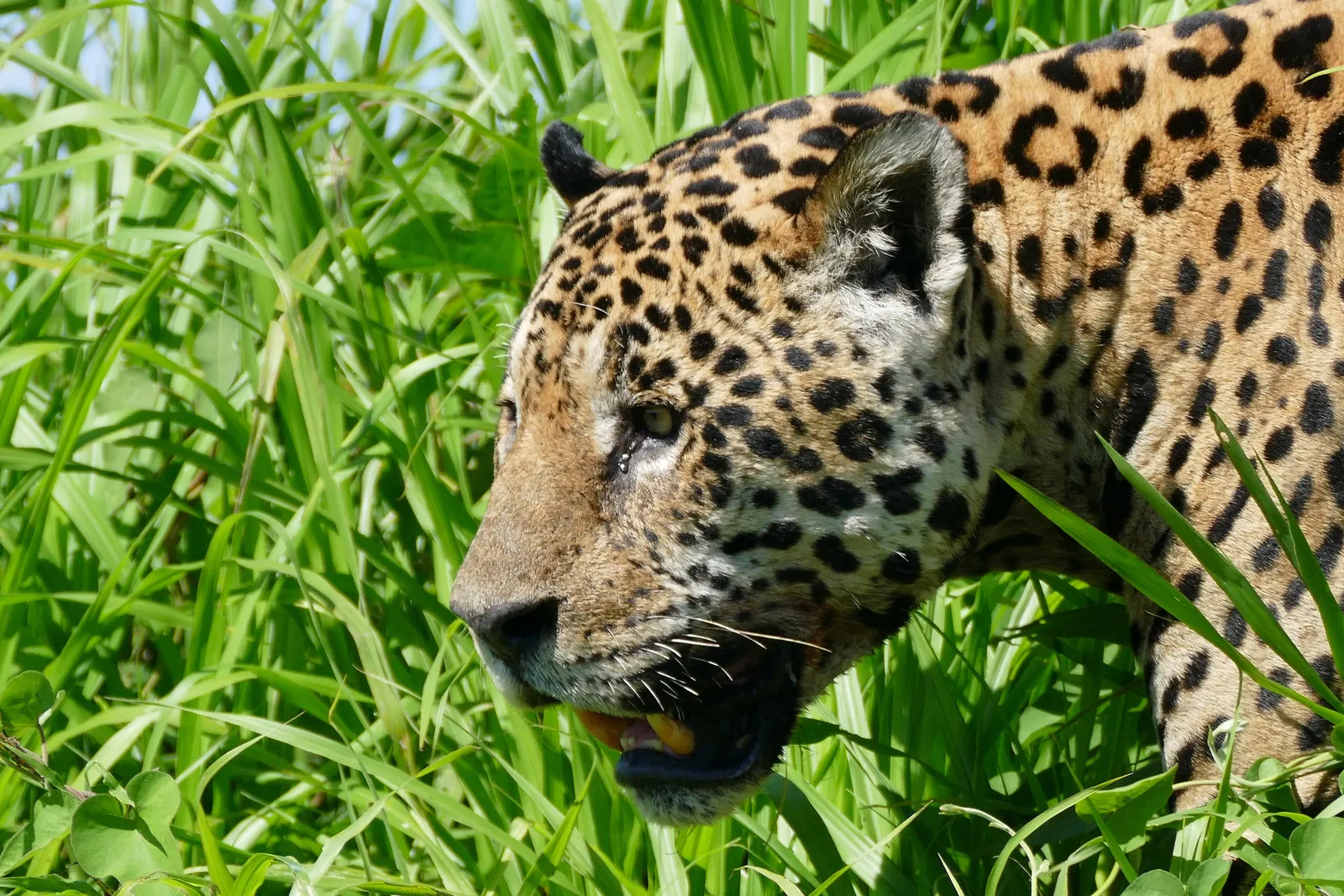
The jaguar (Panthera onca) is the largest cat in the Americas and the third largest in the world, after the tiger and the lion. Adults in the Pantanal — among the largest specimens of the species — can weigh more than 100 kilograms, and the density of prey in the wetland supports a population that is both substantial and, along the rivers of the northern Pantanal, remarkably habituated to boat-based observation. The region around the Porto Jofre area on the Cuiabá River has become, over the past two decades, the world's most reliable place to observe wild jaguars.
Jaguars in the Pantanal hunt primarily along the river banks, preying on caiman, capybara, marsh deer, and river fish. Their swimming ability — exceptional among large cats — makes the waterway environment perfectly suited to them; they cross wide channels without apparent effort and have been observed diving for fish with a precision that is startling in an animal of their size. A jaguar watching a caiman from a riverbank is not simply a dramatic tableau: it is the apex predator of an ecosystem reading the behaviour of a prey animal that is itself a formidable predator, in a calculation of risk and reward that plays out with extraordinary slowness and focus.
The supporting cast: Pantanal wildlife beyond jaguars
Visitors who arrive hoping for jaguar and leave having seen only giant anteaters, giant otters, giant river turtles, and several hundred species of birds have not been shortchanged. The Pantanal holds one of the highest concentrations of wildlife on the continent, and the variety is more difficult to absorb than the drama. Tapirs, the Pantanal's largest purely terrestrial mammal, wade through the shallows at dusk with an ungainly dignity that makes them look like small mastodons. Capybara — the world's largest rodent — gather in herds of dozens on the grassy banks, watched from a respectful distance by yacaré caiman in numbers that gradually become normalised over the course of a visit until a hundred caiman on a single bank seems unremarkable.
The Pantanal's hyacinth macaws deserve more than passing mention. The world population of this cobalt-blue bird numbers around 6,500 to 7,000 individuals (estimates as of recent years), and a significant proportion of them breed in the Pantanal, nesting in the cavities of manduvi trees whose very existence depends on the toco toucan swallowing and depositing the seeds. This interlocked ecology — macaw, tree, toucan — is a visible emblem of the complexity that makes the wetland work. Seeing a pair of hyacinth macaws crossing an open sky, their metallic blue catching the afternoon light, is one of the simpler and more arresting moments the Pantanal offers.
The Transpantaneira: the road into the flood
The Transpantaneira Highway — 145 kilometres of elevated dirt road stretching south from the town of Poconé into the heart of the northern Pantanal, crossing some 120 wooden bridges over rivers, channels, and seasonally flooded plains — is one of the great wildlife drives on Earth. The road was built in the 1970s and was never completed; it ends at Porto Jofre on the Cuiabá River, giving access to the most productive stretch of jaguar-watching country in the world. Driving the Transpantaneira slowly in the dry season is to move through an open-air animal encyclopedia: caiman lying across the road, capybara grazing at the verge, herons standing in the ditches, and, if the timing and luck align, a jaguar on the bank of one of the channels below the road.
The best strategy is to take the full day for the drive, stopping whenever wildlife demands it, and to arrive at Porto Jofre in time for an afternoon boat excursion. The river channel between Porto Jofre and the surrounding oxbow lakes is the heartland of jaguar territory, and the combination of boat access and concentrated prey makes this stretch the most consistently productive big-cat watching outside Africa or India. A two-night stay at one of the river-based lodges gives enough time for multiple boat circuits and reasonable probability of jaguar sightings.
Conservation: a landscape under pressure
The Pantanal is protected in part by its own inconvenience — the annual flooding makes permanent agriculture and settlement difficult across much of its extent — but the pressures are real and growing. Deforestation and agricultural conversion in the surrounding highlands affects the hydrology of the flood cycle; uncontrolled fires during the dry season, historically a minor natural force, have in recent years caused major damage when drought conditions intensify them. The 2020 fire season burned an estimated 30 percent of the Pantanal, a loss of habitat at a scale that researchers are still assessing.
The response has been substantial. Brazilian environmental agencies, NGOs, and local ranching families — the latter an underappreciated conservation force, since fazendas that earn income from wildlife tourism have strong incentives to protect the ecosystem — have worked to establish a wildlife-tourism economy that makes the jaguar more valuable alive than any alternative use of the land. The model has parallels to the recovery of big cats in India and Africa: when local communities benefit materially from the presence of wildlife, the wildlife survives. The Pantanal's future depends on whether that model can be sustained under the political and economic pressures that have repeatedly challenged it.
Planning a Pantanal journey: when and how to go
The dry season from May to October is the prime time for wildlife watching, with July to September generally regarded as the peak. The receding waters concentrate animals, the vegetation is lower and more open, and the jaguar-watching season on the Cuiabá River is in full swing. The wet season has its own appeal — the landscape transforms completely, the birding shifts to species that depend on open water, and the sheer spectacle of the flood is extraordinary — but for first-time visitors, the dry season is the clear recommendation.
The northern Pantanal, accessible via the Transpantaneira from Cuiabá in Mato Grosso state, is the most accessible and the best for jaguars. The southern Pantanal, entered via Campo Grande in Mato Grosso do Sul, is wilder and less visited, with a different character and its own wildlife highlights. Accommodation ranges from working fazendas that have added wildlife-watching infrastructure to purpose-built eco-lodges and floating river camps at Porto Jofre. Internal flights from São Paulo or Brasília to Cuiabá make the journey manageable; once in the Pantanal, there is very little need for additional travel, since the wildlife comes to you.
Quick answers
Is the Pantanal or the Amazon better for wildlife watching?
For wildlife visibility and density, the Pantanal is significantly better than the Amazon. The open, seasonal landscape of the wetland means animals are visible in daylight from boats and vehicles; the Amazon's closed-canopy forest is magnificent but makes wildlife extremely difficult to see. For sheer biodiversity and habitat complexity, the Amazon has no rival — but the Pantanal is the right destination for a visitor whose priority is seeing large, iconic animals at close range.
How reliable are jaguar sightings in the Pantanal?
The northern Pantanal, specifically the Porto Jofre area on the Cuiabá River, has the highest concentration of reliably observed jaguars anywhere in the world. During the dry season, multi-day visitors typically have a high probability of seeing one or more jaguars from the boats. Sightings are not guaranteed — these are wild animals in their own territory — but the track record of specialist lodges and guides in this area is exceptionally strong.
What other big wildlife is reliably seen in the Pantanal?
Giant otters, giant anteaters, tapirs, capybara, yacaré caiman (in huge numbers), marsh deer, crab-eating foxes, and hyacinth macaws are all routinely seen. The birding is outstanding across the entire wetland. Giant river otters in particular are more easily observed in the Pantanal than almost anywhere else in South America — family groups are often active and visible during morning boat excursions.
Is the Pantanal suitable for non-specialist travellers?
Yes. The wildlife-watching lodges of the northern Pantanal are comfortable and accessible, and the experience — slow boat journeys on broad rivers, open landscapes, easily visible wildlife — does not require any specialised fitness or fieldcraft. The heat in the dry season can be intense, and the roads (particularly the Transpantaneira) can be rough in a standard vehicle, but none of this is beyond a reasonably fit and adaptable traveller. Children with an interest in wildlife often find the Pantanal among the most engaging destinations they have visited.

Let the reading become a route.
When an article sparks something, our planners are the next step. Tell us what you are dreaming of.