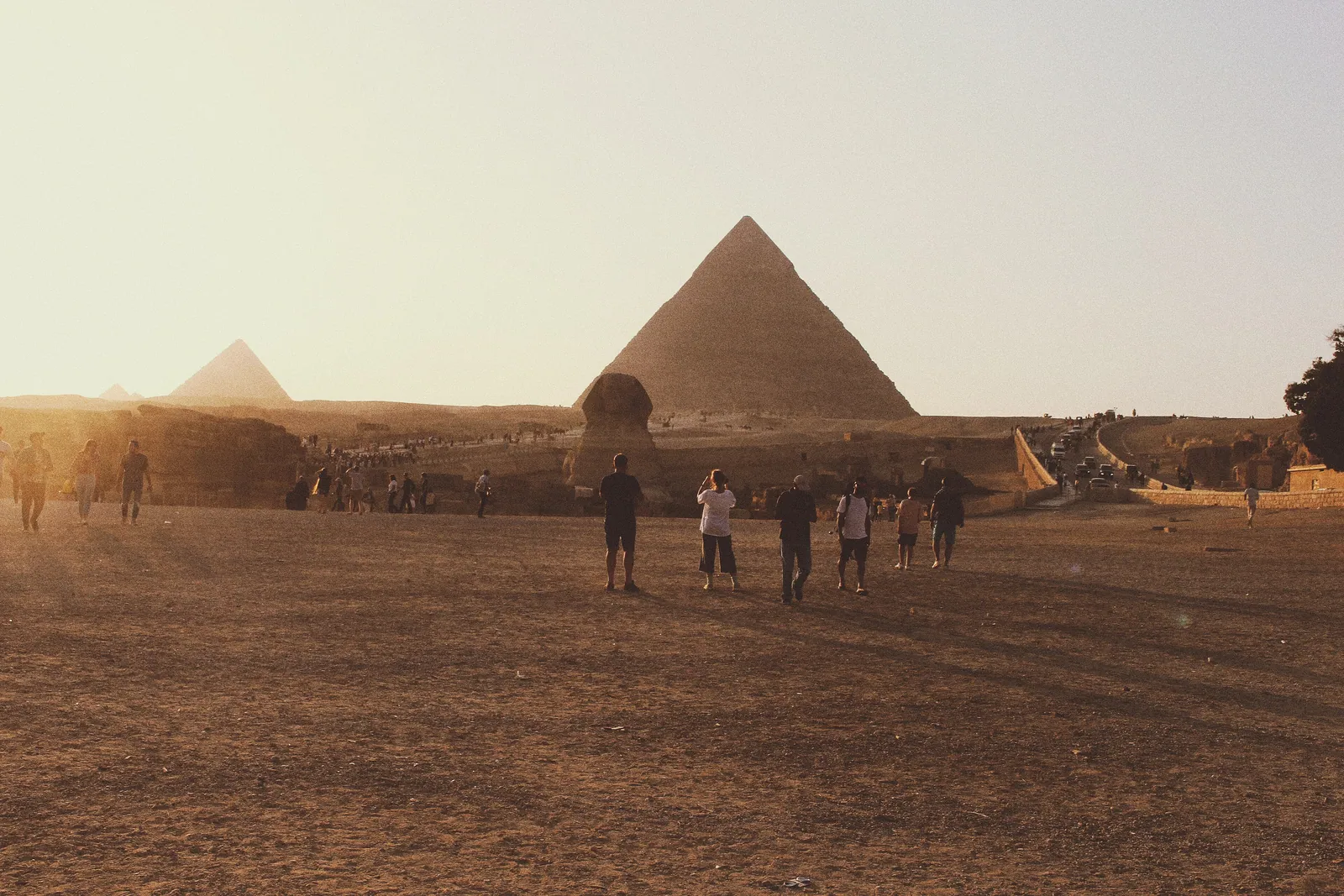
The Pyramids of Giza, Explained
Three pharaohs, one plateau, and the only Wonder of the ancient world still standing. Here is what the Pyramids of Giza actually are, who built them, and how to read the necropolis when you arrive.
The Pyramids of Giza are the royal tombs of three kings of Egypt's Fourth Dynasty — Khufu, Khafre and Menkaure — raised on a limestone plateau on the west bank of the Nile around 2600 to 2500 BCE. They are not temples, not granaries and not the work of slaves: they are the funerary monuments of a single family, built across roughly three generations by a skilled, salaried Egyptian workforce.
What survives is a complete necropolis, not just three triangles on the skyline. Around the pyramids stand the queens' pyramids, the mastaba tombs of officials, the remains of mortuary and valley temples, and the Great Sphinx. Reading Giza as a planned city of the dead — rather than three isolated marvels — is what turns a photograph stop into one of the most absorbing mornings in travel.
Who built them, and when
The three great pyramids belong to the Fourth Dynasty of the Old Kingdom, the period Egyptologists often call the Age of the Pyramids. The Great Pyramid was built for Khufu (Cheops, in the Greek form) around 2560 BCE; his son Khafre raised the second, slightly smaller pyramid; and Khafre's successor Menkaure built the third and much smaller one a generation later. The shrinking scale is not decline so much as changing royal priorities.
The builders were Egyptians, organised in rotating crews and housed in a purpose-built town south of the plateau. Excavations there have uncovered bakeries, breweries, barracks and the bones of cattle and fish — the infrastructure of a paid, well-fed workforce. The image of enslaved multitudes comes from Herodotus and Hollywood, not from the evidence on the ground.
The Great Pyramid of Khufu
Khufu's pyramid was, for some 3,800 years, the tallest structure on Earth — originally about 146 metres, now around 138 after the loss of its smooth outer casing and capstone. It is built from an estimated 2.3 million blocks of limestone and granite, the core stone quarried locally and the finer casing brought downriver from Tura.
Inside, three chambers and the steep Grand Gallery climb through the masonry. The precision is the lasting astonishment: the base is level to within a couple of centimetres across more than five habitable acres, and the sides are aligned almost exactly to the cardinal points. A working knowledge of these numbers makes the climb up to the entrance far more than a photo errand.
Khafre, Menkaure and the Sphinx
Khafre's pyramid looks the tallest because it stands on higher bedrock and still keeps a cap of original casing near its summit — the best surviving hint of how all three once gleamed white in the sun. Menkaure's, the smallest of the trio, was partly sheathed in red granite, some of it left unfinished at the king's death.
The Great Sphinx, a recumbent lion with a human head, is carved from a single outcrop of bedrock beside Khafre's causeway and is generally attributed to his reign. At roughly 73 metres long and 20 high, it is the largest monolithic statue from the ancient world — and a reminder that Giza was conceived as one integrated complex, not three separate projects.
Reading the plateau on the ground
Each pyramid was the centrepiece of a larger machine for the afterlife: a valley temple down by the Nile floodplain, a covered causeway climbing the escarpment, and a mortuary temple against the pyramid's east face where offerings were made. Khafre's valley temple, built of colossal granite blocks, is the best preserved and well worth the few minutes it takes to walk through.
Smaller satellite and queens' pyramids cluster at the feet of the giants, and fields of flat-topped mastaba tombs spread out in ordered streets — the burials of the courtiers and officials who wished to lie near their king. Two boat pits beside the Great Pyramid once held dismantled cedar vessels; the finest, Khufu's solar boat, is now displayed at the Grand Egyptian Museum nearby.
Giza as the start of a journey
Giza is the first morning of The Great Rift, the opening of an eighty-day journey that runs the length of Africa from Cairo to Cape Town. Beginning here is deliberate: the pyramids are the oldest of the Seven Wonders and the only one still standing, and the rest of the route — up the Nile, into Ethiopia, across the Serengeti — unfolds as a passage through deep time that the plateau sets in motion.
We pair Giza with the Old Kingdom sites that frame it — the stepped pyramid of Djoser at Saqqara, a century older and the ancestor of all true pyramids, and the ruined former capital of Memphis. Seen together over a day or two, they show the pyramid as an idea being invented, perfected and finally surpassed.
Quick answers
Can you go inside the Pyramids of Giza?
Yes. A separate, limited ticket allows entry into the Great Pyramid of Khufu, and the chambers of Khafre's and Menkaure's pyramids can usually be entered as well. The passages are low, steep and warm, with no artefacts inside — the appeal is the engineering. Anyone uneasy with confined, sloping spaces can skip the interior without missing the essential experience.
Were the pyramids built by slaves?
No. Archaeological work at the workers' settlement south of the plateau has revealed a paid, organised Egyptian labour force, well housed and fed on bread, beer, fish and beef. Crews worked in rotation, many likely during the Nile flood when farming paused. The slave-army story descends from later Greek writers, not from the evidence.
How old are the Pyramids of Giza?
They date to Egypt's Fourth Dynasty, roughly 2600 to 2500 BCE — about 4,500 years old. The Great Pyramid of Khufu is the earliest of the three, followed by Khafre's and then the smaller pyramid of Menkaure a generation later.
Let the reading become a route.
When an article sparks something, our planners are the next step. Tell us what you are dreaming of.