The River Crossings of the Mara: Anatomy of a Wildlife Spectacle
The wildebeest crossing the Mara River is the most dramatic moment of the great migration. Here is how a crossing unfolds, why the herds gather and hesitate, and how to witness it with patience and respect.
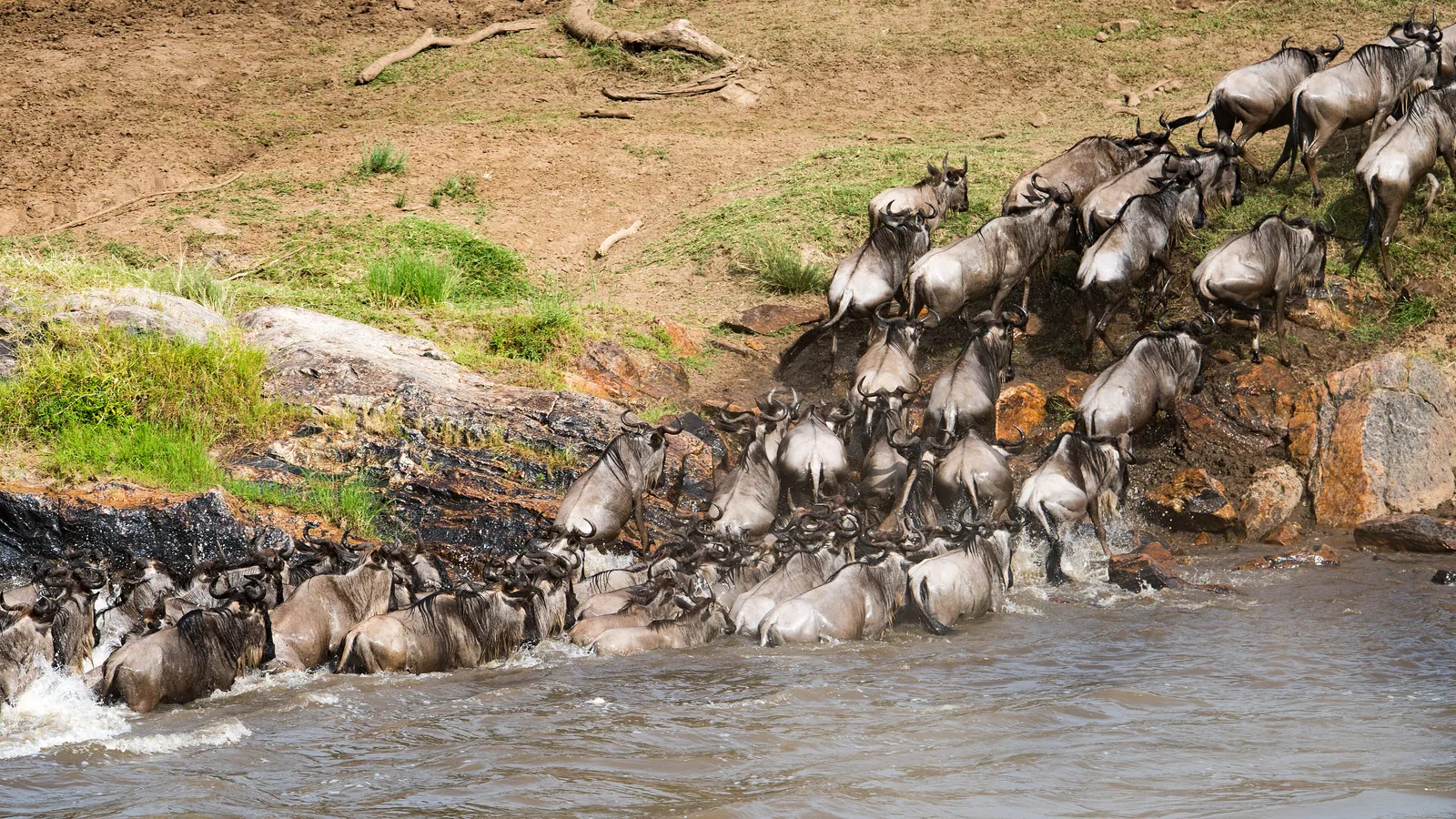
Of all the scenes the great migration offers, none grips a traveller like a river crossing. Tens of thousands of wildebeest pile up on a bank of the Mara River, hesitate for minutes or hours, and then pour in a churning, dust-and-spray torrent through crocodile-filled water to the far side. It is wildlife watching at its most raw and unscripted.
A crossing cannot be scheduled. It happens when the herds decide, often for reasons no one can fully see, and it may last thirty seconds or most of an afternoon. Understanding why and how it unfolds turns a long wait on a riverbank into one of the most absorbing experiences a journey such as The Great Rift can offer.
Why the herds must cross at all
The Mara River is the great obstacle on the northern arc of the migration's year-long circuit. Roughly between July and October, the wildebeest reach the Kenya-Tanzania borderlands, drawn by the green grass of the Masai Mara, and the river lies squarely across their path. To follow the grazing, the herds must get to the other side — and then, as grass and rain shift, they often cross back again.
Crossings are therefore not a single event but a recurring drama through the season. The same stretch of river may see the herds cross north, then south, then north once more over a matter of weeks, as the animals chase the freshest pasture. There is no fixed direction and no fixed date — only the relentless logic of food and water.
The gathering and the long hesitation
A crossing begins with accumulation. Wildebeest, often with zebra among them, drift toward a traditional crossing point and build into a dense, restless mass on the bank, lowing and milling. The tension is visible. The herd seems to want to cross and to fear it in equal measure — and for good reason, because the river holds large Nile crocodiles, the banks can be steep, and the current can drown the weak.
Then comes the wait. The herd may hesitate for a long time, edging forward and retreating, until something tips the balance: a single bold animal commits, or a pressure from behind, or a startle, and suddenly the whole mass surges. This hesitation is why patience is everything. Travellers who hold their position quietly are the ones rewarded when the river finally breaks open.
The crossing itself
Once it starts, a crossing is chaos with a current running through it. Wildebeest plunge down the bank and swim or scramble across in a continuous, panicked column, calves pressed among adults, dust and water thrown up in a haze. Crocodiles move to intercept; on the far bank, the steep, churned mud claims animals that cannot climb out.
Not every animal survives, and the losses feed a wider web — crocodiles, vultures, marabou storks and the great cats that wait near the banks. It is a hard scene, and an honest one. The crossing is not cruelty but the plain arithmetic of a wild river, and the same drowned and drowned-out animals nourish an entire downstream ecosystem.
How to witness a crossing well
Witnessing a crossing asks for patience above all. Guides position vehicles early near likely crossing points and then wait, sometimes for hours, watching the herd's mood. A crossing can collapse before it starts if the herd is spooked, so quiet is essential — engines off, voices low, no sudden movement, and no crowding of the bank.
Behave so the herd is not the one deciding to flee from you. Vehicles should never block the animals' route to the water or their exit on the far side; the wildebeest must be free to choose their moment. Manage your expectations, too: you may wait all day and see nothing, or witness three crossings before lunch. That uncertainty is part of what makes a crossing unforgettable.
Timing your journey for the crossings
The northern crossing season runs roughly from July to October, with the herds concentrated in the Masai Mara and the northern Serengeti. There is no way to guarantee a crossing on a given day, but spending several days in the right area during this window gives a strong chance of seeing one — and usually more than one.
The Great Rift is timed to place travellers in this landscape during the crossing months, but the honest framing matters: a river crossing is a hope, not a deliverable. The herds keep their own counsel. What a well-planned journey can promise is to put you, patiently and respectfully, in exactly the right place to be there when they move.
Quick answers
When can I see the Mara River crossings?
Roughly between July and October, when the migrating herds reach the Masai Mara and northern Serengeti. Crossings continue, in both directions, through this window as the herds follow the grass. Spending several days in the area during these months gives a good chance of witnessing one.
Can a river crossing be guaranteed on a particular day?
No. Crossings happen when the herds decide, and they cannot be scheduled or predicted to the day. A crossing may last seconds or hours, or a herd may gather and then never commit. Patience and several days in the right place are what turn a hope into a likely sighting.
Why do the wildebeest hesitate so long before crossing?
Because the river is genuinely dangerous: it holds large crocodiles, the banks can be steep and slippery, and the current can drown weaker animals. The herd's instinct to cross and follow the grass competes with its instinct to avoid the danger. The standoff breaks when one animal commits or pressure from the gathering herd forces the issue.
Let the reading become a route.
When an article sparks something, our planners are the next step. Tell us what you are dreaming of.