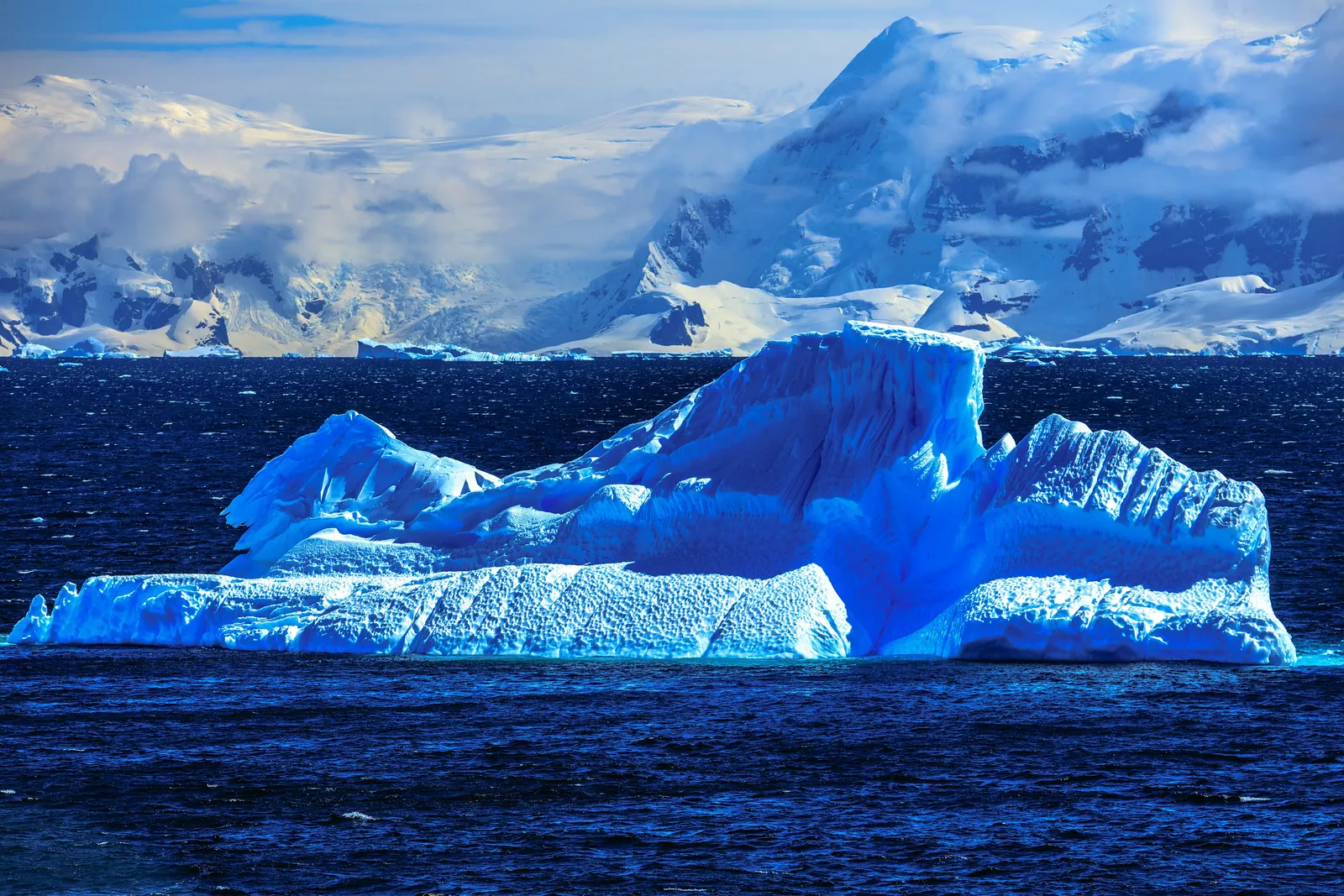
The Ross Sea and the Deep Antarctic: The Last Wild Ocean
The Ross Sea — declared the world's largest marine protected area in 2016 — is the ultimate frontier of Antarctic exploration: an ocean of ice, active volcanoes and wildlife that has never learned to fear human beings.
If the Antarctic Peninsula is accessible Antarctica — reachable by crossing the Drake Passage from Ushuaia in two days of sailing — the Ross Sea is the real Antarctica: more remote, more extreme, quieter, and for those who know it, incomparably more powerful. Located in the Pacific sector of the Southern Ocean, between longitudes 160 East and 158 West, the Ross Sea is a vast indentation in the Antarctic coastline where ice and open ocean meet in a balance that the seasons shift dramatically. Its inner coast is dominated by two landmasses, Victoria Land and Marie Byrd Land, and by two colossal volcanoes, Erebus and Terror, named for the ships of James Clark Ross's 1841 expedition.
In 2016, after years of negotiation in the Commission for the Conservation of Antarctic Marine Living Resources (CCAMLR), the Ross Sea was designated the world's largest marine protected area, covering 1.55 million square kilometres under fishing restrictions. The designation recognised what scientists have been documenting for decades: the Ross Sea is one of the most productive and least altered marine ecosystems on the planet, home to the world's greatest concentration of Antarctic orcas, to colonies of emperor penguins and Adélie penguins that know no human fear, and to a krill-based food chain so intact that oceanographers call it the last ocean.
Mount Erebus: fire in the ice
Mount Erebus, on Ross Island, is the world's southernmost active volcano and one of the most fascinating on Earth. At 3,794 metres it holds in its crater one of the few permanent lava lakes in the world — a pool of molten rock that bubbles and occasionally throws lava bombs of several metres — which has been the subject of continuous scientific study since the installation of the seismic observatory at the summit. Seeing Erebus from the ship, its plume of steam and volcanic gas erupting into the Antarctic sky, creates one of those images that collide categories: fire and ice in the same frame.
Ross Island also harbours the hut at Cape Royds where Ernest Shackleton wintered in 1908 during the Nimrod expedition, and Robert Falcon Scott's huts at Cape Evans and Hut Point, preserved almost perfectly by the Antarctic cold and designated as historic monuments under the Antarctic Treaty. Entering Scott's hut — with the supply tins still on the shelves, the men's boots beside the bunks, the expedition journals on the table — is one of the most emotionally affecting historical experiences Antarctica offers.
The Ross Ice Shelf: the world's largest ice shelf
The Ross Ice Shelf is a floating ice mass anchored to the Antarctic coast roughly the size of France. It is the world's largest ice shelf — approximately 487,000 square kilometres — and its northern front, the Ross Barrier, is a wall of ice between ten and fifty metres high above the waterline (and several hundred metres deep below it) that extends horizontally for hundreds of kilometres. It was this ice front that stopped James Clark Ross in 1841, who described it as a wall of ice "as impassable as if it were the cliffs of England".
The Ross Shelf was also the launching ramp for the great expeditions to the South Pole. Both Amundsen and Scott reached the pole crossing the shelf, Amundsen departing from the Bay of Whales — an inlet in the shelf that he used as the base of his victorious 1911–1912 expedition — and Scott from his base on Ross Island. The bay has changed shape since then — ice dynamics are constant — but sailing before the Ross Barrier, with its ice wall extending to the horizon, makes it visually comprehensible why those early-twentieth-century expeditions are considered among the most extraordinary in the history of human exploration.
The orcas of the Ross Sea
The Ross Sea has the world's highest concentration of orcas, particularly Type C (also called small Ross Sea orca), a subspecies adapted specifically to the Pacific sector of the Southern Ocean that feeds primarily on fish — particularly the Antarctic toothfish (Dissostichus mawsoni) — rather than mammals. But the Ross Sea also harbours Type A orcas, which hunt Weddell seals and penguins, and Type B orcas, which hunt seals cooperatively using highly sophisticated techniques such as wave-washing: several orcas swimming in parallel to generate a wave that slides the seal off an ice floe.
The density of orcas in the Ross Sea is such that sightings are almost guaranteed on a two-week expedition. Watching a group of orcas hunt cooperatively beneath the ice floes, or a mother teaching her calf the wave-wash technique, are moments that wildlife naturalists rank among the most extraordinary of any expedition anywhere on Earth. The absence of hunting pressure over decades has produced orcas that approach the ship with genuine curiosity, rolling and blowing metres from the hull.
Emperor penguins and Adélie penguins
The Ross Sea harbours several emperor penguin colonies (Aptenodytes forsteri), the world's largest penguin species, which breed on sea ice through the austral winter — May to August — in temperatures that can drop below minus fifty degrees Celsius. The colonies most accessible to summer expeditions (November–January) are found at Atka Bay, Cape Washington and Coulman Bay. Seeing an emperor penguin — nearly 1.2 metres tall, with its yellow chest patch and an almost stoic composure — is one of the most memorable encounters Antarctic wildlife offers.
The Adélie penguin (Pygoscelis adeliae) colonies of the Ross Sea are the largest in the world. The colony at Cape Adare, at the northern tip of Victoria Land, has around 280,000 breeding pairs — the largest known colony of the species — packed onto a gravel spit at the base of vertical cliffs. The density, the smell and the sound of a colony on this scale are experiences that defeat advance description; the penguins move like a living tide, completely indifferent to human presence.
Cape Adare and the first to winter in Antarctica
Cape Adare holds the distinction of being the site where the first human beings wintered on the Antarctic continent. In 1899, the Southern Cross expedition, led by Carsten Borchgrevink, spent the winter at Cape Adare in two wooden huts that are still standing — the oldest surviving structures in Antarctica. The shore party of ten men endured polar darkness, extreme temperatures and absolute confinement with a combination of determination and, in some cases, well-documented psychological crisis.
Borchgrevink's hut is visitable under controlled conditions — its state of preservation is remarkable, thanks to the dry cold — and its interior, with the original cooking utensils and the bunks where the men slept, has a ghostly quality that Scott's hut amplifies with even greater intensity. For any traveller with an interest in the history of polar exploration, the Ross Sea is a living museum in which the settings and the protagonists are physically tangible.
Getting there and what to expect
Travelling to the Ross Sea is a genuine expedition: ships depart typically from Dunedin or Christchurch, New Zealand, or from Hobart, Tasmania, and sail for five to seven days before reaching Ross Sea waters, crossing the Southern Ocean in conditions that can be demanding. Full itineraries generally last three to four weeks, with sailing days and intensive landing days. There are no direct flights to the area; the ocean crossing is an inherent part of the experience.
Ships that operate these routes must be polar-class vessels — ice-strengthened hulls, capable of navigating through brash ice — and carry scientific teams and naturalists who are specialists in Ross Sea ecosystems. Berths are limited and demand among serious travellers frequently outstrips the supply available for a given season. Our Ross Sea itineraries are planned months in advance and require a level of physical fitness and capacity for weather and motion adaptation that differs from standard Antarctic Peninsula expeditions.
Quick answers
How does the Ross Sea differ from the Antarctic Peninsula?
The Antarctic Peninsula is the most accessible Antarctica: two Drake days from Ushuaia, with gentler temperatures and the best-known wildlife (chinstrap, gentoo, leopard seals). The Ross Sea is more remote — five to seven sailing days from New Zealand — colder, with emperor and Adélie penguins, the Erebus volcano, the Ross Ice Shelf and a history of early-twentieth-century polar exploration that has no equivalent. The experience is more demanding and more radically austral.
When is the Ross Sea expedition season?
The season runs from November to January, the austral summer. November and early December are the best months for emperor penguins with chicks and for denser sea ice. December and January offer more daylight hours, slightly milder temperatures and the possibility of pushing further south. Expeditions attempting extreme latitudes (beyond 78 degrees south) need the conditions of December–January.
How many people go on a Ross Sea expedition?
Ships suited to the Ross Sea typically carry between fifty and two hundred passengers, with the best itineraries on ships of a hundred or fewer to facilitate landings and proximity to wildlife. The number of landing permits at sites such as Cape Adare is regulated by the Antarctic Protocol, which restricts simultaneous visitors on shore.
Can you reach the South Pole from the Ross Sea?
The Geographic South Pole is in the interior of the continent, around 1,300 kilometres from the Ross Sea coast. It is not reachable from an expedition ship. Visiting it requires a private flight from Punta Arenas, Chile, or from Antarctic bases; it is an option available for small groups with specialist logistics, but it lies outside the scope of standard maritime expedition itineraries.
What level of physical fitness is required?
The Ross Sea expedition requires medium to high physical fitness. Zodiac landings on rocky terrain or in swell conditions demand unassisted mobility; the ocean crossing involves days of continuous ship movement that can be difficult for those with balance or mobility issues. Cardiovascular health and the absence of medical conditions incompatible with extreme cold are requirements reviewed in the pre-departure medical questionnaire.
Let the reading become a route.
When an article sparks something, our planners are the next step. Tell us what you are dreaming of.