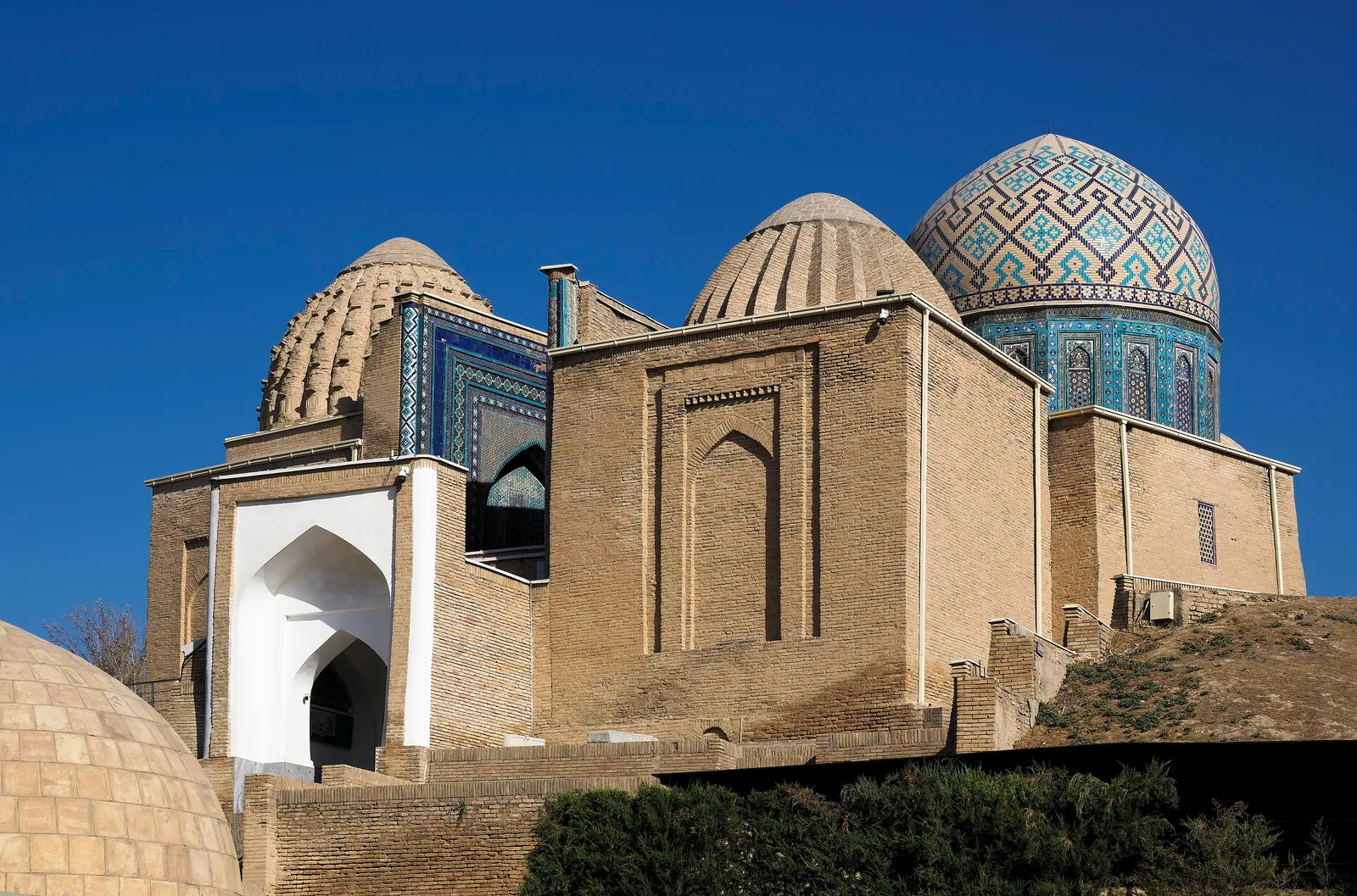
The Shah-i-Zinda Necropolis of Samarkand
Behind the Registan, an alley of tombs climbs a hill in Samarkand — a thousand years of tiled mausolea for generals, queens and holy men, and some of the most extraordinary mosaic work on Earth.
The Registan gets the photographs. It is the face of Samarkand that every traveller knows — three great madrasas around a square, their tilework blazing under the Central Asian sun. But those who leave time for the Shah-i-Zinda, twenty minutes' walk to the northeast, often come away saying it is the more affecting place. Where the Registan is a public monument, Shah-i-Zinda is a necropolis: a lane of tombs climbing a low hill, built over a millennium for royals, generals, court women and holy men, their facades tiled in colours and patterns of almost reckless beauty.
The name means 'the living king', a reference to Qusam ibn Abbas, a cousin of the Prophet Muhammad who, according to local tradition, brought Islam to the region in the 7th century and is buried here — not dead, the legend holds, but living, hidden in a well beneath his tomb, awaiting the day he will emerge. That story has made the site a place of pilgrimage for fourteen centuries, and it has drawn the patronage that made the tilework possible. This is one of the holiest sites in Central Asia, and one of the most beautiful.
The alley and how to read it
The Shah-i-Zinda is approached through a portal and climbed via a staircase of roughly forty steps — forty, by tradition, being the number counted by pilgrims ascending to receive blessing. The alley at the top runs roughly north to south along the edge of the ancient Afrasiab settlement, the pre-Mongol Samarkand whose ruins lie on the hill above. To the right and left of the lane, mausolea press against each other in a sequence of facades that reads like a compressed history of Timurid and pre-Timurid tilework.
The tombs were built across a wide span — some pre-Mongol sections survive from the 10th and 11th centuries, and a major phase of construction followed under Timur and his successors in the late 14th and 15th centuries. The most intense concentration of the finest work is from this Timurid period, when the patronage of the royal house attracted the best craftsmen in the Islamic world to Samarkand. Reading the alley from south to north is, roughly, to read it from older to newer — but more useful is simply to pause at each facade and look closely.
The tile: what you are looking at
The facades of the Shah-i-Zinda represent the full range of medieval Islamic tilework technique at its highest development. The simplest panels use plain glazed bricks in single colours, typically turquoise or cobalt blue. More complex is mosaic faience, in which small pieces of differently coloured tile are cut and fitted together to form intricate geometric or floral patterns — the technique demands extraordinary precision, since each piece must be shaped to fit its neighbours without gaps.
The most refined panels use a technique called cuerda seca in which a greasy line is applied between colour areas before firing, preventing the glazes from bleeding into each other and allowing multiple colours in a single tile. The result is that the tilework of the Shah-i-Zinda can display, in a single square metre, the deep lapis of lapiz lazuli, the turquoise that gives the architecture of Uzbekistan its chromatic identity, gold, white, aubergine and green — all meeting in patterns drawn from geometry, calligraphy, and the natural world.
The tombs of the women of Timur's court
Several of the Shah-i-Zinda's finest mausolea were built not for generals or holy men but for women of Timur's household. The tomb of Shadi Mulk Aka, a niece of Timur who died young in 1372, is among the earliest of the Timurid structures and among the most beautiful anywhere in the complex — its facade a composition of interlocking geometric medallions in turquoise and cobalt that has survived with unusual completeness.
Near it stands the tomb of Tuman Aka, another woman of the court, its facade using a different but equally accomplished combination of carved terracotta and tilework. The presence of these women's tombs at the most prestigious site in Samarkand reflects the significant role women of the Timurid royal family played in patronising architecture and scholarship. Timur's wife Bibi-Khanym, who gave her name to the great mosque he built across the city, was part of a court in which female patronage was both legitimate and celebrated.
Qusam ibn Abbas and the pilgrimage tradition
The original reason for the site's sacredness is the tomb of Qusam ibn Abbas, reached at the far end of the alley. Qusam is believed to have been a companion of the Prophet and a cousin who brought Islam to Central Asia; his tomb has been a pilgrimage destination since at least the 10th century, and the practice continues today. Women in headscarves move quietly through the tile corridors; older men sit in prayer at the tomb's entrance; flower sellers do a steady trade at the bottom of the stair.
This is not a museum. The Shah-i-Zinda is a living holy site, and its atmosphere is qualitatively different from the purely tourist spaces of the Registan or the Bibi-Khanym mosque. Visitors are expected to dress conservatively — shoulders and knees covered at minimum — and to behave with the consideration appropriate to a place of active worship. The reward is the experience of the place functioning as it was built to function, which adds a dimension to the tilework that no guidebook photograph can provide.
When to visit, and for how long
The Shah-i-Zinda receives fewer visitors than the Registan and can therefore be visited with more ease — earlier in the morning or later in the afternoon, when the crowds have thinned, and the low-angled light picks out the relief of the carved tilework in a way that the flat midday sun cannot. An hour is the minimum; a serious look at every facade, with time to stand in the alley and absorb the whole, takes closer to two.
The site is open every day and is located close to the Bibi-Khanym mosque, making it easy to visit both in the same half-day. The walk between them passes through a working neighbourhood of old Samarkand — the fruit market that operates in the shadow of the mosque's great portal is one of the most genuinely local scenes in the city, and a useful reminder that Samarkand is not only its monuments.
Quick answers
What is the Shah-i-Zinda?
Shah-i-Zinda — the name means 'the living king' — is a necropolis in Samarkand, Uzbekistan: an alley of mausolea climbing a hillside, built over roughly a thousand years for royals, generals, women of the court and holy men. It is one of the holiest sites in Central Asia, associated with the tomb of Qusam ibn Abbas, a cousin of the Prophet Muhammad said to have brought Islam to the region. Its tilework is among the finest anywhere in the Islamic world.
How does Shah-i-Zinda compare to the Registan?
The Registan is the monumental public face of Samarkand — three great madrasas around a square, designed to impress on the largest scale. The Shah-i-Zinda is more intimate: a narrow alley of tombs whose tilework can be examined at arm's length. It is also a living pilgrimage site, which gives it a different atmosphere. Many visitors find it the more moving of the two, precisely because it is quieter and more personal.
What should visitors wear at Shah-i-Zinda?
The site is an active place of Islamic pilgrimage, and visitors are expected to dress modestly. Shoulders and knees should be covered for both men and women. Scarves for women's hair are not mandatory but are respectful and commonly worn by local visitors. Quiet, considerate behaviour is appropriate throughout the complex. Shoes are not typically removed outside individual tomb chambers.
Who is buried at Shah-i-Zinda?
The most important tomb is that of Qusam ibn Abbas, a cousin of the Prophet Muhammad traditionally credited with bringing Islam to Central Asia. Surrounding it are mausolea built across several centuries for members of Timur's family and court, including notable women such as Shadi Mulk Aka and Tuman Aka, as well as generals and court officials. The oldest structures predate the Timurid period; the most elaborate tilework dates from the late 14th and 15th centuries.
Let the reading become a route.
When an article sparks something, our planners are the next step. Tell us what you are dreaming of.